Napoleonic & ECW wargaming, with a load of old Hooptedoodle on this & that


Showing posts with label Battlefields. Show all posts

Monday, 24 January 2022

Sieges: More Preparation Work

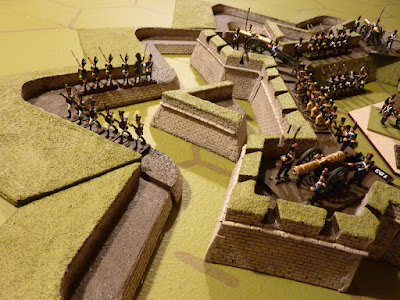
 This is good fun, and a rather different way to spend an evening, but there is still a lot to do to prepare for my solo "practice" siege using Vauban's Wars (VW). After a couple of (short) evenings, I've worked my way through the official start-up checklist from the manual, decided on the forces involved (points-based purchase system), and set up the battlefield (approximately). I still have a lot of stuff to work on - jobs like photocopying and laminating the game turn markers, and making up damage indicators from gravel and PVA glue. Once I have these things in stock, the overheads of putting on a game should be much reduced. I've also laid out my stock of trenches and gun emplacements (mostly from Fat Frank) on a series of canteen trays - it's a bit like a weird tray-bake.

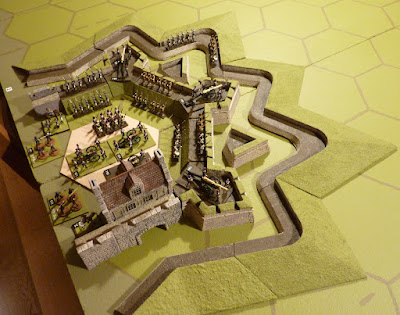
To be going on with, for this evening, here are some photos of the field, and the checklist, including the OOB.


The besieging troops are laid out along the First Parallel. Yes, it does look like a road, but it is a proper trench - since it is out of range of the fortress, and cannot be the objective of a Sortie or a Trench Raid, and since it is assumed to be complete, to get the game off to a flying start, the convention is that it just looks like a road, but if you screw your eyes up a bit it will look fine. There will be plenty of digging coming up, that's for sure. I'm working on a positioning convention for infantry on the walls or covered way - I may need to revisit this, but at present the rule will be that bases touching the parapet are on the firing step, and thus are exposed and may fire. If they are down below then they are in cover and may not fire. OK - I'm on it.

If it's possible, I'd like to add a small table extension behind the fortress section, to include part of the town, including a Rallying Point. I'd also like to add a little Artillery Park for the besiegers, outside the lines (if only to add a little scenic value to what is a very bleak terrain!).

 I've used my old Terrain Warehouse fortress with the supplied glacis pieces, which is pleasing, but does place restrictions on the design of the fort. I may (reluctantly?) opt to use trench pieces to lay out the glacis - most VW users seem to do this, and what it loses in visual brownie points it probably makes up for in flexibility.

I'll knock together another post when I've made sufficient further progress to justify it.

More soon - I think I've got an evening or two of this prep work before any shooting starts!

*************

Trial VW siege - British attacking French in the Peninsula.


3-bastion fortress - no mining (ground too wet or something)


Initial set-up, as per VW manual   * = "hidden"


Checklist

Item

Attribute

Besiegers (British)

Garrison (French)

1

Season

Spring


2

Powder Supply

(D6 + 6)

8*

11*

3

Supply Dice

D6

D4

4

Food Supply

-

17* (Average)

5

"Popular Support" [low is good]

-

D8* (fairly hostile)

6

Security

D8

D8

7

Strength of Fortress

Assumed "Poorly Maintained"

Walls 6*. Ravelins 5*, Bastions & Gates 7*. Earth Walls 2

8

Location o f Magazine & Sally Port

To be determined when layout is done

Keep hidden

9

Mining/Countermining

No (too wet)


10/11

Forces

[36 points]

Genl & CinC               Free

3 Siege guns              Free

1 Spy                           Free

4 Sappers                    8pts

3 extra Siege Guns    12

2 Heavy Mortars        2

2 Lt Shrapnel Mtrs     1

2 Medium Guns           4

6 Infantry                      6

1 Grenadier                  2

1 extra Spy?                  1

Total exp                     36pts

[18 points]

Genl & CinC         Free

3 Fortress guns  Free

1 Spy                      Free

2 Sappers             4pts

2 Heavy guns       6

1 Light Gun           1

4 Infantry              4

1 Grenadier           2

1 extra Spy?           1

Total exp            18pts

12

Leadership Dice (LD)

D10 [Average]

D12 [Average]

13

Siege Morale Pts (SMP)

(decided not to use "Army Specials" for this game, to keep things simple)

23 units => 26SMP


13 units => 14SMP


Friday, 3 September 2021

Kilsyth 1645: Battlefield Dry-Run

 Having spent a week or two deep in my books, sorting out the details of the Kilsyth battlefield, and a day of falling into ditches, plugging around the actual countryside, I've now assembled a tabletop version for the forthcoming game. From the sublime to the agricultural.

As mentioned previously, I've decided to turn the battlefield through 90 degrees, and start the action as the actual fighting started. It looks OK - the distances are about right - the next viewing will be in a couple of weeks, when there will be more soldiers and rather fewer dining chairs on show.

It's a very plain-looking field - rather a bleak piece of Scottish moorland. I had thoughts of adding streams to break up the ground a bit, but decided against it. The streams are all small, and they just disappear into the general idea that the ground is rough! The picture above shows the valley from the South - Montrose will be on the left side as we look at it, Baillie on the right. The hills and woods are unambiguous, the hills with rocks on top are impassable, the walled-off areas at Colzium Castle (left foreground) and Auchinvalley Farm (brown field, in centre of the table) are proper enclosures which may be defended; the other buildings are just scenery, with no cover or other function, to identify positions on the battlefield.

And now we are looking back the other way - Montrose will be on the right, in this view. Colzium Castle (far end) was the home of the Livingston family - strong Royalists, and Montrose's troops camped on their land the night before the battle. The castle was demolished in the 18th Century, and much of the estate is now under the modern reservoir.

My reference to a "dry run" is a sort of lame reference to constructing a battlefield with the reservoir removed. You can see how an idiot with too much caffeine might think this was amusing at 11pm.


***** Late Edit *****

Specially for WM and Stryker, here's a close up of Colzium Castle (aka Claypotts Castle, courtesy of Lilliput Lane)


*********************


Saturday, 28 August 2021

Kilsyth 1645: Wargame Homework - Facts and Legends

 I am preparing for a Zoom wargame, to take place in a little over 2 weeks - I shall host it and I'll be the umpire, which is a situation I enjoy very much, though the experience of the remote generals is heavily dependant on the technology and the picture-quality at their end!


I once had a solo game which was (sort of) based on the Battle of Kilsyth, which in reality took place on 15th August 1645. The game was interesting and a great deal of fun, and I've had a hankering to try it again, with some changes based on things which I've read subsequently, and on aspects of that first attempt which I'd do slightly differently now.

Kilsyth? Well, you may know a great deal about the battle, maybe not. It took place in Lanarkshire, not far from Glasgow, during one of the Scottish bits of the ECW. It featured the Covenanter army, in which I am very interested, and (of course) James Graham, the Marquis of Montrose. Montrose is a fascinating character - to this day there is still an active society to preserve and enhance his legend; in its way, this is a warning sign - the central personality can get in the way of any kind of impartial study. Trying to get some facts about the campaigns of the Marquis is not unlike trying to find some factual history about Robin Hood. The ghost of Walt Disney never seems far away.

I'm having a great time preparing for my Zoom game - I have a lot of books here, most of them excellent, and there is some good stuff online, but there are some surprises for the amateur student. First of all, we have the first-hand narrative of the General in command of the Covenant troops, William Baillie, which - since he was badly beaten - is bound to be something of an exercise in self-justification, but overall it's not a terrible account. We also have the version of the tale which comes from George Wishart, who was Montrose's personal chaplain, and later his biographer - this is adulatory throughout. This theme goes through all the subsequent secondary works. 


Dame CV Wedgwood (Montrose - 1952) and Nigel Tranter (Montrose: The Captain-General - 1973) are both historical novels, really, written in homage to the handsome, brilliant, tragic hero. The good guys are perfect - brave, and breathtakingly wise and just - and the bad guys are - well, ugly, and evil. Boo. Tranter has Montrose and his chums speaking like the lads from a GA Henty novel, and there is much reference to keen eyes, and frowns upon noble brows.

Vol.2 of SR Gardiner's marvellous History of the Great Civil War is heavily pro-Royalist (which was seen as a patriotic position to take, it goes without saying). Again, the references to Montrose and his short career emphasise that he is a heroic character who can do little wrong, and the sizes of the forces involved are tweaked throughout to polish the legend - Gardiner's numbers for Kilsyth look very unlikely. His estimate of 6000 Foot for the Covenant forces seems far too high, and the statement that all but 100 of them were killed is preposterous.

John Buchan (Montrose - 1928) admits in his foreword that the book is really about his fascination with the central character - it is not primarily a historical record, it is the splendid tale of Montrose's adventures. I have no problem with this - it's an excellent read, but it's as well to be aware of where it is coming from.

And so on. The big discord comes with the modern works of Stuart Reid, of which I am a big fan. Reid is a thorough, nuts and bolts military historian, but he, also, seems a bit partial. Stuart gives the impression of having been irritated by the traditional representation of Montrose as a god-like martyr, and strives to present the flaws as well - maybe he pushes too hard the other way - but this is a good starting place from which to construct my game.

A couple of trivia facts - you may disagree with them - if you do, then it's OK - I'm sure you are right.

* Montrose's campaigns of 1644-45, though regarded as part of the Civil War, were not primarily driven by support for King Charles. Charles eventually saw some advantages for his failing war effort in Montrose's success, but this was opportunist rather than planned. The main drivers were clan-based rivalries of great age - the MacDonalds, the Ogilvies, the Gordons and various others vs the Campbells and the Hamiltons and their allies. The Covenant (and, no doubt, the Presbyterian vs Catholic struggles) gave a context, but this was fundamentally older stuff 

* It is interesting to observe that in my reading of the last week or so I have seen both sides described as "rebels".  Royalists considered that Montrose was fighting against the Covenant "rebels", who were allied with the English Parliamentarian "rebels", but a more logical view is that Montrose was leading a rebellion against the armies of the Scottish Parliament. However you view this, the Campbells vs The Rest thing is always there.

* Montrose himself was a signatory to the Covenant, and fought against King Charles in the Bishops Wars of 1639 and 1640. His change of allegiance had a great deal to do with the fact that his personal standing in Scotland was leapfrogged by the rise of the Marquis of Argyll (Archibald Campbell) - there was ambition and a personal feud in here as well. When Montrose first went to join with the King, Charles was neither interested nor welcoming.

OK - this is rambling on a bit. I now have a decent grasp of the OOBs I'm going to use for my tabletop Kilsyth. These are, I hope, based on fact, but they are also drawn up to give a decent game. The next point of interest is the battlefield itself. There is a good overall description in the Battlefields Trust's section on Kilsyth, but there are a few big holes in our knowledge. Much of what the BT sets out is the reasons we know surprisingly little.

Again, Stuart Reid is a useful source, but there are many things which are not clear. Partly because the battlefield has never been properly examined, and partly because some of it has now been altered by coal and ironstone workings, and by the creation of a man-made lake, Banton Loch, which covers at least part of the centre of the fight. We know where the battle took place (roughly), and there are some definite identifiers in Baillie's account, for example, but there are still arguments about exactly where the armies were, and maybe even about which way they were facing. None of this is a problem, by the way, I will happily set out a battle on my table!

Here a few random photos of the Kilsyth battlefield - not mine, by the way.


I confess to something of a blind spot when it comes to looking at battlefields. I can read a map, I think, and I can understand a toy battle laid out on a table, but place me on the ground and I will struggle; for a start, I am very poor at judging distances! This was brought home to me very forcibly when I spent a day on a guided tour of Eggmühl, a few years ago. I had a great time, but spent the day nodding rather dumbly and trying to relate what I was seeing to the map! 

Having said which, I did get a lot of valuable understanding in preparation for another wargame, a few years ago, when I walked the full width of Marston Moor (in the pouring rain). I may use this approach again - if there's a suitable day next week, I live about 80 minutes' drive from Kilsyth. I could go and have a look at it. Rain is not essential.

Hmmm.

You will hear more of Kilsyth before long. This has just been a little explanation about why I am so busy (and enjoying myself very thoroughly) during the homework phase!

Monday, 26 October 2020

Wet Day - Keeping Busy...

Very nice, sunny morning first thing, but it gradually clouded over and from early afternoon we've had what one might describe as biblical rain. At one point I had to get the recycling out to the bin, and I stood in the downpour to watch what looked like a shallow river running down the lane outside our gate. Yes, I got a bit damp, but it was worth it - not much happens around here.

Among the boxes of soldiers from the Eric Knowles collection which I have here, waiting for refurbishment, there are some generals and staff figures. A lot of these are very early Hinton Hunts, and the quality of the castings is a revelation to those of us who first met up with HH in the 1970s. I've done very little with these fellows thus far, so I decided to have a go at one. The original painting was of a very nice quality, but, being singly-based commanders, they have been subjected to a lot of handling, so the paint is worn in places, and the colours have (obviously) faded during the last 50-odd years.

So here is my new General Lord Somerset (though he could be almost anyone), a vintage Hinton Hunt BN107 OPC figure, freshly retouched and based, fronting his (ex-Eric) Household Brigade, ready for Waterloo if required.

I also glued up some of these. This is the production run of the Max Foy Mark 2 Siege Doofer (Vauban version) - Michael of Supreme Littleness did a nice job on these. I shall slap some paint on them sometime this week. All taking shape on the siege front - I'm waiting for the postie to bring me my latest shipment of trenches (they're in transit from Fat Frank's emporium).


This evening I'm listening to the Burnley vs Spurs match on Radio 5 Live, while working to set up a battlefield for Thursday. Still some work to do, but a decent start. You may hear more of this. Note the bag of Orange Chocolate Minis, courtesy of Terry's Chocolate - other sweets are available, of course, but these are the official confectionery of choice of Foy's Battlefield Construction plc.  

Now you're talking - these bags are now resealable, so you can have one or two minis and put them away for later. Can't understand that at all - surely they would go stale? Certainly I can't remember ever having a bag which lasted into a second day. Still, it's an interesting development.


Wednesday, 27 September 2017

Talavera - (0) - the field

Talavera on Saturday. I think, to be more precise, it is the second bit of Talavera, but since it is unlikely to follow the history too closely, it doesn't really matter.

All these photos are taken from the Allied side of the field. In the foreground is
part of the town of Talavera de la Reina. The French attack will come from the
right-hand edge of the table.
And here we are looking back from behind the Allied left flank.
This is based on the Commands & Colors user site EPIC scenario for the battle - I've shrunk it just a little to get it on my 17 hex x 9 hex table. Some soldiers will appear on this ground in a day or so (I don't want them collecting dust any longer than necessary, and have to keep the sunlight off the flags...) - there'll be another photo or two then, and I'll also include some QRS stuff and scenario information - we have a nifty little experimental rule to prevent Wellesley and Cuesta co-operating too well.

I fear that all my battlefields have a kind of generic look, but it's a flexible system. Here
we are looking down at the Allied right wing. The Portiña stream looks fairly substantial,
but in fact it's a watersplash - units have to pause when they step into it, but it has no
other effect, and all sorts of troops may ford it throughout it's length. There are some
bonus Victory Points available for the French if they can take any of Talavera itself (top
right corner). The things that look like gumshields are the earthworks of the Pajar
de Vergara redoubt - there'll be one Spanish and one British battery in there by Saturday.
Aerial view of the Allied left wing - the 10 hexes of the Cerro de Medellin, on this side
of the stream (complete with the omnipresent Wellington's Tree) are the British main
position, and possession of these hexes is another potential VP generator for the
French. The building on the left is the farm estate of Valdefuentes. 
On some future occasion, Talavera is one of the battles for which I really fancy doing a bigger version - this game on Saturday will be about half size - for numbers and ground scale - but with enough boards and a big enough hall (and some volunteer extra generals - please leave your name with the secretary) there's no reason why it couldn't be done in something closer to the Grand Manner (oops! - copyright wording...).

More soon.

Wednesday, 12 November 2014

The Adventures of General Reel (or Rile)

It takes me a while to build up to these things; for some time I’ve been aware of the Pen & Sword series of Napoleonic DVDs, but I was rather put off by some unenthusiastic customer reviews on Amazon. Eventually, I had a careful think about the matter (prompted by a reduction in price, I admit) – if we are sensible about such things, I am not looking for a piece of great art, and I have previously bought and enjoyed the Pegasus series of ECW films (notwithstanding their cheerful, home-movie quality and the guy in the dodgy fake whiskers playing Charles I), so I decided to order some up.


I bought all four of the Waterloo Collection volumes, plus the newer one about Salamanca. Thus far I have watched the first two of the Waterloo items, and I am very pleased with them – I found no trace of the sound problems which came in for such harsh criticism on Amazon from Napoleon Fan, of Hants, UK, and quickly got into the feel of the presentation. This is not the History Channel – thank God – we do not get constant reminders (in case we have forgotten in the previous 10 seconds) that “he is now in great danger – if a bullet hits him in the head he could be deaded” – and the pace and style are fine. I warmed to the affable chaps (all professional battlefield guides, apparently) who walked us around the various locations and described the action sensibly and in a manner calculated to enable us to get a good feel for how the battle developed. I felt, whilst watching, that a film presentation can have definite advantages over actually being there; that is not to say that I would not like to go there, but watching the film gives a valuable overview and covers more ground more quickly than a walking tour could, for example. All right – go there, but watch the films first.

All very positive then – provided you approach this in the right spirit, I would recommend these films wholeheartedly (this is based only on having watched the first two, of course) – they are intelligently done and very informative – well, I found them so. A few minor themes occurred to me on the way:

(1) the film makers have gone to a lot of trouble to correct the traditional British downplaying of the role played by the Dutch-Belgian and German troops in the Waterloo campaign, which is welcome.

(2) the many inserted clips of re-enactors add colour and a lot of authenticity, but most of the participants, strangely, seem unable to stand up straight, never mind march convincingly. A real sergeant would have given them all a right shouting-at. I’m sure the buttons and lace are correct, but it would be nice if they looked like soldiers, too, rather than like self-conscious office workers dressed up. That may have been a very elderly thing to say – I’ll think about that.

(3) the presenters’ grasp of French pronunciation is so universally, well, crap, that at first I almost thought it must be a joke. I have no wish to appear precious about this, but if I were making a film about a battle involving a lot of people and places with French names (to show on the telly, like), I think I would have taken a little more trouble to get the hang of this – especially if I claimed to make my living at battlefield tours, and thus, presumably, to travel in Belgium a lot. It is not even up to the WW1 soldiers’ “san-fairy-anne” standard – at least that was a phonetic approximation. No, this is a literal, schoolboy reading of French words, mispronounced with the most English of English accents, avoiding all traces of any (embarrassing?) foreign-sounding inflection. Did they coach them specially? Did they agree this strange assault on the French tongue, as a matter of policy, before they started? Interesting. Poor old General Reille is referred to by a number of versions of his name – none even slightly correct. In the general flow of things, General Drouet d’Erlon morphs into General Drouot, who I believe was a different bloke altogether. Not to worry – it grates a bit, but I got used to it.

Not put off by any of this, I look forward to watching Part 3 tonight. Very good on a dark evening, with a glass of something.

Reading further, I see that the same team have produced a further two titles on the Peninsular War, one being a history of the 95th Rifles and one entitled The Keys to Spain, which I believe is a discussion of fortresses and sieges. I am intrigued to see that these are available only in the American NTSC format (that’s “Never the Same Color”, I am told) and are Region 1, so will not play on European TV equipment. Somewhere in my library of software I’m sure I have something which will convert video files into other formats, so I must look further in to this. Maybe they are available in a more UK-friendly format, and I just missed them.

Anyway, if you’re prepared to approach them in the right spirit, these DVDs would make a nice little stocking filler. God – is it that time already?

Saturday, 15 December 2012

My Bluff Is Called? – Feasibility Study


Monument at Eggmuhl

I believe I’ve mentioned here before that I have long nurtured a fantasy that one day I might take a little time to make a tour of Napoleon’s 1809 adventures along the Danube. Like all unlikely dreams, it has a built-in safety factor in that if I never get to do it, I’ll never find out that it was a really stupid idea.

The whole point of a trip like this (in theory) is that you do a lot of enjoyable reading, plan it all out and then spend fulfilling days in the sunshine, walking around clearly-signposted, well maintained battlefields, looking forward to the next bottle of halbtrocken and the odd hot chocolate. Oh – and cakes. Lots of cakes. The campaign is very compact – the early stages involved actions just about on consecutive days, so the distances to be covered are relatively small, and – exactly because it was such a fertile area – Napoleon had his army march right along the tourist magnet of the Danube itself. They would have had cakes every day, you bet.

Stadtplatz, Abensberg

When I mentioned it in the blog before, I got a very gratifying degree of supportive jostling – hey! just do it – all that. Excellent. This is what you need to keep your fantasies tickly and fresh. I can’t even claim to get any opposition at home – Mme La Comtesse thinks it’s a really good idea. Now that I have the time, and provided I don’t have to cash in the kids’ future to finance the deal, there’s no reason why not.

Well....

Landburg Trausnitz, Landshut

Well, that’s true. The only argument against getting on with it is that I would then have to organise it and make a job of it. I might mess it up. It might be, as discussed, a stupid idea. There is a risk that my lovely fantasy might turn into a boring mud bath (like some parts of my recent Hadrian’s Wall pilgrimage), or that the battlefields are now underneath local authority housing estates, or a sewage works. I don’t know the area – the Tyrol and Rothenburg ob der Tauber are as near as I have been. Würzburg, maybe.

Next tightening of the screw is that a friend has expressed great enthusiasm for the project, and reckons we should go next September. Should we do Vienna as well? – maybe that would require a second week? – hmmm. At this point, the kids’ future is looking a bit more shaky.


So I promised I would have a look to see what would be involved, and how it would be, and what the costs might look like, and I would get back to him. I dug out Loraine Petre and the John Gill trilogy, and the trusty Elting & Esposito atlas – now you’re talking – and the AvD road maps, and I started taking serious notes. A return flight to Vienna from Edinburgh is a bit over £200 if you book it far enough ahead. Hire a car at the far end, and from Vienna it is around 250 miles to Abensberg, then short hops back towards Vienna will get you to Landshut, Eckmühl, Ratisbon (that’s Regensburg to you and me and the road signs), then a bit further to Aspern-Essling and Wagram. Small, family-run hotels – possibly a couple of centres would cover the whole area. Or maybe that’s too much for a week. The more I got into this, the more it seemed like an actual military campaign. Needs a lot more work. Where the blazes is Berthier when you need him?

I had a root around on the internet to see if anyone publishes battlefield guides for this campaign, or this area. So far I came up with very little. Maybe the local tourist organisations can provide more information. Now I come to think about it, I don’t even know how many of the battlefields would make a worthwhile visit. I’m quite happy to work away on this – my only misgiving is that at the moment it looks as though it might be a fair amount of work just to decide if it’s at all feasible.

Oh well, all right then

I could, of course, look for a commercially available organised tour – if there is one – these things tend to cluster around bicentenaries these days. The really big downside of such a tour (apart from the cost – I’m sure these are excellently done, but they are not cheap) is that I do not relish spending much time on a bus with a bunch of people who are like me. No, thank you. Also, I was once told a scary story about a trip someone did to the WW1 battlefields of Northern France, which was spoiled only by the fact that the organiser/owner/guide was a total pain in the neck, which caused problems after 5 days of continuous, unrelenting monologue. High risk, I think.

So I would definitely prefer the do-it-yourself approach, if I only had a few more clues to get me started. Please – anyone done this, been to this area, know of any books or sources, have any tips on how to go about it? Even insider info about the best cakes in town would be most welcome.

Sunday, 21 October 2012

Hooptedoodle #68 - Funny Couple of Days, Really


In which we get some high-quality free scran and visit the Highlands briefly, and Martina loses it completely in Inverness


On Wednesday evening we went into Edinburgh to have our scheduled prize meal at the expense of the Sunday Times, which I mentioned previously. The restaurant we had selected (from two on the list for Edinburgh) was The Honours, in North Castle Street. I had never visited the place before, though I used to be an occasional customer of Cosmo’s, which occupied the same premises back in my days of business lunches.


The Honours was opened last year by Martin Wishart, who is a Michelin-rated Edinburgh chef and restaurateur, and is really rather outside the range of places we would normally patronise, so it was a delightful treat for all sorts of reasons.

I had a starter from the day’s specials whose name I could not possibly remember, but it was a very light chowder of artichokes and seared scallops, frothed cappuccino-style and finished with almonds and grated tartufo bianco, while Mme la Comptesse had classic smoked salmon. I managed to squeeze in a small pasta course – buttered tagliatelle with morels and roasted garlic – and then we shared the Chateaubriand, which arrived complete with French fries cooked in duck fat. Madame was driving, so I was the only one drinking – ordering wines by the glass does have some advantages for sight-seeing the wine list. I had a Jurancon Sec (2010 Clos Lapeyre - very nice) with my starter, and an excellent (and quite inexpensive) Cotes du Ventoux (2011 Domaine Perrin) with the steak.

My wife had a crème brulée to finish and I had the cheese platter – not least so that I could have a second glass of the Ventoux. All absolutely first rate – superb quality and service. We didn’t get close to our permitted £250 budget, but we must have spent about half of that, so my thanks to Mr Wishart and to the Sunday Times for making it possible (and to my wife, of course, for entering the competition!). If you are in Edinburgh and are feeling especially affluent, I would recommend the place without hesitation.

Only slightly odd note was introduced by an American lady at the next table, who insisted that the rack of lamb, which the menu noted was only available for two people, should be served as a half portion for her – the assumption being, presumably, that Mr Wishart had made a mistake about this or else that the restaurant would find another customer prepared to volunteer for the other half. After a lengthy harangue, of course, she got her half rack and then proceeded to complain about it. Before she left, the manager apologised unreservedly to her – I guess for having the temerity to open a restaurant in the first place. Why do people do this? – do they feel it makes them appear important, or ”used to better”, or specially knowledgeable?

Great evening, anyway. Unaccustomed as one is.

On Thursday we drove up to the Highlands, partly to fit in a short break at the end of my son’s half-term hols and partly to visit the new Visitor Centre at the Culloden battlefield. Since it is (finally) running well, we took my Mitsubishi truck – it is rather thirsty, but well suited for getting out of mud.

Weather for our run was dull but dry. We went over the Forth Bridge, then up the M90 and A9 as far as Dalwhinnie, then across to the West to Spean Bridge (where we stopped to take a look at the Commando memorial), and finally up the Great Glen, past Lochs Lochy and Oich to Fort Augustus. We spent a little time exploring the locks on the Caledonian Canal at Fort Augustus – always fascinating – which work like staircases to get the boats up and down to cope with the different water levels in (in this case) Loch Oich and Loch Ness.

We had a slightly bad break – this time of year, a lot of the guesthouses in the Highlands have closed for the Winter – my B&B of choice was not available, but I had booked a decent-looking place online which offered a family room. In reality it was clean but a little disappointing – the real bad news was that our landlady’s very enthusiastic Full Scottish fried breakfast on Friday morning gave us all mild food poisoning which is still lingering, which was not a positive contribution to the trip. We visited a cheery Free House pub on the Thursday evening (before the condemned bacon episode) which had good bar food, but a disappointingly standardised range of beers (Stella, John Smith’s, freezing cold Guinness, draught cider...). The only thing I fancied was Belhaven’s Export, which is brewed 10 miles down the road from my home, at Dunbar. Decent enough pint, but I had hoped we would get something more interesting than that. Ach well. Here’s some pics of our run up, and of Fort Augustus.


Friday was the day to visit Culloden. Pouring rain. Not to worry – this is Scotland, after all, so might as well see it at its best. We drove the length of Loch Ness, negotiated downtown Inverness, and got to Culloden without problem, where I got my first sight of the new Visitor Centre. Impressive. Big. Expensive.

I’ve been to Culloden a number of times before. As a kid, I remember being bewildered by all these clan memorial stones hidden in the middle of a forest – the field was deliberately planted with trees in the late 18th Century so that it could not be preserved as a Jacobite shrine. I think they cut down the trees and restored things a good bit around 1970 or so. Last time I was there (I am surprised to recall) was maybe 20 years ago, when the previous Visitor Centre was open, and I was very favourably impressed at that time. Guided tours were provided. A young man in appropriate Jacobite attire marched a party of visitors around the battlefield – we walked the line of the Highlanders’ charge, stood in the Government lines with Barrell’s and Munro’s regiments – the lot. It was nicely done – any children in the party were equipped with wooden swords and targes and recruited to keep the grown-ups in order. The guide was personable and knew his stuff, and could answer any questions you might have. I have always had a hankering to go back.

Well, the world has moved on. The new Centre is superbly laid out. The exhibits are terrific, and the timeline format usefully explained a few things I had never fully understood before – for example, I had never realised the wider context in which Prince Charles’ rebellion was set – just why the Hanoverian English monarchy were so concerned about it. I realise that I should have, but I had never been aware that Charles originally intended to invade a couple of years earlier with full support from the French army, and that his eventual effort was an attempt to go it alone, since the French had given up on the idea (though they lent him some troops, of course).

We saw a couple of excellent little presentations on the nature and weaponry of the armies – very well done. If we’d known, what we really should have done was arrange to get there for 11am so that we could join the once-a-day guided battlefield walk with an actual human guide.

First major problem on Friday was the rotten weather, but we had sort of prepared for that. Second problem was the PDAs they hand out to visitors. On the face of it, this should work well – the machines play you a structured commentary, cued (and this is the clever bit) by GPS – when you arrive at the next key location, the PDA chimes in with the next bit of the commentary. Very good. They do instruct you when you are given the machine that you have to stand still until each section has finished – if you keep walking things will get mixed up. What they do not tell you is that if you touch the screen to activate the sections of copious back-up information – as you are encouraged to do in the commentary – the PDA gets confused.

My wife’s machine became terminally mixed up quite quickly, and after a respectable time she gave up on walking around in the rain and the mud and retired to the nice warm Centre.

Being more grumpily determined, I walked back to the starting point and started the tour again – my son and I then studiously avoided the extra information buttons and stuck with the basic script. And it conked out again. One of the touch fields on the PDA screen is WHERE AM I? At one point we were out beyond the big monument, by the clan graves, but both our PDAs showed us as being some distance away, behind the government lines. Aha. So that’s why it didn’t work properly – the GPS system was on the blink.

At that point we, too, had had enough of the weather, and I was beginning to suffer from the bacon problem, so we withdrew from the field. To anyone who intends to visit the place, I would recommend it wholeheartedly, but take plenty of money with you, and make sure you arrive before 11am in good weather. I have very few photos of our visit, sadly, because it was so wet, but the Well of the Dead kind of sums up the mood of the day.


And the National Trust for Scotland seem to have their own alternative
arithmetic – if you can explain this to me, I’d be obliged.

The strange business with the GPS, unbelievably, had an echo on the way back to Fort Augustus, which leads us to wonder whether there is something unusual about the Inverness area.

My SatNav is a Garmin Nuvi250 (or something) which is a few years old now, but we regularly refresh the map data and it has never let us down. There are two ways from Inverness to Fort Augustus – one is a single track road along the south shore of Loch Ness, one is the A82 along the northern shore – the main road to Fort William – which is the one we wanted. I decided to use the machine to guide us through the one-way system in Inverness, and – to make sure we got the right road out – asked for directions to Drumnadrochit (no, really) which is definitely on the A82.

This SatNav has a very nice young lady’s voice – she is always very patient with us, invariably correct, and doesn’t get at all irritated or petulant if we ignore her instructions. We call her Martina – short for Martina Satnavrilova. Sorry about that, but that’s what she is called.

Anyway – the impossible happened. Martina completely lost the plot in the centre of Inverness. We traced the same back-street loop twice before I decided to ignore her directions to do it again, and at one point we were stopped at some lights when we witnessed something very like a brainstorm. A bewildering series of garbled instructions came out in quick succession – you could see the illuminated route changing like a crazy cartoon on the display – then she subsided into a disconsolate “Recalculating – recalculating – recalculating – recalculating...” until I switched off – out of pity, really. It isn’t pleasant to see one’s friends in trouble.


We adopted the older method of peering through the rain and spotting signs for the A82, and got out of town safely. Next time we risked the SatNav, of course, it worked flawlessly, and once again spoke with great confidence and authority – but our relationship may never be the same again. We have seen frailty. Feet of clay. Not exactly weeping, but something close.

Makes me wonder, though, whether there was a problem with satellite communications in the Inverness area on Friday. I guess the Duke of Cumberland just used maps and compasses and stuff, back in his day. 

Monday, 17 October 2011

An Unpractised Eye

I've been very busy for the last few weeks, partly because I've been in the process of selling a small publishing business which had begun to take up too much of my time. Selling is easy, but handing it over in such a manner that it continues to function is not unlike changing the engine in your car while it is going along. Tricky. I'm still involved a bit in supporting and answering questions, but things are starting to quieten down.

A number of people have warned me that I am going to have to make serious arrangements for something else to fill my days - I don't see that as a problem. I'll be able to get back to hillwalking and cycling, spend more time with my family, get the garden under better control and keep an eye on my other business interests. Oh - and there's wargaming, of course. I could do a lot more of that.

Manor Water from Cademuir Hill

On Saturday, I spent the day with three former work colleagues, walking over Cademuir Hill and thence along the Tweed near Peebles. We had intended to go to Killiecrankie, but the weather forecast was not good for Perthshire. On the walk, conversation turned to the Killiecrankie battlefield, and had any of us ever seen it, and from there we went on to battlefields in general that any of us might have visited. One of our number was lucky enough to have been to Austerlitz a few months ago, so he was far and away the star expert. I mentioned that I enjoyed visiting Culloden (of which more in a moment), and I also owned up to the fact that I have a real struggle to visualise actual battlefields from the ground. It turned out that this appeared to be something of a difficulty for all of us, and I got to thinking about why that should be.

Postcard from Austerlitz

I am very comfortable with maps, and I have spent very many hours reading campaign atlases and looking down on miniature battlefields from the infamous helicopter height. In the real world of fresh air, I also do a fair amount of walking in the hills, I live in an area which is heavily agricultural (I have a view across to the Lammermuirs from my bedroom), and I used to take part in competitive cross-country running, so I am pretty good at looking at a distant object and estimating how far away it is. I would regard my spacial awareness as pretty good, in fact. Maybe it is the two-dimensional nature of a battlefield which complicates things, but if someone puts me on an observation post with a guidebook in my hand - even a telescope - then things get out of proportion quickly. I can see the near distance and understand it - no problem. Then that very slight elongated bump over there is actually a significant ridge, and is 2 miles away. Is it? - it doesn't look it. Then that other bump which looks about the same distance away is actually the famous such-and-such heights, and that is 4 miles away, and in the undiscernible space between these two smudges on the horizon there were 40,000-odd men on the Great Day.

Erm - Dunbar battlefield?

Well, I can imagine what 40,000 men might look like, and I'll accept, as an act of faith, that this is where it all happened, but to me the map in the guide doesn't seem an awful lot like what I'm looking at. Suddenly, you begin to understand why there used to be official guidelines of how far away troops were when you could distinguish horses, when you could see their faces etc. It always seemed over-helpful to have such an instruction, but it makes more sense now. Visualisation is not helped, either, by later additions to the battlefield - the Lion Mound at Waterloo, a motel at Manassas, a modern housing estate at Bannockburn, the cement works which dwarfs everything at Dunbar, the motorway at Vitoria. However, my difficulties seem to boil down to two main things:

(1) Battlefields are big and convoluted - they are not football fields

(2) I am not used to assessing the lie of the land in this way, and am very much aware that it is a difficult skill.

I have to presume that the generals of history were trained in this stuff, and were rather good at it. I followed with great interest the series of battlefield visits which featured on thistlebarrow's blog , and make no secret of the fact that I would like to do more of this sort of thing myself, but I have a little education to think about first.

A very long time ago I visited Flodden Field in Northumberland, and found that it was just a piece of farmland that went up and down a bit, with a monument - I hadn't prepared for the trip, so knew little about it, and at that time I couldn't find anything very helpful in the way of visitor guides (though I believe it is very good now). Culloden was different. Since they cleared the trees off the battlefield (planted after the battle, to avoid the place being preserved as a Jacobite shrine), this is a marvellous place to visit. It also is small enough to make sense to me. Knowledgeable guides in appropriate highland dress will walk you around the field in the rough order of events, so you get to walk up the area covered by the Highlanders' charge, stand where the Hanoverian line was (checking out the position of the various units), look at the wall which enfiladed the highland troops etc. It is all really very clear, even to a klutz like me. That is all very well at Culloden, but I would not be confident about Austerlitz, though I am assured it is a fantastic place to visit.

Leanach Cottage, at Culloden

I talked to the Austerlitz man (who has also seen a lot of the ACW historical sites) about my half-baked dream of doing a leisurely battlefields and beer trip down the Danube, following Napoleon's 1809 campaign. Now that the pesky publishing business is gone, I might actually have a chance to do it, and we agreed that maybe we could go, while our legs, hearts and livers are still up to it.

We also agreed that we'd have a fair amount of homework to do first, to get the best of it.