Last week I finally (finally) managed to set up a range-finder game of For King and Parliament - Count Goya was kind enough to travel down from his estates up North to take part.

What follows is not a serious critical
review of FK&P - since the game
is becoming very successful and popular, and is played enthusiastically by a number of
people whose taste and judgement I respect, anything I write here is likely to
say more about me than it does about the game, and much has already been expressed
about its merits. If you have not played it yourself, there is a good chance you will have seen one of the spectacular demonstration games at wargame shows in recent months. On the other hand, whether or not it suits me is -
inescapably - an important personal criterion.
I did have some concurrent distractions going
on in the Real World, which is a lame excuse really, but I found it quite difficult to get up to speed
with the rules. I had no background involvement with its Ancient and Medieval
father, To the Strongest (and I still
reckon that makes a big difference to understanding the concepts). I found a
lot of excellent ideas in it, and I very much liked the spirit in which the rules
were written and presented. I have also benefitted, I must add, from some very
kind after-sales consultancy from the co-authors, and from on-line friends and
blog contacts who have played it already, so I have little or no justification for being obtuse.
It's not that the game is complex - it is a
little unusual, maybe even quirky, in some respects, but that's all grist to
the wassname. I found there was a lot to remember - a lot of exceptional
combinations of things which need to be jotted down somewhere [example - although I thought I was OK with
this one, I suddenly had a wobbly moment during our game - I was sure that when
"Dutch" style horse attack "Swedish" style, the melee has
to switch around so that the defenders become the attackers (in rule terms).
Damned if I could find it in the rule-book in the heat of the moment, so we had
to fix up a Convention of the Day. I was disappointed with myself...]
With all due respect, I have to say that
the official QRS is among the three or four worst I have ever seen - it is
verbose, yet it seems to avoid saying anything about combat, for example. I was
very grateful for the inclusion of a very good index in the book though - I'd
have been in big trouble without it.
I had real problems getting my head around
the Activation Penalties rules, but it turned out that I was confused by a
couple of errors in the worked examples in the book. I know that Ver 1.1 of the
rules has these slips corrected. I have no problems at all with the gridded battlefield,
that's all pleasingly straightforward (though Morschauser followers may object
to the fact that I find square-based terrain a lot more alien than my usual
hexes). The use of playing cards did not alarm me, provided I could keep the
tabletop clutter down to acceptable levels - I have bought in supplies of
half-sized patience cards, which helps a lot, and have tried to develop a very
OCD regime for tidying up after each turn. One thing which is actually
suggested in the rule book, and to which we should have attached more weight,
is the need to keep the "To Hit" and "Save" cards
physically separated from the "Activation" cards - it is important to
keep the former on your baseline, and tidy them away immediately after play,
and to keep the latter on the table, placed tidily alongside the unit or leader
to whom they apply. My newly-developed house protocols also require the cards
to be tidied and placed face down with each brigade when its activation is
complete (so you can see which brigades haven't done anything yet this turn),
and we tidy all cards away and shuffle them back into the deck when the
player's turn is finished. This game includes a lot of potential for making a
real mess with the playing equipment, which is aesthetically suboptimal and
especially so if you use small figures like mine. You have to be able to take
photos of your game, after all...
On the same theme, there is a lot of
information to be carried around with the units. I was a bit alarmed at the
outset with the potential for the game to become buried in counters. The
systems are well thought out, no doubt, but I think it is necessary for each
player to decide for himself how he keeps track of the unit info. I have a
long-held hatred of off-table rosters, which I find distracting and which
disrupt the on-table flow. I am also famously cack-handed when it comes to
knocking over piles of tiddlywinks, or leaving the things adjacent to the wrong
unit, which may be explained as the Fog of War, but doesn't help the
already-confused.
I got a lot of help and good ideas from a
number of people (to whom I have offered my thanks previously), and I adopted
(to some extent pinched) a system of small, attached labels, laminated, on
which records may be maintained in dry-wipe whiteboard pen. The labels actually
worked out pretty well, though the magnetic attachment system proved unreliable
- labels kept getting separated from their units, which was fiddly and
inconvenient. I had hoped to avoid it, but I think I had better make proper
sabots for the units to stand on - it will simplify moving, and tidy things up
a lot. That's sort of pencilled in as a must-do.
One aspect of the game which I appreciated
(perversely, maybe) is that to some extent it is an ideas toolkit - it is not overly
prescriptive - there is a need for each player adopting the game to think
seriously about how he will set it up physically - what size squares, how (and
if) he uses playing cards, or chits-in-a-bag, or decimal dice, how he adopts
(or adapts) the information counters system to suit his scales and his sense of
aesthetics (and level of OCD).
I set up a decent-looking game the night
before the arranged date, and spent some of the night worrying about it, so
that first thing the next morning I came downstairs and cut the size of the
game down by about half. That was a sound idea - we played very slowly, since
we spent a lot of time with our heads in the book, but we did OK. As units
collected "disorder" markers, their fighting effectiveness fell away,
and for a while there was the impression of a relentless (occasionally
bewildering) series of card drawings which for the most part didn't achieve
anything. With more time and experience (and wisdom), of course, we'd have put
more effort into pulling units back out of the action and attempting to rally
them back into shape, in a more soldierly manner. The card play is entertaining - in a social game, there
is good scope for associated banter and mock applause, etc, but for a solo game
I am not so sure. It might be a grunt.
We didn't finish the game, but that wasn't
the point. I am left with a recollection that, even in a small game, each
player's turn is quite long, and it is easy to forget where you are up to,
especially when units are fighting back in melee, or returning fire - I think I
might try to add a little jotter system to remind me whose turn it is. We
didn't use Victory Medals (though I strongly fancy the chocolate coins idea) -
we counted backwards on my ex-billiards scoreboard.
Unfortunately, my period of induction to
the game has coincided with some issues elsewhere, but for a couple of months
the rulebook has accompanied me on train journeys and so on, and has been my
bedtime reading matter. It is a genuine relief to have advanced as far as
playing a game - I have a better feel for what is involved now, I can put some
more focused effort into setting up the next game. I can also put the bloody book
away for a few weeks and think about something else!
The game is good - it is not the
life-changing experience some might have hoped for, but it will doubtless become more
familiar and more intuitive. My first impressions are a bit mixed, but overall
probably more favourable than my first efforts at Commands & Colors, which has become a way of life for me now!
Some pictures follow - I won't attempt any
kind of logical narrative, since it was a rules try-out, and there isn't one.
Apologies for the cut-price scenery - I'm working on it.
 |
| The trial game - if the cards behave themselves, and co-operate, you can get a lot done in a single turn, and move some of your units a long way |
 |
| Horse - we adopted a convention that "Swedish"-style (galloper) horse deployed as a line of 3 bases, and "Dutch"-style as a column of 4 |

 |
| Foot getting up close |
 |
| General view - our trial game was a little sparse (intentionally so) - note the face-down cards, tidily denoting that each brigade has finished its business for this turn, and the little pile on the left is the used "To Hit" and "Save" cards - very confusing if these get mixed up. Parliament on the left here, with the red cards. |
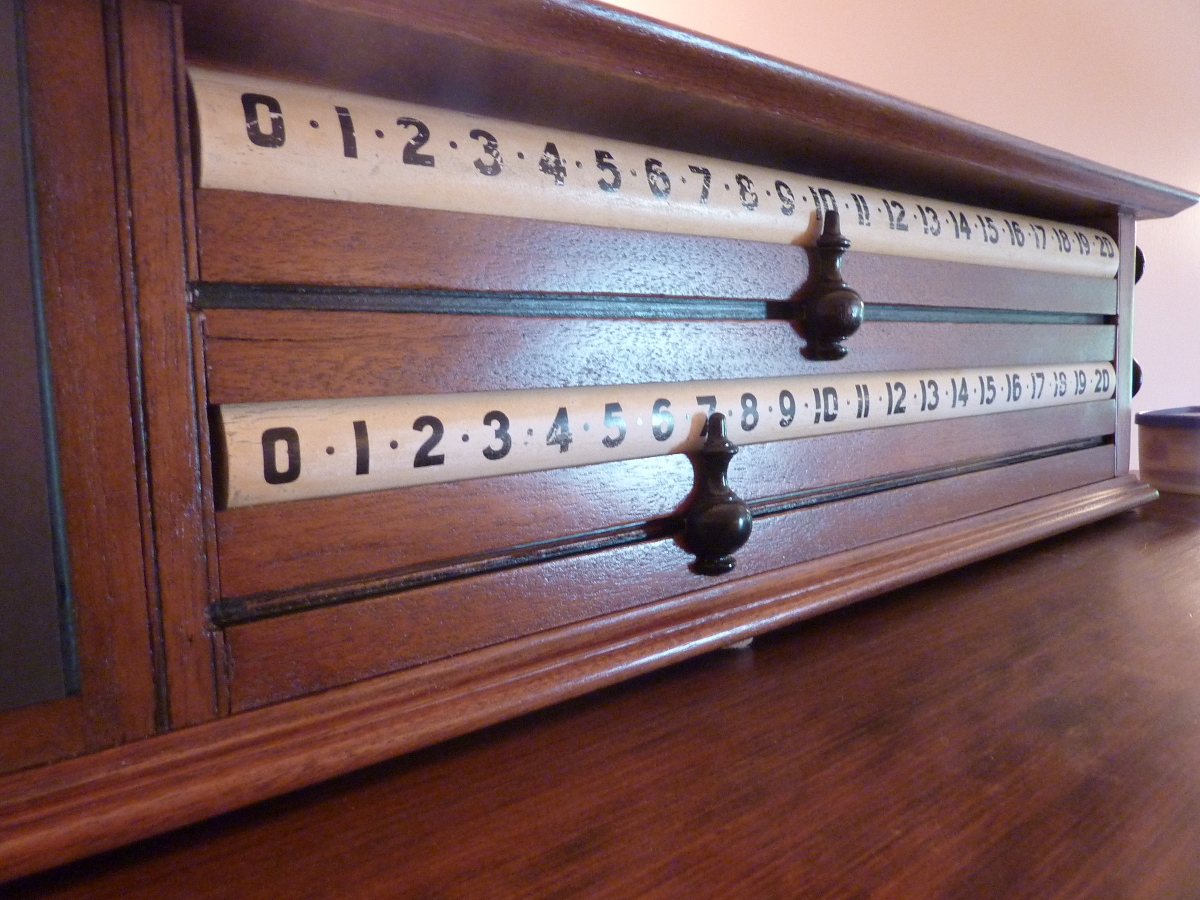 |
| No Victory Medals for us - too mean, for one thing - just the old scoreboard waiting patiently for some action |
 |
| This and the remainder of the photos are here under false pretence - this is the original, larger game I set up the night before, which would have been nice to look at but a really bad idea for getting to grips with the rules. |


 |
 |
| In passing, note that the ploughed fields were cut from a pair of needle-cord trousers I had in about 1970. Astonishing that I cut them to fit the square grid I would adopt for this game nearly 50 years later. What planning has gone into this hobby, now I think about it. |

 |
| As always, I use undersized buildings to help with the ground-scale anomalies - 15mm Hovels buildings here, with 20mm men, laid out on 7.5-inch squares (or boxes, as we say in FK&P). Plenty of wine handy, but the Puritans won't touch it, of course. The rules are within easy reach, too - the "corners-only" phantom grid markings work nicely. |


