Napoleonic & ECW wargaming, with a load of old Hooptedoodle on this & that


Showing posts with label Vauban. Show all posts

Wednesday, 9 February 2022

Sieges: The Siege of Toro (1811) - Part 2 (of at least 2)

 Two further days of solo play (and a lot of rule reading and checking) brought my second "practice" siege game to a close. The result will become apparent in the photo gallery.

 
View of the siege from the British No.3 24pdr Battery

I resumed the game with the British pushing ahead to develop their 3rd Parallel.

 
British Sappers zig-zagging forward to mark out the beginnings of the trenches for the 3rd Parallel
 
 
And, because of one of my Peninsular War tweaks, the trenches themselves are dug by infantry units, with Sappers in support
 
 
The new trench starts to grow some gun emplacements
 
 
...on both flanks
 
 
Confronted by this fine display of digging, the French couldn't resist sending out a Trench Raid to try to destroy one of the new emplacements before someone occupied it
 
 
Just like that bad boy who used to flatten your sandcastles at the seaside, they wrecked the emplacement, and then scampered off back to the fortress, giggling hysterically
 
 
The British were assembling their big guns in the 3rd Parallel now, while the French fortress guns tried to do as much damage as possible
 
 
The British 24pdrs now started to bombard the old stone wall - you can see the damage chips building up - the big ones are 10 hits each, the mummy-sized ones 5 hits. The British were supposed to be unaware of the true strength of the wall, but an early piece of successful espionage found out that 40 hits would create a breach. The spy in question was, very unusually for the British, of excellent quality. Sadly, he was subsequently captured and "persuaded" to reveal the size of the British powder stores to the enemy


As the damage to the wall worsened, Thiébault sent his Sappers to attempt to repair it, while it was still under fire. These brave chaps managed to repair about 3 hits-worth, but it was hopeless, and when the total damage passed 30 hits the wall was technically unreparable anyway, so the Sappers - miraculously unhurt - withdrew back into the town
 
 
I'm not sure what was going on here - Thiebault had a great idea about shifting his biggest mortars into the old castle, but it wasn't very useful. Thiébault himself was killed around this time - reportedly by a shell fragment - I think I may have a look at the mortality rates for general officers in Vauban's War - maybe this can be calmed down a little - that's two commanders lost in 2 games thus far!
 
 
When the next "Leadership" card was turned up, GdB Valladière was duly promoted to CinC, but the French Leadership Dice now went from a D12 to a D10, because of the less experienced Governor
 
 
Inevitably, the wall was breached, and the British 24pdrs turned their attention on the earth "Fausse Braie", which was rated at only 20 hits
 
 
Belatedly, the French heavy guns started to inflict some damage, and silenced two of the British 24pdrs (the ones with two white counters)
 
 
A smart move - on a "Siege Move" card, Sir Thomas Graham withdrew the two damaged 24pdrs, sending them to the rear where the chances of rallying/fixing them was better, and replacing them with a couple of 12pdrs to keep up the bombardment of the earthen bank
 
 
Almost for old times' sake, Valladière sent out a couple of Trench Raids, to try to inconvenience the bombardment as much as possible, but they were sent packing very quickly
 
 
The Morale Points indicator (which is supposed to be a secret to both parties, which is a bit tricky in a solo game!) shows that the French are not in good shape - 6 pts from disaster. On the other hand, the British were rapidly running out of powder, much having been consumed during their extended (and disappointingly ineffective) long-range exchange with the fortress guns. Thus an assault was becoming a pressing necessity, and the optional "Assault" card was duly placed in the British card deck.
 
 
However, an assault was not possible until the Fausse Braie had been breached - still progressing - I think we're up to 13/20 of a breach at this point
 
 
It collapsed soon enough - the stand-in 12pdrs were useful in getting this job done
 
 
The way is now open - Valladière had everyone rushing around inside the town, and got some of his Infantry to make a warlike appearance on the walls. The Sappers were commissioned to go to read the rule book, to see if they could barricade the back of the wall, or demolish the houses inside the breach 
 
 
The "Assault" card arrived too soon for much to be done by the defenders
 
 
Graham was allowed to call up an extra 6 battalions from the troops outside the Lines, to bolster his assaulting force - the British now had a huge numerical advantage


At this point, the game had become a tactical wargame, using Commands and Colors - the heavy siege and fortress guns, and the heavy mortars, may not be used in the tactical game. Two British battalions, including the 88th Foot, took one of the hornworks by escalade, and captured a battery of 24pdrs
 
 
The French garrison were right on the edge now...


...and the final touch was applied when the 74th Foot stormed the breach, and eliminated the last Morale Point. With a practicable breach and zero Morale, the French were obliged to surrender. Toro was in British hands

I'm still a bit shell-shocked by the experience - good fun, and very educational, but a lot of work and I have a big long list of things in the rules I need to look at again. As a siege, the narrative is pretty reasonable, I think. I got to the 8th turn (the British had enough powder left for about 2 more turns, accidental explosions notwithstanding). Since I started with the 2nd Parallel in existence as a trench, and my previous game suggests that it takes about 5 or 6 turns to get that far, at two turns to the week the Siege of Toro took about 7 weeks from starting the 1st Parallel - again, reasonable for the Peninsular War.

I may add another post to discuss the rules, and how the game went, but I'll give that some thought. At the moment, I am left to ponder what earthly use the Coehorn Mortar is. I decided to purchase some for the British, and they were a waste of time. Potentially lethal at short ranges, but useless for anything else - maybe the Coehorn Mortar is a weapon for the tactical game? Hmmm.

If you have read this far, you have my considerable respect - thank you very much.


Sunday, 6 February 2022

Sieges: The Siege of Toro (1811) - Part 1 (of several)

 Another solo practice game with Piquet's Vauban's Wars. I have a few days to work with this, so I took some trouble today to set everything up and play through the first couple of turns.


This time I've carried out (committed?) a few changes to the rules, to give a better fit with my idea of how sieges in the Peninsular War operated. I'm interested to see how these work out, and may say something about them as I go through this. Some are changes to the basics of the Piquet-style game - nothing too outrageous - some are behavioural things for the armies.

This siege did not trouble the writers of factual history, but it could have done if it had happened. Toro is a town on the River Douro. The fort is a classic hybrid for the Peninsula, with the medieval walls and towers of the town and with it's 10th Century citadel, Alfonso III's El Carrañaco. In an attempt to cope with the arrival of gunpowder warfare, the side of the town away from the river has been improved in the early 18th Century by the addition of two hornworks (named Pablo y Pedro locally), which offer platforms for fortress artillery (there is no space for guns on the walls themselves), and the whole section is protected by earth banks to shield the base of the old masonry wall.

The French commander is General Thiébault, better known as some-time governor of Burgos, and his energetic 2inC, General Valladière. The British besiegers are commanded by Sir Thomas Graham, and his chief engineer is Colonel Daniel Fogarty.

 
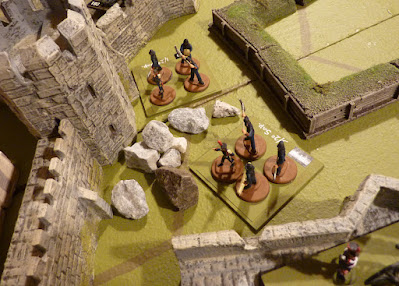
As I did last time, I set up a segment of the fortress on the edge of the table, with the remainder off the table on extensions (floating in mid-air!), to provide space for the garrison troops and also a little gratuitous scenic content. The old castle on the right is entirely scenic here, being the ancient citadel from the time of Alfonso III, but it doesn't get out to play very much, so I decided to give it an outing. Made by ECO, of Bavaria, in the 1970s. The smoke puffs are Boots' finest cotton wool, and these are not just for show; they indicate which guns have fired and have not been reloaded, and then when the Reload card comes up I count the puffs to assess powder consumption
 
 
To get things off to a brisk start, I used one of the options suggested in the rule book, and set the game up with the Second Parallel complete, but with no gun emplacements added to it. Here, a little way into the action, the British have brought some guns up into new emplacements, and it is apparent that everyone is banging away in fine style. At this point the two front lines are still some 700-800 paces apart, and cannon fire is not especially effective at this range. The French have heavy mortars mounted on a couple of the ancient towers, and they did some damage to British infantry sheltering in the 2nd Parallel


You can just see in these last few pictures that the French commander has turned up a Trench Raid card, and - having learned how useful these are in the previous test game - the elite infantry companies have been sent out to cause a nuisance...
 
 
Since this is supposed to take place at night (each turn represents about 3.5 days), I dimmed the lights to give a suitably murky view of the Trench Raid action. The smoke is a bit incongruous here - the mortar is not firing at the raiders, it is just marked as unloaded. In this case, the raiders were driven off with loss, which is a fine show for an unsupported mortar crew
 
 
The other Trench Raid on the same night, however, caused some damage to a 24-pdr gun, which was withdrawn for repair and solace
 
 
Much firing going on, but very little in the way of casualties or damage - that will improve as the guns advance into the 3rd Parallel, so Graham's way forward is to start work on this parallel, and do as much damage as possible to the enemy guns from his position in the 2nd Parallel


A couple of teams of Sappers set off to advance the zig zag saps - the brown felt saps provide good cover, as we are reminded by the little sets of gabions, but the Sappers themselves are really wishing that the British guns had been more successful in quietening the French artillery, long range or not
 
That's as far as I've got thus far - there was a brief outbreak of disease among the British troops - like desertion, disease generates losses which cannot be recovered, though the numbers are not high. Tomorrow I'm headed for the 3rd Parallel - things should get correspondingly nastier for the fortress gunners, but I have to say I really don't fancy the sapping job!


Wednesday, 26 January 2022

Sieges: Trial Solo Game - the Siege of San Juan el Timido

 
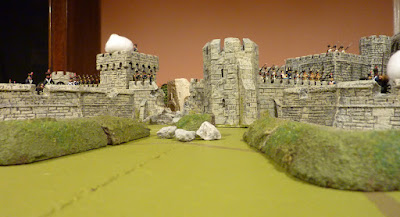
View from the fortress, with the British First Parallel in the distance

It took me about a day and a half elapsed to fight my test game to a result. I learned a lot, especially about Vauban's Wars, with which I made a rather daunting start, but which was flowing a lot better by the second day. Although I'd read the book a few times, there is a lot to learn. There is no substitute for just memorising the Combat and Defense values of each unit type - once you've mastered that, things get a lot easier, but for the first two turns I had to read the details of everything that happened, which is really heavy going. After that - after I'd seen most of the things which could happen - things picked up.

Vauban's Wars is Piquet-based, which means it's a very prescriptive, card-driven game, aspects which some people find unappealing, but it is a practical approach, especially for a solo game, and it generates a nice narrative as you go along (or, alternatively, the player(s) will build their own narrative to explain what happened).

My scenario involved an attack on the (fairly modern and tidy) fortress town of San Juan el Timido, somewhere near the Spanish-Portuguese border, in the year 1811. The French commander was the well-connected and irascible Corsican, Général de Division Léonardo, Comte Cindérella, supported by the very capable (though little seen) Général de Brigade Dandini. The fortress has 3 bastions on the table.

The attacking British force was commanded by Major General Sir Paladin Lassiter.

Lassiter's plan was to develop a 2nd Parallel covering the whole south side of the fortress, and then to construct two short 3rd Parallels with a gap in the centre - the intention being to effect a breach on the South-Eastern Bastion (the one on the right from the British viewpoint.

I'll start with a spoiler: the British had such rotten luck during the first 3 game turns (a turn is about half a week, if you are comfortable with such an idea) that any sensible general would have abandoned the siege and tried again another time. In a campaign context, this would have been a no-brainer, but such a proceeding would be of little use for my apprenticeship with the rules, so Lassiter was encouraged to stick with it. 

 
First priority for the French garrison was to shift their infantry into the town, and move the heavy field guns on the walls, on to some specially constructed platforms (or "doofers" in my house jargon)


Something of a minimalist town, I'm afraid, I had all sorts of plans to paint up the add-on extension board in the regulation baseboard colour, and lay out buildings, gardens and a monastery to double as a powder magazine, but the green paint had gone off, so minimalism it is. Sorry about that, but there was a war on. Here you see Dandini in the Rallying Point in the town, with 4 line battalions, a light howitzer and the second company of sappers

 
Having no cannons within range until such time as the emplacements in the Second Parallel were constructed, the earliest British efforts were concentrated on forward sapping, and a couple of heavy mortars lobbed a few shells into the town, to keep them on their toes. Trivial effect.

There was a strangely hushed period - the French fortress guns had a few shots at the sappers at work on the approaches, but they were a long way away, they were in good cover and sappers are a poor sort of target anyway. Both generals (being inexperienced!) were nervous about wasting powder, which turned out to be a mistaken approach - the supply of powder is more adequate than you would think, and on balance the rules make it more efficient to give plenty of fire. Since Cindérella was the better of the two commanders, he tended to win most of the initiative rolls (having a D12 against Lassiter's D10), but since the British were making such poor progress he often allowed them to go first, in the hope that the Opportunity Fire rules would give him something to fire at as they approached.

 
The British working on their forward saps (brown felt, as recommended by Gonsalvo!), still fairly safe from the artillery on the walls
 
 
The French turn up a "Trench Raid" card, and bring into action a battalion of elite troops they had placed specially in the fort. The first two such raids seemed very effective - two parties of sappers were sent scrambling back to the 1st Parallel. One of the two raids was very closely contested - the French grenadiers were armed with (in Piquet jargon) a D12+1 (blue), and the sappers had a D8 (red) - the "+1" bit on the blue die was enough to scare away the sappers - here's an exciting war photo of the dice action
 
 
The markers in the town indicate that we are on Turn 3 (about a week and a bit after the completion of the 1st Parallel), and the accumulated damage caused by mortar bombardment is 4pts, which is insignificant
 
 
At this point things took a turn for the worse for the British; encouraged by their success with Trench Raids, the French tried again. In the absence of protective infantry, the sappers were badly exposed, and this time the two attacks resulted in the elimination of two sapper companies (out of an army total of four companies!). This was not going to help much with getting the 2nd Parallel operational.
 
 
Here's a close up of one of the Trench Raid disasters for the British - wiped out. In itself, this is a nuisance, but should be recoverable, since the CinC can create new Sapper teams by converting infantry companies

 
Not so fast. On the same initiative, General Lassiter, who has to check his health and safety as part of the "Leadership" card, is laid low by a roll of 1 on a D20. Since there was no firing going on, so as you would notice, I have to assume that he fell off his horse, or was just taken ill. Whatever, the British now had no CinC, until the next Leadership card came their way, so there were quite a lot of things which they now couldn't do, such as winning initiative rolls, and recovering (rallying) losses - oh yes, and they couldn't replace the vanished sappers with infantrymen...
 
 
And so, being sort of stuck for the moment, the British brought forward most of their infantry, to protect against further Trench Raids. The French artillery - three 24pdr fortress guns plus two 12pdrs, started knocking lumps out of the British infantry, and the British morale was sinking fast
 
 
Eventually, the British 2nd Parallel was seen to shape up, emplacements were dug, big guns installed, and they started to fire on the French artillery, very inaccurately to begin with. 
 
 
Almost immediately after this, the weather became foggy for the next turn, so any serious fire was not possible. The British infantry also had a slow but steady stream of deserters
 
 
When the fog cleared, there was a new CinC (Lord Bakewell), replacement sapper units were created, and the British 24pdrs eliminated the central fortress gun and badly damaged one of the French 12 pdrs
 
 
In a sensible world, the British, who had no chance of making a decent attempt at a 3rd Parallel and were in any case running out of men and morale, should have abandoned the siege, but in the interests of gaining experience of the game I pressed on
 
 
At the end of Turn 6, some 3 weeks after the completion of the First Parallel, the British ran out of morale points, and they had lost. The starting position had been 26-14 to the Brits - at the end it was 0-8, as you see
 
 
In fact, they were doomed anyway, since one of the Unique Event cards turned up had scheduled the arrival of a relieving force for the French during Turn 8. The French knew about this, the Gamemaster (that's me) knew about it, but strangely the British commander had no inkling of it. The British spies had been very unproductive - right from Turn 1, when an attempt to sow insurrection in the town had failed and the spy was arrested and shot. A lack of intelligence, undoubtedly, in several senses, but also a bucketful of bad luck and dreadful dice!

 
The final state of the French - they had lost one fortress gun, destroyed, suffered damage to a heavy field gun (with white markers), and the one element of damage they had suffered to the match-winning elite battalion had been recovered at the first attempt by Cindérella. They had plenty of food and powder left, too

***** Late Edit *****

I had a couple of emails last night which mentioned the fact that my test siege game may have produced a result (technical knockout?), but didn't get to blowing holes in walls or any of that stuff that one normally associates with sieges. Agreed - the game only got as far as the 2nd Parallel, at which stage shooting at walls is still some way off. The test game was invaluable because it gave me a first serious workout of the rules; I've now seen most of the cards in the pack, and learned a lot about convenient ways of keeping track of the game without written notes and without covering the room in counters and Post-It stickers. One of the more alarming things about Piquet is the potential for clutter - I have a problem with clutter in any form, and it is not an essential part of this game, if you go about it carefully.

After a laboured first couple of turns, my enthusiasm picked up as I became more confident of carrying most of the rules in my head. The lack of wall-bashing is a big gap, however.

It says in the VW manual that you can, if you wish, shorten the game by starting with the Second Parallel built, to whatever degree of completeness you wish, and it offers suggested adjustments for Powder and Food Levels for this later start. Sounds good to me. I believe that the 2nd Parallel, as supplied at the start, probably needs a little careful design, to set the game up for the demolition stage. I'm keen to have a shot at this - it would be interesting to pinch some design ideas from real sieges (or bits of them). Anyway, good so far, and a further test game should appear here once my wife has recovered from the trauma of every scenery box I have being dragged out of the cupboards. I'll have a better idea what I'm doing next time.

For anyone who has read this far, my appreciative thanks. There are a couple of things which I haven't found in the rules yet - storm by escalade may be an example, though I'll no doubt receive a note pointing out that it's on p44. I'm still not altogether comfortable with all the digging being done by specialist sappers, but will think further on this. The game works nicely and, like all Piquet games, is intended to be tweaked as required.  My compliments to Eric and Peter and the other guys who worked hard and long to get VW published - a splendid effort.

*********************
 
Lassiter (in later life, as Governor of St Kitts)