Napoleonic & ECW wargaming, with a load of old Hooptedoodle on this & that


Showing posts with label MEP. Show all posts

Thursday, 15 December 2011

Solo Campaign - Commands & Colors Grand Tactical Variant


This post is going to look at what, if anything, I need to do to GMT's Commands & Colors: Napoleonics (CCN) rules to allow them to handle bigger battles. If you are not a CCN user, or could not care less, some of the reasoning might still be of interest. If you would like to see the rules of CCN, you can download them from here.

Last year I put a lot of effort into developing my in-house grand tactical Napoleonic rules, which - through lack of inspiration - kept their joke working title of MEP (short for moins est plus). I did a lot head-scratching and testing, and eventually carried out a refight of Salamanca (Los Arapiles), which in hindsight may have been a tad over-ambitious. The reason this all becomes relevant again is because I will need some means of managing very large battles for my coming solo Peninsular campaign. I have banged on about some of this in previous posts, and thus I will try not to say all the same things again, but I must explain up front that by Grand Tactical I mean that the units on the tabletop are brigade-sized.

My MEP version of Salamanca threw up a number of issues to do with command and activation, and especially with the endless chore of managing skirmishers and artillery, which really became a problem. So much for streamlining the game and abstracting unnecessary levels of detail! Around the same time, I became acquainted with CCN, and since then I have become a devoted user, relishing what I have previously described as an order-of-magnitude improvement in playability over my previous rules - the CCN mechanisms and systems are developed from other similar games, are tested and proved to a commercial boardgame standard, and they hang together and actually work. I mean quickly and logically. The feel of CCN, as I have also said before, is like the old, fun battles I fought when I was first involved in wargaming, the chief difference being that the game doesn't have all the old holes and patches that used to stop the flow and cause arguments.

CCN obviously is not going to be everyone's cup of tea - although I use miniatures with the rules almost exclusively it is, after all, a hex-grid boardgame, which is a major turn-off for many. Also it does not allow you to enjoy deploying your column into line, or handling skirmishers, so if that is your favourite part of Napoleonic warfare you should look elsewhere. For me, it works well. The card-based activation system is simple but challenging (and avoids the exhaustion which comes from marching entire armies pointlessly around the table), the special battle dice are easy to use, and the games run quickly enough to come to a successful conclusion, which is a colossal plus in my book. A regular feature of my wargames over the years has been the feeling of disappointment when I couldn't raise the enthusiasm (or the opponent) to finish off the previous evening's unfinished epic. 

In the Introduction to the rule booklet for CCN is the following claim:

The scale of the game fluctuates, which allows players to effectively portray epic Napoleonic battles, as well as smaller historical actions. In some scenarios, an infantry unit may represent an entire division, while in others a unit may represent a single regiment or battalion. The Napoleonic tactics you will need to execute to gain victory conform remarkably well to the advantages and limitations inherent to the various Napoleonic national armies of the day and the battlefield terrain features on which they fought.

OK - if we gloss over the promotional overtones, the scalability bit is very interesting. A quick read of the example scenario booklet which comes with the game makes it obvious that the scale of the Waterloo scenario is obviously rather larger than Rolica. If this nice, crisp game is really scalable in this way, then this is a most attractive idea. Here was the starting point for my previous consideration of what adjustments would be necessary for a grand tactical [my definition] variant of CCN, which, to save typing, I shall have the conceit to call GTCCN for the time being. Adjustments? - hmmm - if it works in its basic form, the best approach is to leave it alone if possible, not easy for a life-long tinkerer/improver/wrecker.

So I set myself a First Objective, which was "only change the game if it is really necessary to do so in order to avoid scaling distortions".

This is all about putting another tick on my list of things to do for the campaign, since a set of rules for big battles, compatible with CCN, is required. I shall move on to run a test battle using this trial version of GTCCN – it will probably be after the holiday period now. This trial was going to be another shot at Salamanca, but I may try something else. My definition of what constitutes a big battle is up for grabs – currently I am thinking of a battle where the number of CCN units (including Leaders) on either side would exceed 30, but I may change may mind when I see how it looks.   

I must point out at this stage that one of GMT's future expansions to CCN will be a larger, Grande Battle [sic] version, similar to the Epic version of Commands & Colors: Ancients or the Overlord version of Memoir 44 from the same originators. These games are primarily intended as multi-player games on a double-width board, and are thus designed as wide versions of the same-game-with-more-units, rather than the same-game-with-bigger-units which I am looking for. Thus, though I am sure CCN Grande Battle will be a terrific game, my ideas for GTCCN are heading in a different direction, to meet my need for a big battle manager in my own campaigns.

What I'll do here is set out the areas I have considered - I hope this becomes structured enough to follow! - and list the rule amendments I have developed. Bear in mind that I am trying hard to make amendments only where the scale change makes it necessary.


Ground Scale

If we are going to have more men in a hex, it stands to reason that there is an implied change to the ground scale. CCN does not state scale assumptions, which is sensible since each scenario is designed to fit a specific battle onto the board, so I’ll base this exercise on CCN rather than going back to metres/paces and starting the game design from scratch. In CCN, a combat unit (for example, an infantry battalion, normally of 4 "blocks" strength) will occupy a hex. It is possible to add a Leader to the same hex, but otherwise one unit to one hex is the rule. For reasons which are not very scientific, I sort of visualise a 4-block battalion is some parody of Column of Grand Divisions, 2 wide by 2 deep. It would be very convenient if in GTCCN a battalion were represented by a single block (let's see you deploy that into line!), which is half as wide on the board, which effectively doubles the ground scale - in other words, whatever the size of a hex is in CCN, it is something like twice that in GTCCN, and the terrain features depicted in the hexes become twice as big.

Time Scale

Righto - what does that do to the movement rates? In CCN, infantry may move 1 hex - there are some exceptions for light infantry, but 1 hex is the norm. Easiest approach is to leave that alone and assume that the turns last twice as long - so the implied time scale (whatever it was) is doubled, and infantry still move 1 hex - all movement rates are unchanged, though they are twice as far on the ground. That was easy.

Sanity Check - Artillery Units   

A faint klaxon sounds when you consider artillery. A battery in CCN is 3 blocks strong, and occupies a hex, and CCN also has the concept of a “reduced” battery, i.e. one that has only a single block remaining. Using the same approach as for the infantry, we can scale things down by making the standard 6-8 gun battery a single block, so that the “reduced” battery unit becomes the standard arrangement for anything less than a massed grand battery. Insisting on such a reduced battery occupying a hex on its own doesn't seem right, so I have adopted an approach for artillery whereby a battery may be deployed in two different ways:

(1) Up to 3 such batteries may be brigaded together as a single Grand Battery, which is a unit in its own right. A 3-block battery of this type is just like the normal CCN battery, apart from some trimming of the ranges (see later).

(2) Otherwise, batteries will normally be used in a divisional role, at 1-block strength, and will correspond to CCN’s “reduced” form. A big change here is that they may be attached to (or separated from) a brigade in the same way that Leaders are handled in CCN. This will require specific orders, and my original feeling was that they should only be allowed to join a brigade from the same division, but I've dropped that idea for the moment because the game may be tricky enough without that constraint. A brigade may have both a Leader and a battery attached, though no more than 1 of each. A Leader or Battery may be given orders along with a brigade if they are attached, but they are really distinct units, and count as Victory Banners in their own right if lost. Thus, for example, a brigade with attached battery which receives an Artillery hit on the battle dice will lose the battery, and a Victory Banner is awarded to the opposition, though the rest of the brigade is still in the field.

Missile Ranges

In CCN, there is Melee Combat (which is what you do to people in the next hex – and note carefully that includes short range fire as well as the use of bayonets and swords, so all canister fire is included in Melee) and Ranged Combat (which is firing at people further away). Ignoring tactical variations, CCN gives ranges thus:

Muskets             2 hexes
Rifles                  3 hexes
Horse Artillery   4 hexes
Foot Artillery      5 hexes

Since the ground scale has changed, we have to trim the ranges down. My approach is a touch crude – I simply reduce all the ranges by 1 hex. This means that foot artillery can now probably fire a bit further than in the original game, but they are so ineffective at extreme range that I am hoping it will not be a problem. If we adopt a range for muskets of 1 hex, then we can make this part of Melee Combat, and muskets will no longer carry out Ranged Combat. [I make a careful note at this point to check later that I haven’t devalued infantry by this assumption.] Thus my revised table for GTCCN becomes:

Muskets            none - included in Melee
Rifles                 2 hexes
Horse Artillery   3 hexes
Foot Artillery      4 hexes

Mixed Units

The units are now to be brigades, which includes Grand Batteries. To keep the game playable, I outlaw brigades of infantry mixed with cavalry. The “blocks” within a brigade will now represent the constituent battalions, cavalry regiments or attached batteries. Note that either type of artillery (foot or horse) may be attached to an infantry brigade, but only horse artillery may be attached to cavalry, and that horse and foot artillery must be kept separate when forming grand batteries.

Although the idea has been to avoid considering the detail of the scales, assume that an infantry block represents a battalion, a cavalry block is a regiment, an artillery block is a battery of 6-8 guns. It would be nice to have a one-to-one mapping of regimental blocks against a historical OOB, but, if working from historical numbers, allocate (about) one block per 600 men for infantry, per 300 men for cavalry, per battery (company) for artillery. If you can represent each unit which was present with a block then that is terrific, but the total for the brigade is the important thing. Thus a company of 50 men from the 5/60th Rifles attached to a brigade in the original OOB is insignificant on this game scale – you don’t get a Rifles block just for that.

Note also that Ranged Combat is now going to be carried out at block level. If a brigade contains one or more Rifle blocks, and/or an attached battery, these blocks will be able to fire individually if the brigade has orders – and remember that 1-block artillery batteries correspond to “reduced” batteries in the CCN rules.

As an example, the British Light Division in the Peninsular War might consist of

1st Brigade
            1/43rd Ft            (750 all ranks)
            2/95th Rifles       (400)
            1st Cacadores    (500)
2nd Brigade
            1/52nd Ft            (800)
            1/95th Rifles       (550)
            3rd Cacadores    (500)
plus a horse battery

In GTCCN, each brigade would be represented by single unit of 1 British LT + 1 Portuguese LT + 1 British RL (rifle light) = 3 blocks, which would move and melee (on average) as British Light Infantry, and would be entitled to 1 block of rifle-armed Ranged Combat. And, of course, the 1-block HA horse battery may be attached to either of these brigades, or may be left to operate on its own.

Though this may appear disrespectful, in my game the French Léger regiments are classed as LI (line infantry), not LT – I consider this appropriate for the Peninsular War.

A brigade will move at the rate of its slowest block type – thus mixed light and heavy cavalry may move only at heavy cavalry speed.

A brigade will carry out Melee Combat as if it were all of its predominant type – if more than one type is equally represented, the owner may choose. A brigade of 1 Grenadier battalion and 3 of Line will fight as Line. A brigade of 2 light cavalry blocks and 2 heavy may fight as heavy or light cavalry as the owner chooses (though its moves are limited to the slower, heavy cavalry rate).

Losses to a mixed brigade – if they are not obvious from the Battle Dice results (e.g. an artillery symbol) these will be from the predominant type; if more than one type is equally represented, the owner may choose.

If a cavalry or infantry brigade is eliminated which has a battery attached, the battery will be lost also.

Numbers of Battle Dice

For infantry and cavalry units, the rules are the same as for CCN, though only eligible blocks may use Ranged Combat.

For artillery, there are some changes to the rules - the bonus for Guard artillery is dropped, all ranges are reduced, and the numbers of battle dice are now thus:

Foot artillery (3-block Grand Battery) – 4 dice for Melee, and 3, 2, 1 dice at range 2, 3 or 4 hexes respectively
“Reduced” (1-block) Foot artillery – 3 dice for Melee, and 2, 1, 0 dice at 2, 3 or 4 hexes

Horse artillery (3-block Grand Battery) – 3 dice for Melee, and 2, 1 dice for range 2, 3 hexes. No fire at range 3 is permitted if the battery moved.
“Reduced” (1-block) Horse Artillery – 2 dice for Melee, and 1, 0 dice for range 2, 3 hexes.
The CCN rule whereby a “reduced” horse battery may not move and fire is dropped, since 1-block batteries are the norm in GTCCN.

Squares in GTCCN

Essentially, the rules for forming and fighting in square are the same as for CCN. If a brigade of infantry is ordered into square, it may mean that the whole brigade forms one big square or – more likely – an array of battalion squares. It doesn’t matter – the GMT-supplied marker indicates that the brigade is now in square. A special rule is now needed if the infantry has an attached artillery battery.

I assume that the gunners will take shelter inside the squares as necessary, so they do not influence the Melee Combat involving the square, with a single exception – if the attacking cavalry roll an artillery symbol on their single permitted Battle Dice, the artillery are lost.

Leaders/Generals

In GTCCN there will be a higher proportion of these, since generals down to Divisional level will normally be represented – in addition a detached brigade with a specific role may also be allocated a Leader if the scenario requires this.

You may attach a Leader to any unit you like, as in CCN, but – unlike CCN – he allows them to ignore a Retreat result from combat only if he is in their chain of command. He will, in any event, still be at risk of being lost even though he is not able to influence their Retreats.

Command Cards

The only implications for the normal Command Card pack are that the “FIRE AND HOLD” cards (of which there are 2) will no longer offer any advantage for musket-armed infantry (though rifles and artillery will still benefit) and the extra bonus for Guard artillery on the “BOMBARD” cards (there are 2) is no longer applicable – all artillery is the same in GTCCN.

Victory Banners

Scenario requirements for victory for GTCCN will need rather inflated numbers of Victory Banners, to allow for the increased numbers of Leaders and the likely numbers of lost divisional batteries. Remember that if a brigade with attached Leader AND attached battery is completely eliminated, and the Leader is lost, that is THREE Victory Banners.

Initial recommendation will be to add 3 or 4 to what you would expect the normal CCN Victory Banner requirements to be.


I’ve done it again – I started out very pleased with the small amount of change I had introduced, but my usual windy explanation means that this looks like a whole pile of stuff. I had intended to summarise the rule changes at this point, but I think this has gone on long enough. If I feel brave in a day or two I may do this, though.


Saturday, 26 March 2011

CCN - thoughts on a Grand Tactical Variant


I find myself most of the way through a 7-day Cabbage Soup de-tox. For the uninitiated, or the non-believer, this is a no-coffee, no-tea, no-booze, hardly-any-carbohydrate, very-little-fat regime which will leave me feeling terrific and ready for a large coffee, a big steak with fries and onions and half a bottle of Montepulciano on Day Eight. In the meantime, I am existing on what feels like a single figure allowance of Kcals per day, which is disorienting. This has no relevance at all to the subject matter, but it may help to explain things if I suddenly lose the plot, or end a sentence with the wrong artichoke.

It must be the time of the year or something, but everyone seems to be writing or revising wargame rules. Not wishing to be left out, and (temporarily) not having the mental resources to think of anything more original, I am joining in with the trend. My particular angle on this came after my recent stocktake of in-hand projects (and I forgot to mention the translation of Max Foy's "Vie Militaire", which is making rather halting progress). The particular food for thought came from comparing my recently tested, home brewed MEP rules for Grand Tactical Napoleonic battles, with my experiences with Commands & Colors: Napoleonics (hence CCN) to date.

Interesting. The main contrast - immediately - is the order-of-magnitude difference in ease and speed of play. CCN plays like a game, rather than a post-graduate research project. It does not suffer from being bogged down in all the convoluted extra cleverness which it has taken me years to build into my own game. Some of the things which it does not have are a source of minor regret, since I have grown to be very attached to them (skirmishing, for example), but the negative side is pretty substantially swept away by the playability and the logical flow. I find that having CCN available (and I play it as a miniatures game, remember) means that I can regard my cupboard full of soldiers and the rest of the paraphernalia as a game which I can play whenever I wish, with the certain expectation of finishing, and finishing, moreover, while still in a physical shape to appreciate it. Previously, there has always been an element of my wargames - and I have always tried to simplify them as much as possible - of having a cupboard full of equipment with which I may once again attempt to wrestle with the problem of striking an enjoyable balance between fun and my personal finicky views on military tactics.

I am, understandably, not going to scrap my MEP game, or any of my other games, but at some hungry moment or other during the last few days it occurred to me that I could produce a slight variant on CCN which would handle most of the aspects of MEP yet still move with the swing of CCN itself. If the changes were minor enough, it could almost be viewed as a kind of scenario amendment to CCN. So let's regard this as a possible new game, not as a replacement for anything, and toss some ideas around. [Bear in mind that this is not as heretical as it might seem - study of the published CCN Scenarios makes it obvious that Waterloo, for example, must use a different unit size and implied ground scale than Rolica.]

These are a first-cut list of changes to the standard CCN game:

(1) The Command Cards mechanism from CCN - in fact just about all rules from CCN - will be adopted as a starting point, and adjusted as necessary. The actual pack of Command Cards will need to be checked - some of the cards will require some new definitions, or may need to be excluded (I haven't looked at this in detail yet).

(2) The scaling and grouping from MEP will be introduced. This means that, in general, a unit will be a brigade, and the number of "blocks" (bases in a miniatures game) will indicate the numerical strength, the identity of the blocks representing the historical units present - typically, a block will be a battalion or cavalry regiment. This immediately introduces the idea of mixed units, so some commonsense rules will be required to average this out where necessary. A couple of examples here: (a) my view of French Light Infantry in the Peninsula is that they were pretty much indistinguishable from Line, so a brigade of mixed Light and Line units will be Line; (b) the Anglo/Portuguese Light Division will have brigades which are entirely Light Infantry, with some Rifles blocks present; (c) divisional artillery attached to a brigade will be present at a strength of 1 block, and will not affect the troop class of the brigade (artillery may also be formed into massed or reserve batteries of up to 3 blocks in strength); (d) a 4-block unit which has 3 Guard blocks and 1 Line will normally be taken as Guard (etc).

(3) There will be some implied change in the ground scale. Movement will be as normal, but artillery ranges will be reduced to 3 hexes for horse artillery and 4 for foot artillery. Ranged combat will not be allowed for infantry other than Rifles. Rifles will be allowed ranged combat at a range of 2 hexes. I still have to think about all this, including drawing up new Combat Dice numbers for artillery. Bonuses and deduction for Combat should remain unchanged, though the number of blocks counting for dice should be limited to 4, to stop a large, poor quality brigade becoming unstoppable.

(4) The rule whereby a single-block horse artillery unit cannot move and fire is suspended - typically, batteries will have a single-block strength.

(5) I have no idea how to decide which block in a mixed unit (brigade) is hit - maybe the owner can choose? If the dice shows an artillery symbol, the battery must go if there is one. Needs work.

(6) Leaders/Generals will normally be deployed at Divisional level and higher – it might be that a detached brigade might justify having its own Leader. This will give a higher proportion of Leaders to combat units – to compensate, there is a change to the rules: you may attach a Leader to any unit you like, but he only allows them to ignore a Retreat result if he is in their chain of command. Also, it may be necessary to add 1 to the victory flag requirements to allow for the greater number of potential Leader casualties.

That's my very first thoughts on this. My current assumption is that the rest of the CCN rules stay as unchanged as possible.

More soon. I would kill for a cheese sandwich.

Thursday, 17 March 2011

Taking Stock


A lot of plates spinning at the moment. Sometimes in blogs you can witness people changing their minds, or you read of a proposed project which stalls, or of which you hear no more. That's absolutely fine - blogs should have that sort of daily journal role, with all the swings and changes which feature in our real lives, but it can also be rather a public way of failing to do something. That would worry me a bit, so I thought I’d do a personal checklist of where I’m up to. If you wish to share my checklist, then welcome aboard, but this is really for my own benefit!

My current projects which have started and which I've mentioned, but are currently somewhere in flight (or not) include the following.

Army Complete

Well, yes - I've arrived at the supposed destination, with some tidying up to be done, but during the journey it occurred to me that I could extend the line a bit. Some existing units are to be replaced (mostly for aesthetic reasons), I'm still working gently on an Allied siege train, and I have decided to add two further brigades to the armies - the French are to get the (fictitious) Vorpommern brigade, and the Allies are to get some Spanish militia and guerrillas to fight alongside the line troops. And then, of course, there is the small matter of providing more limbers for the artillery.

My Spanish Troops

The post on the Nationalist forces has appeared – I intend to do another two, one on King Joseph’s troops (and that one is waiting only for a couple of command figures to be painted for one of the units, so as not to spoil the team photo), and one on my new/proposed militia and irregulars, which will be a little while since there is much fettling and painting to be done to get them finished.

Vorpommern

This project has not disappeared. The first unit – the foot artillery company Stadt Stralsund – is at the painter as I write this, and should be back soon. I have figures reserved for the grenadiers, the jaegers and the 2 line battalions, though they are Scruby 25mm, and I spend alternate days worrying about how they can be painted effectively, given the almost complete lack of detail on the castings. I had cavalry put aside for them – also Scruby – but I really have decided that they are too awful to use, so the Vorpommern cavalry will be extra regiments of French-style chasseurs a cheval, which gives the slightly pathetic advantage that I can also use them as Frenchmen if required. Painting will proceed in due course.

The Grand Tactical Game (MEP)

Well, it exists, and I got through the Los Arapiles test with ideas for some changes. Further progress has been shelved while I get more experience with the Commands & Colors rules. Apart from anything else, there are mechanisms in CCN which are similar to, but simpler than, those in MEP, so there may be a little judicious cross-pollination coming up.

The Band of the Old Guard

This Minifigs S-range item has been sitting about for many years, waiting to be finished. Like all non-combat units, it keeps getting pushed down the painting queue. I finally got an official-issue drum major, and have bravely sent them off to the painter to be prepared as the band of King Joseph’s Spanish Royal Guard. No, I don’t know how they were uniformed, but I doubt if anyone else does either, so they are going to look very like the French Guard band out of Funcken! They will exist primarily for parades and other ceremonial fol-de-rols. I have abandoned the idea of a special morale bonus for neighbouring friendly troops.

Sunday, 2 January 2011

The Grand Tactical Game - Rules Revision

As suggested in the last post and subsequent comments, a minor revision to the MEP rules has been made, to simplify the artillery fire phase. I have left the skirmishing procedures unchanged for the time being.

The revised rules can be downloaded from here.

Wednesday, 29 December 2010

The Grand Tactical Game - Action at Los Arapiles

This was the planned refight of Salamanca, using my new MEP rules. It's the first time I have attempted to stage a historical battle, and I thought long and hard about the best way to do this.

Since part of the objective was to prove the rules, it seemed inappropriate to attempt just to act out what really happened, yet ignoring the history altogether would kind of nullify the whole point of making it Salamanca. I decided to set up the action as it stood at about 1pm, put a few of the principal events into the first few bounds, and see what happened.


Well, it didn't turn out to be a very close copy of history - my starting point was to be the attack on the French left flank by Pakenham, with cavalry support, and Pack's independent Portuguese brigade's assault on the Greater Arapile, a hill in the middle of the French position.

Things started pretty much as in the real battle - Pack's attack was repulsed, and Pakenham quickly broke Thomieres' leading brigade, though his own losses were severe. History stopped dead at this point. The British heavy cavalry (Le Marchant's brigade) made no progress at all in following up - they were checked by Thomieres' weak second brigade - so much for the most glorious cavalry charge in British history. Then Cole's and Leith's Divisions were very badly mauled by the divisions of Barbot (vice Clauzel), Maucune and Bonet in the centre, and the momentum was lost. The French position was strong, any further British attempt to attack would have been foolhardy (the Allied off-field reserves, primarily the 7th Division and De Espana's Castillian troops, were not due for an hour, and were not capable of affecting the outcome), and there was little else that Wellington could do but resume his retreat towards Portugal. The French cavalry was not up to the job of harrying the withdrawal, and both sides left the field in reasonable order around 3:30pm. French casualties were slightly higher at about 10% of all troops engaged, and they lost two senior generals in Bonet and Tirlet (commander of the artillery reserve).

The rules worked well enough - artillery counter-battery fire seemed possibly a bit too effective, but it's debatable. The weather was fine and dry throughout, the only command snag of note was when Lowry Cole called off his attack on Bonet, which was probably good judgement. The game (it didn't feel very much like a game, since I spent much of the time with my nose in Dr Muir's book, checking the script) was over in about 90 minutes - I was running the rules on a computer, and did cut back on the skirmishing, which was mostly ineffective (which is probably correct, and was expected).

So a bit of a damp squib, all in all. I was persuaded by Dr Muir that Maucune was accompanied by an amount of artillery which could only have been possible if part of the reserve park was so deployed, and that may have been a significant element. Don't know, really. I also have to say that, when you see the real numbers of troops set out on the battlefield (scales were 1 hex = 1/4 of a mile, 1 bound is an hour, 1 figure = 125 men for this game), it seems improbable that the French could lose, unless there is some major morale advantage working against them.

I do not intend to repeat the action, so I include some pictures, just to prove it happened.

All right - it was a lot of fun, really, but I'm rather disappointed that the big battle stalled! It was pleasing to be able to attempt a battle on this scale, but the little units still feel a bit strange.


General view of the battlefield, looking West. The French position is down the near edge of the table, then up the left hand edge. From the right, the French have the Divisions of Foy (far right), Ferey, Sarrut, Bonet (on the hillock and beyond), Barbot, and Maucune in the centre on the ridge. At the far end, on the left flank, is Thomieres, with support from Taupin and the light cavalry of Curto. Note the rather exposed position of William Anson's British brigade, on the hill of the Lesser Arapile in the centre of the picture.


Wellington's hammer - the Allied Third Division on Wellington's extreme right, under Pakenham, with cavalry on both sides, forced-marching to attack Thomieres. It didn't go too well...


The rest of the Allied position - Leith's Division in the foreground, supported by Clinton, then, further away, Cole, Pack's independent brigade, Henry Campbell's First Division and the Light Division (Karl von Alten) on the extreme left.


View from behind Clauzel's position. In the real battle, the French were convinced that the Allies were in retreat - you can see why - there's not much over there, is there?


Almost the end - the French haven't moved very much, but their centre looks pretty solid. Time to get marching and try another day.

Saturday, 18 December 2010

Weather in Wargames


In my experience, weather is an important addition to wargames, but it is one of the most likely things to get forgotten about when you are trying to rally the troops one last time at about 2am, and it is certainly one of the most likely things to be dropped from the rules for big games.

Accordingly, I really only consider the weather in detail in computerised games – the old computer, he never forgets, he never gets tired. I’m sitting here this morning, happy that the last lot of snow has gone, but aware from the TV news that more is expected, so some mention of weather seems appropriate.

I have to apologise immediately for the fact that, since they are primarily intended for Summer campaigns in Spain, my weather rules, in their present form, do not cover snow or extreme temperature, neither do they allow for fog/mist (except by implication). Oh – and wind isn’t covered either. In fact, I’m becoming increasingly ashamed of the whole thing as I write.

So this is just an outline – food for thought, if you like. If you find the ideas interesting, I’m confident you can easily improve on what I do, or produce something more suitable for your own games. My weather rules are very much based in the scale and style of games I fight. For example, my main Napoleonic rules have 30-minute bounds and 200-pace hexes, and do not allow for formed musket volley fire – musketry is included in close combat, and the effect of weather on the combat rules reflects this. My MEP Grand Tactical variant will use the same set-up in its automated form, with some adjustment for the 1-hour bounds, the halved ground-scale and the simplified combat rules.

Although the implementation of these rules is on a computer, I shall attempt to illustrate them in the form of dice-throws.

My starting point is a simple, linear, numerical barometer which I think I originally adopted from Charlie Wesencraft (or it might have been Featherstone) about 40 years ago. You can use a cardboard track, or a homemade numbered pegboard – whatever you like. You start with a 2D6 throw to set the weather indicator (wr) – the detail of all this is set out in the attached note – 2 means that it’s fine, 12 that it’s bucketing down with rain.

There are 4 indicators, Weather, Visibility, Mud and Dampness. You’ll need to keep track of the time of day, and determine (at the outset) the official time of dusk, and you’ll need a pair of weather dice – just normal 6-sided dice, but different colours. I use a white one and a black – where necessary, the white counts as +ve and the black as –ve – in all that follows, w is the white dice score, and b the black one. At the end of each bound, roll the 2 weather dice once and adjust the indicators (note this is just a single roll of the 2 dice - eveything can be worked out from this one roll):

Weather (wr), which is the main sliding barometer – this is set initially by rolling the weather dice and adding them together (w + b) – thereafter it is moved up and down each bound – increase by 1 if w > b, decrease by 1 if w < b. If w = b then it stays the same.

Visibility (visi), is the number of hexagons at which units may be seen on the tabletop, and thus the limit of artillery fire. The distance at which Blinds may be spotted, and it which generals may influence the conduct and discipline of their troops is also limited by small values of visi. visi is calculated as (12 – wr), tweaked for the onset of dusk and given a minimum value of 1.

Mud (mud), which is another sliding scale, is initially set equal to b, and its subsequent change is driven by the current value of wr and the value of (w + b) each bound – progressively higher values of mud will limit artillery “bounce-through” for deep targets, prevent the use of movement bonuses, reduce movement rates for all troops, and ultimately prevent all movement of artillery and vehicles.

Dampness (damp) , is initially set to w, and subsequently changes in a manner very similar to mud. damp is a measure of the effect of wet weather on powder-dependent troops. At high values, it stops skirmish fire, reduces the combat effectiveness of infantry and, ultimately, also limits the effects of artillery fire.


At the outset, the start time is set, and the time of dusk (from a scenario, or whatever), and the initial values of wr, visi, mud and damp are set, as described. . If they agree to do so, the generals may request a re-throw, but they may only do this twice – after 2 recalculations they must accept the conditions as given.

Sunday, 12 December 2010

The Grand Tactical Game - Salamanca OOBs again

This has been a very odd two weeks - I was effectively snowed in for most of the time, and, now that we are getting back to what passes for normal around here, I've been rushing about catching up with all the things I couldn't do during the bad weather.

Hence the drop-off in the blogging activity. I have, however, managed to spend a little time putting the MEP Grand Tactical rules onto the computer, and things are progressing well - I hope to have everything up and running in a week or so.

I've also been refining the set-up and scenario for my proposed Salamanca battle. I'm still not sure whether I just try to act out the actual events, or (more likely) set it up at a point in time and then let the game rules rip, and see where I get to. My intention is to start the action at about 1pm, as the French left flank is becoming over-extended and just after Marmont has been carted off, wounded, and replaced by Clauzel.


To set the context and check details I have a full set of Oman's history available, and various other useful works, but have had an absolutely wonderful time re-reading Rory Muir's book. Just great. He dissects the battle into its principal actions, and at the end of each chapter there is a commentary section which discusses the inconsistencies between the various sources and tries to resolve areas of doubt - in many instances this is at least as fascinating as the account of the fighting. Yes, this is a well-known book, but I thought I would record my appreciation, and recommend it most highly to anyone who has not read it.

So here is my (tweaked) Order of Battle, as printed out by my computer program.

The figures are EL: Elements (750 inf, 500 cav, 1 battery), QB: Quality Bonus, SK: Skirmish capability. The numbers in square brackets are the identifiers for the computer.


I have followed what I believe to be current thinking on the French organisation: Barbot stands in for Clauzel, Col Loverdo for Barbot, Taupin is in charge of Brennier's Divn, Thomieres in charge of Souham's; the cavalry brigadier Carrie de Boissy is absent, since he had been wounded and captured 4 days earlier. Senior colonels command brigades wherever appropriate.


On the Allied side, I've excluded the Spanish lancers (because it's a small force, and I'm not sure where if at all they were engaged), and I've put all the Spanish infantry into a single brigade, just to make it large enough to be useful.

Throughout, units which are known to have been absent or posted off the field are omitted, and the listing of battalions and cavalry regiments is fudged a bit to balance the total numbers against the historical OOBs. If your favourite regiment has disappeared then I apologise - I too was disappointed that my newly painted Regiment de Prusse was excluded by the rounding rules!

Saturday, 27 November 2010

The Grand Tactical Game - Complete Rules


I'm supposed to be working today, but it's snowing heavily, so I've taken the opportunity to get the various pieces of the MEP rules stitched together. Result is the first proper version of the game, downloadable from here.

I've taken a little time to check it hangs together, but there will certainly be some typos and inconsistencies remaining. If anyone spots anything daft, please let me know - I am reconciled to an open-ended period of tweaking and fixing!

I'll do some serious playtesting over the next few weeks, and then transfer the rules onto the computer - the game, however, should work perfectly well with dice and lots of red wine...

I'll have to get on with organising the Salamanca session. Watch this space.

Friday, 26 November 2010

The Grand Tactical Game - The Butcher's Bill

Bits and pieces, today.

First off, sadly, un petit dommage - after the photo session for the Combat examples, I managed to drop General Maucune, and had to superglue his horse's ankles. Seems OK - better than I feared it might - but it does occur to me that a Hinton Hunt horse would have withstood the fall without problem. The NapoleoN horses are a bit on the elegant side, though less fragile than the current Minifigs horses, especially the rearing ones, on which the old fetlocks cannot support the weight of the figure if you remove the reinforcing struts.

After going over the Combat examples, I am now thinking that a Unit attacking a village or other built-up area should be limited to a Pinning Attack (2D6) - there must be a limit to how many men they can actually bring to bear against a wall?

Finally, since I am not going to include a rule for Weather, here is the last of my proposed Optional Rules for the MEP draft. This gives a method of determining the actual casualties in a battle (or a day of a battle), which is really of more relevance in the context of a campaign. I hope to have a new draft of the Rules downloadable in a few days. At that stage, it should be the first attempt at a full set - I may even write a Contents page and all that!


As ever, all comments most welcome. Apologies for the amount of dice-rolling required for the casualty calculations - another advantage of using a computer.

Thursday, 25 November 2010

The Grand Tactical Game - Combat Examples

Rather later than I had hoped, here are some examples of Combat under the draft MEP rules, which can be downloaded from here.

Two Units Attack One

In this example, Maucune's French Division of two Units (brigades), coming from the bottom of the pictures, attacks a single British Unit. Maucune is visible, with his right hand Unit. In all that follows, black dice are for the French, red for the British.


The first action is an exchange of skirmish fire - each of the Units has a skirmish (SK) value of 2 (denoted by the bright green counters next to each skirmisher base - yes, in a sensible example I would have skirmishers mounted individually, but I haven't), and the Brits choose to split their skirmish strength so as to take on both sets of French skirmishers. Skirmishers hit with a throw of 1 - in the exchange with the French Unit which has Maucune present, each side scores 1 hit, so they cancel out - no net effect; in the other exchange, both sides miss - no net effect.


The actual Combat is fought as two 1:1 Combats. Because there is no requirement for one Combat to be fought first, Maucune (the attacker), chooses to start with his larger Unit. This Unit has 5 Elements present (don't count the skirmishers) - the max number of Elements which can count towards PV is 4, so PV is 4. The adjusted PV has a bonus for the presence of a friendly Unit in the Combat, and for the presence of the General. Adjusted PV is theoretically 6, but since a throw of 6 is always a miss anyway, 5 is the maximum. The French are going for an all-out attack (in both Combats - must be the same for both), which means they roll 4D6, and they are looking for throws of less than or equal to the adjusted PV of 5 (for clarity, I've set the required throw on a large white dice). The British Unit has 4 Elements, so it may match the full 4D6 allocation set by the French, there are no adjustments applicable, so the throws have to be less than or equal to 4 to hit. In the event, each side scores 3 hits.


Because this is a tie (a "score-draw"), each side loses 1 Element (and therefore 1 from its SK), and the attacker (the French Unit) retreats 1 hex. We have to test to see if Maucune himself is a casualty - the Unit lost 1 point from its PV, so a throw of 1 will put Maucune in trouble. In fact it's a 3, so he's OK. Disgruntled, but OK.


Now the second French Unit attacks. It has 4 Elements, but it gets no bonus for multiple attackers, since the support has disappeared. No adjustment - PV is 4, it throws 4D6, and required throws for hits are less than or equal to 4. The British Unit now has only 3 Elements present, so it is restricted to 3D6, and throws must be less than or equal to 3.


In the event, the French have 1 more hit than the British, so the British Unit loses 1 Element (i.e. 1 from its PV), plus 1 from its SK - so the skirmish capability is now eliminated - and retires 1 hex. The French lose nothing, and since they were the attackers, they may advance into the vacated hex if they choose to do so.

Attack Against a Village


French Unit advances against a small British Unit in a rather unattractive village. First action is skirmishing. SKs are both 2, so each side throws 2D6, looking for 1s to hit. Both score a hit, but the British skirmishers are a Protected target, since they are in hard cover, so a checkroll of less than or equal to 2 is needed to confirm the hit. The checkroll fails (it's 6), so the British have a net skirmish advantage of 1 hit. French lose 1 skirmish point.


Now the Combat - French have 4 Elements (i.e it's a brigade of about 3000 men), and are attempting all-out attack against cover. PV is 4, so full 4D6 attack is allowed, but PV is subject to a deduction of 2 since the defender is in a village, so the dice must come up 2 or less for hits. British defenders have a PV of 2 (2 Elements), so may roll only 2D6, which must come up less than or equal to 2.


The dice roll gives the British a rather lucky win by 2 hits to 1, so French lose 1 Element (and therefore, also, their last SK point) and retreat.

A Flank Attack


In this example (and apologies to any Spanish readers - it's just an example!) we have a Spanish Unit which has 3 Elements and a Quality Bonus of -1 (white counter), and thus a PV of 2, and an SK of 1; it is charged in the flank by a Unit of French dragoons which has 3 Elements, plus a General. Note that the Spanish can't use their skirmishers here - skirmishers can act only to the front of the Unit, and, in any event, cannot act against cavalry. So the first thing to check is whether the infantry can manage to react to the charge, forming squares. For this test, their PV (which is 2) must be reduced by 2 because of the flank attack. The minimum of 1 for adjusted PV comes into play - a throw of 1 will allow them to form squares. In the event, the throw of 4 means they are unable to react in this way.


In this example I used red dice for the French - yes, it was a mistake. The French have a PV of 3, so may throw a max of 3D6, and the adjusted PV is 3, plus 1 for the general, plus 2 for the flank attack. The dice must turn up 5 or less to score hits. A flank attack is unopposed, so the infantry do not get to roll any dice in reply. In this example, the cavalry score 3 hits - the 1st hit is the white counter plus 2 Elements (plus the SK point), the 2nd hit is the last remaining Element, the 3rd hit is not required. The infantry have been eliminated, and the cavalry, if they choose, may occupy the vacated hex.

Sunday, 21 November 2010

The Grand Tactical Game - Generals & Command

I've amended the downloadable draft of the MEP Rules, which you can get to from here. This revised version now includes the Rules for the use of Blinds, and I have amended the Game Sequence accordingly.

In this post I've also included previews of some more of the optional rules I propose to add, firstly the procedure for General's Personalities, which is a prerequisite for the Command rules, and which sets an Ability Rating (compliance/initiative, really) and a Leadership Style, which ranges from Cautious to Aggressive.


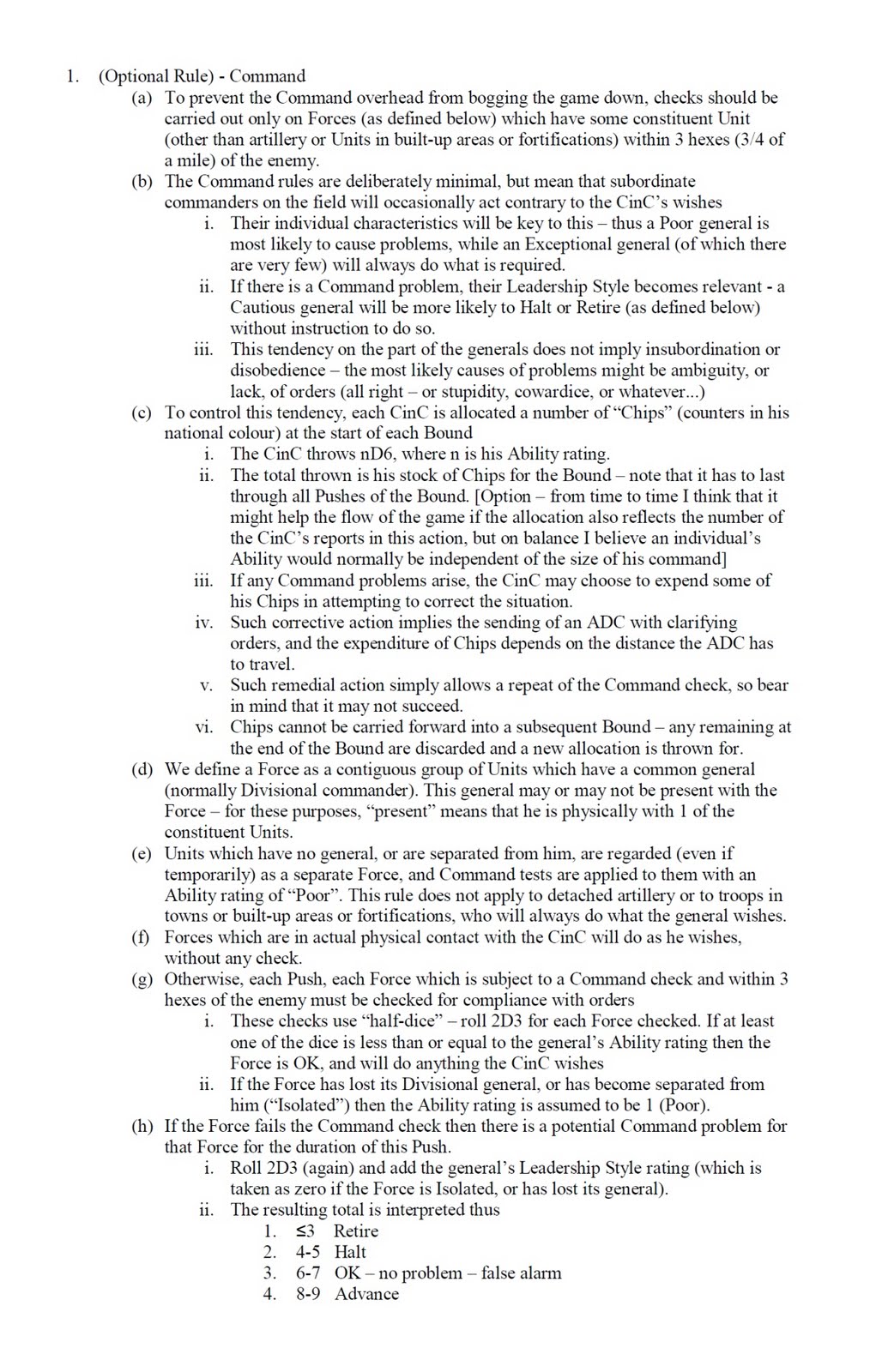
And then there are the Command Rules themselves - as previously mentioned, these are supposed to be as minimalist as I can get away with - please forgive any lack of elegance here! In my original notes, these are described as "Command Hassles", which kind of sums up the approach.


As ever, I would be delighted to receive comments on these - this is, after all, supposed to be a working draft.

Tuesday, 16 November 2010

The Grand Tactical Game - Blinds

Here is another of the optional rules for MEP, which I air for public criticism before incorporating into the draft (probably next weekend, all being well).


Blinds provide an interesting element of "Fog of War" - highly recommended. My solo game has an option where you can shuffle the identity of the blinds for one or both armies, so that one or both commanders has/have no idea who or what is arriving when - that is a decent working definition of chaos. Probably takes the idea a little too far, though it can generate some furious fun.

This draft rule will be identifiable as heavily influenced by TooFatLardies - but who else am I going to borrow ideas on Blinds from?

Sunday, 14 November 2010

The Grand Tactical Game - Downloadable Draft

This is an attempt to get organised. You can see or download the latest draft of the MEP rules from Google Docs by clicking here.

In future, so that I only need to maintain a single link, all references to the downloadable draft of the rules will link to this post, and the version you get to from here will be the latest extant version.

*** Very Late Edit ***

Some six years later, I removed the link, since the game is no longer in a maintained, playable state. Apologies if you came here looking for it.

*******************

The Grand Tactical Game - End of the Day

This week, progress with the blog has been upset a bit by events in the Real World - a place I avoid whenever possible. The Combat examples have been a bit delayed, though I have done some re-writing of the MEP rules draft, which will appear shortly in downloadable form.


In the interim, here's a general note about victory conditions, nightfall, what happens at the end of the day - all that stuff - which is to be incorporated into the draft as one of the optional rules.


As ever, I'd be very grateful for any comments or (polite!) suggestions.

Sunday, 7 November 2010

The Grand Tactical Game - Morale (or Not)


This week I started doing some detail testing of the Combat mechanisms for MEP, and it became obvious that there are a few more changes needed. Simplifying the actual Combat, and calming down the casualty rates a bit, will be addressed in a forthcoming post – probably next week, in which I also hope to do a couple of walk-throughs of examples of Combats. I’ll make a new draft of the rules available at that time.

But the first surprise, and the most radical (for me) was the realisation that the whole subject of morale needed a rethink.

I remind myself that this is a grand tactical game, and the basic units are brigades. As I have mentioned before, it is spiritually close to being a boardgame. In passing, I must observe that I don’t recall seeing very much in the way of detailed morale rules in boardgames, though I’m sure there are some somewhere. Maybe this is a clue.

In a tactical game, I am used to seeing a battalion routing from contact, subsequently rallied – maybe by the personal intervention of a general officer – then turned round, formed up smartly, and sent back into action, though maybe a bit more circumspectly than before.

But this grand tactical game has brigade-sized units comprising Elements which are each a battalion or equivalent. Losses are counted in Elements – a complete battalion is the smallest amount of loss which we bother with. Let’s think about that for a moment – if a 3-Element unit loses an Element as a result of some incident, it does not mean that 750 infantrymen have just been vaporised, it means that the combined effect of actual casualties and demotivation caused by the incident have reduced the combat capability of the unit by an amount which is roughly equivalent to a battalion’s-worth of the soldiers not contributing any more. They may be dead, or hurt, or they may be shocked into uselessness, or they may be legging it to the rear – it doesn’t actually matter. The point is that there are not so many of them taking part - the “loss” is an amalgam of reduction in headcount and loss of morale. The italics are deliberate.

Continuing this theme, when a unit has lost all its Elements it is eliminated. At risk of unnecessary repetition (after all, this is not a difficult concept, though I seem to have some trouble getting the hang of it!), they have not all been wiped out, they have been reduced to a crowd of fugitive survivors, retreating in disorder, probably throwing away all military paraphernalia as they go, to speed their exit. Whatever else, they are not coming back. Again, their elimination is as much – maybe more – to do with morale as it is to do with casualties.

In view of this, I suddenly had a blinding flash of the obvious – having morale tests in addition to this process is too much of the same thing. What if we dropped the stand-alone morale tests altogether? Also, what is the point of having units on the tabletop explicitly marked as Routing when the casualty mechanisms already allow for people running away? A unit which is reduced to zero strength is running away, and won’t come back – that’s probably all we need. OK – we won’t have Routers, so we don’t need to try to rally them, so that’s another morale test scrapped.

The initial draft has morale tests for units which suffer (significant) loss to artillery and skirmisher fire. OK – it is possible to imagine a unit being reduced to zero by continuing fire – they have run away. If they have not run away, and have just been damaged a bit, there is probably a need for some Activation or Command style check to see if they are prepared to follow orders if they are required to advance (or whatever), but the reaction-type morale test as drafted is not necessary.

So I propose to drop the morale tests, and units losing in combat will be pushed back – they will not run away until they are eliminated. There will be no Routers, and no rallying of Routers.

I feel a bit elated at removing a sizeable piece of fiddle-faddle from the game – I am also nervously aware that the morale tests may be back next week, after some more playtesting, so am not going to make too much of a fuss about it!

More soon.

Friday, 29 October 2010

The Grand Tactical Game - Rule Tweaks

Righto - updated version of MEP rules is now downloadable from here. Thanks again for comments and general help with this.

Divisional artillery may now share a hex with a brigade from their own division, and I've changed some of the Combat rules to suit. I did consider making such a battery just part of one of the brigades, but that becomes complicated if you wish to separate them, or have them acting independently.

I've also made a small change in the scaling of Elements in a Unit (brigade) - if the action is based on a historical OOB, the Elements will now be rounded to the nearer 750 men (500 for cavalry) rather than the higher. Nearer is probably more intuitively sensible anyway - it was higher only to prevent small units vanishing from the OOB. I've thought better of it - let 'em vanish!

Thoroughly enjoying my return to Rory Muir's book. There were a number of incidents which occurred at the Battle of Salamanca which affected the outcome, but which are at much too fine a level of detail to be covered by Grand Tactical rules. Examples are:

(1) Wellington himself detached a couple of guns from the 7th Divn's artillery, and put them on the Lesser Arapile (these were young Capt Dyneley's RHA boys - a tale straight from GA Henty if ever there was one)...

(2) ...and (according to Dyneley), a shell from one of these guns wounded Marshal Marmont, the French commander...

(3) ...and a major panic ensued, while the French HQ went to find General Clauzel, to tell him he was now in command...

(4)...alas, Clauzel had been wounded also and had been taken to the rear, so they now had to find Bonet, who was next in seniority...

(5)...but Bonet was also a casualty. Luckily, Clauzel, with his wound dressed, was able to take command shortly afterwards. Throughout this confusion and this series of bad breaks, Thomieres' Division was still heading for the horizon, which did not help the French situation at all.

None of this fiddly stuff, I promise you, is going to be covered by the intended scope of MEP!

I hope the changes in the draft make some sense - I'll attempt some low-level Combat experimentation with dice and toy soldiers to see what other horrors I haven't thought of...

Tuesday, 26 October 2010

The Grand Tactical Game - Salamanca Battlefield

Having put together a first-cut OOB, the next task has been to draw up a battlefield diagram and see if it is possible to get everybody on! Here is my first attempt - I learned a lot in the process, and found some things where I need to decide on some rule changes.

This is all a fudged approximation, based on my understanding (such as it is) of maps in Oman, Marinsin, Ian Fletcher's Osprey book, Rory Muir's excellent study and various other sources. I also consulted the set-up instructions for Maplay Games' Salamanca boardgame and for the Simtac Los Arapiles game.


You will see Thomieres heading off to the left, his orders based on the incorrect assumption that the Allies were retreating in that direction. The Allied 3rd Divn is moving down to attack him. Green hexes are woods, green troops are Portuguese.

Behind Point A are Bradford's Portuguese Brigade, De Espana's Spanish division and George Anson's Light Cavalry Brigade.

Behind Point B are the Allied 7th Division.

Some slight changes in the OOB - no doubt there will be more:

(1) Victor von Alten was wounded early in the day, and his brigade is commanded by Col Arentschildt of the 1st KGL Hussars. For convenience, I propose to include D'Urban's small brigade of Portuguese dragoons in Arentschildt's force.

(2) French 15th Dragoons were detached, off the battlefield to the French right, so I propose to amalgamate Boyer's 3 remaining dragoon regiments into a single brigade, as shown.

(3) Bock's KGL dragoons are also detached, somewhere off the table on the Alled left, so I'll omit them from the OOB.

(4) Just for commonsense, I'll give one of Thomiere's batteries to Bonnet.

Now - Artillery. Shock horror. I have suddenly realised what was probably obvious from the outset, which is that scaling down the numbers of infantry and cavalry units while keeping the artillery unchanged results in the table suddenly becoming covered in artillery. Why didn't I think of that before?

If I try to deploy all the artillery in its own space, the table gets swamped again. Hmmm. You will notice that this first attempt at the battlefield shows no artillery at all, while I decide what to do about them.

First thing I did about them was I did some more reading of other people's rules. Sam Mustafa's Grande Armee, which is of a similar scale and approach to MEP, makes no attempt to represent divisional-level artillery on the table at all - they are simply assumed to be part of each division, and the only guns that are explicitly deployed are reserve batteries. I can see how that would work, but it doesn't appeal. As with the skirmishers, I'd rather have the divisional guns visible on the table, but in some way that isn't a nuisance.

So my current idea is that a divisional battery just squeezes into a hex with one of the brigades. I'm still thinking this over - a hex is about a quarter of a mile (500 paces). What's the frontage of a 6-8 gun battery? Maybe 100 paces - maybe a bit more? Would it be possible to squeeze them in like this?

I'll do some more reading on the subject - as ever, I'd be delighted to receive advice here. I'm also intrigued to know what Marmont did with his artillery - there are some odd references to the work of divisional batteries - supporting Thomieres, for example - but I've never seen any reference to the reserve batteries, and there were 5 or so, as far as I can see. Further, I've never seen any map or depiction of Salamanca which showed any positioning of French artillery.

Since Marmont started the day assuming that his army was about to resume their march to keep pace with Wellington's retreat, maybe the artillery reserve was simply limbered up in order of march, ready for a long trip. I'd like to get a bit more detail on some of that. So - back to the books.

More soon.

Saturday, 23 October 2010

The Grand Tactical Game - Salamanca OOBs

This feels like jumping the gun a bit - it is my intention to stage some kind of re-run of the Battle of Salamanca at some point during the playtesting of the MEP Grand Tactical Rules. As I mentioned before, I have very mixed feelings about any kind of re-enactment of a real battle, but I've never been able to do it before, so this will be proving a point. In the interests of humanity, it will probably be a solo effort!

One of the things I need to do is check that I am actually going to have enough troops to do it (and that they'll fit on the table!), so I've translated the historic OOB's into MEP terms - you'll find the tables below, somewhere. The numbers in brackets after the unit names show how many elements that unit contributes - this will not necessarily be the number of actual battalions which took the field in 1812, the numbers are tweaked to match the overall headcount. And, especially on the Allied side, some of the very small regimental units have been omitted - the numbers still add up.

Thanks once again to my loyal friend Marco, who emailed me some very useful feedback on the MEP draft. He pointed out that a very large brigade is potentially unstoppable, and that a very small one with bad morale could have a starting points value (PV) of zero, which means, of course, that they are eliminated before they set out! Accordingly, two new amendments have been incorporated in the draft (which can be downloaded here):

* a maximum of 4 elements count towards a unit's (brigade's) PV, thus (for example) a unit with 5 Elements and a Quality Bonus of +1 has it's PV restricted to 4 + 1 = 5.

* any single-element unit whose QB is -1 should have a minimum PV of 1 - do not attach the white (negative bonus) counter. Unless such a unit has a significant role in the battle, it is suggested that single-element units be dropped from the OOB, or rolled into another unit.


So here is my first attempt at the OOBs for Marshal Marmont's Armee de Portugal and the Earl of Wellington's Allied army on 22nd July 1812. Remember that the "Units" are the entities in the "Brigade" column. PV figures in red in the table are ones which have been adjusted for Marco's new rules. I have consciously been niggardly in awarding QB points, and I have also marked Bonet's Division down a bit since his troops appear to have had little battle experience. The "Sk" notes in the details of the Allied army show where, for mainly cosmetic reasons, skirmish figures should be from a particular unit.

Conclusions? I'm a bit short of Brunswick skirmishers, but I can do it, fairly comfortably, if I use stand-ins. I think I'll omit the Portuguese cavalry and Don Sanchez's Spanish lancers, just because they were tiny units.

I am thinking of commencing the action at the point at which the French left becomes over-extended. Since it is a (sort of) re-enactment, I will not need to use Blinds or Command rules, so the current MEP draft will probably suffice. I could do this playtest quite soon, in fact.

I'd better get myself organised. More soon.