Napoleonic & ECW wargaming, with a load of old Hooptedoodle on this & that


Showing posts with label Figure scales. Show all posts

Friday, 1 April 2022

WSS: Strelets - the briefest of flirtations.


Strelets set No. 253

Very strange week for my WSS project. I've been playing about with ideas for a couple of French dragoon units, complete with stocking caps. The big problem in my scale is the command element - especially mounted drummers!

My most recent thinking has been along the lines of using Irregular dragoons - they manufacture 20mm dragoons in stocking caps - at a pinch I could have the officers in tricorns - I understand that both kinds of headgear were issued. The drummer is a scary idea. I've been experimenting with conversion possibilities, none of which were pleasing. After a lot of fiddling about, I sat down to have a really close look at odd figures I have here.

My WSS armies are primarily Les Higgins/PMD 20mm from the 1970s - small figures - 20mm to the eye. Only Irregular will work with these; plastics are too big, as are the very nice 1/72 metal offerings from Minairons and Hagen. I reckon the Higgins boys are about 1/76, in old money, and in this scale a millimetre on the hat brim size is very obvious. Fine visual tolerances. I have been talking myself up, therefore, to use Irregular, and there is a value-added pinch to this, since I could use some of my spare Irregular horses, which are appreciably smaller than the Higgins horses I use throughout this project. Robert Hall says that French dragoon horses were normally about 12 hands, as opposed to 17 hands for cavalry horses, so this is looking like a sensible possibility.

OK. I put that idea on hold while I just checked if anything better presented itself. 

I have in my bits drawer a box of the Strelets "Early War" WSS Fusiliers. Very nice models. A little chunky in the head and hands for a perfect match with Higgins, but very interesting. They are described on the PlasticSoldierReview as "24mm high" (I never know what that means) - OK, still interesting - they are about 20mm to the eye, according to the plastic ruler I nicked from my son's former school on their open day. If Strelets's stocking-cap dragoons are to the same scale, I reasoned, then - since the hats will be different from the standard tricorns and thus not directly comparable - I could do plastics for the French dragoons, and these sets come replete with all sorts of mounted drummers and fancy officers. PSR describes the dragoons as "24.5mm high", and certainly I've seen specimens painted by Will and by Lee which look very attractive. The Big Issue, then, is that of scale match.

 
"Mounted Dragoons in Attack"

After a long ponder, which went as far as measuring on-screen images with my trusty 6-inch ruler, I decided this was the way to go, so I ordered 2 sets of the Mounted Dragoons in Attack (box 253) and 1 of Dismounted Dragoons Skirmishing (box 254). These are very hard to find - I tracked down the mounted chaps at Model Hobbies, and the dismounted ones from an Italian eBay shop, which was a bit painful in the shipping cost department, but times are tricky.

Today I received an eBay message from Italy, apologising for selling me an item which they did not actually have in stock. Apparently this was not their fault (that's what they all say). They offered me a refund or they could get me another box by the end of May. So the dismounted dragoons are not going to arrive any time soon. Also, this morning Model Hobbies did very well to get my mounted dragoon boxes to me. So I rushed upstairs with them, to get my first in-the-plastic look at some actual Strelets horsemen, and compare them directly with my usual metal figures, which did not even require me to unseal the plastic bags inside the boxes.

Bummer. The Strelets figures are very obviously taller and heftier than my Higgins standard. This business is in the eye of the beholder, of course, but to me these will not fit in at all with my armies, very nice though they are. I was also a little disappointed in the amount of flash, the odd "leaning" horses which I'd read about in PSR, and - especially - with the fact that the mounted dragoons, with a scabbard sticking out on the left and a slung musket on the right, are each about 25mm wide, which will not work even a little bit with my standard system of 3 mounted figures side by side on a 50mm wide base.

So, very quickly, my Strelets period came and went. I messaged the Italians and said that I would take the refund, thank you very much, and emailed Model Hobbies to apologise for messing them around, and to see if there is any scope for returning the figures - if not, I'm sure I can move them on through eBay - these things are in very short supply, and, since they come from Ukraine, the situation is likely to worsen.

Back to my Plan B-and-a-half, then, which is to use Irregular men on their (small) Irregular horses, and just not have any musicians in the units. If someone subsequently comes up with a nice little mounted drummer in a small 20mm scale I'll pop a couple in. In passing, it occurs to me that if Newline made figures for this period they would be about right. They don't, of course...

Ultimately this was a bit of a damp squib of an idea, but I'm now satisfied that I couldn't have gone ahead with it. One thing for certain is that I'm not going to derail the whole project for the sake of two dragoon drummers. They'll be fine. Now that I've decided, I'll start getting the metal castings prepared for painting, which will feel more like progress.

Monday, 3 June 2019

A Tale of Two Flags


Yesterday was a flagging day, which means I was involved in attaching a flag to a new unit. I keep stocks of my home-printed flags, and fitting them is not complicated, but it does require some care, because it is very easy to mess it up. And I do mean a mess. Water-based glues and ink-jet printed flags are a potent mixture, especially if you have fingers like elephants' feet.

Thus my stock of flags includes enough extra copies to allow for the odd failure.

Since I had the flagging kit out anyway, and since I have now (at long last) produced a correct flag for the Régiment de Prusse (4eme Étranger), I thought I might as well invest in a little drop of creeping elegance, and replace the flag for that unit. A tale of yesteryear beckons...

The fact that I have a Napoleonic army at all has a lot to do with the OOB for the Battle of Salamanca, which has always been a central inspiration. I'm not sure exactly when, but maybe 10 years ago I was tempted by mention of the Regt de Prusse in that OOB - admittedly only a residue of 80-odd men by 1812 (in Brennier's [Taupin's] 6th Divn), but that was enough of an excuse to encourage me to paint up a battalion of something (anything?) to provide a little variety among the otherwise relentless blue and white of the Armée de Portugal.

At this time NapoleoN Miniaturas had released their pack of "Allied Infantry", which basically represented Confederation troops in Spain during the 1808 period. These chaps are in moderately scruffy campaign dress, with covered shakos and rolled overalls. I painted them in the dark green of the Foreign regiments - the Prussians had red facings, silver lace and rank insignia. They also had, I had read, a non-standard flag - it was 162cm square instead of the normal 80cm for a French 1804 flag - and it had a spearpoint finial instead of an eagle. This was all faithfully reproduced in my little battalion.

A couple of asides here.

NapoleoN Miniaturas are sadly missed nowadays, but their figures are an odd mixture, ranging in quality from the exquisite to the downright agricultural. This is probably not unconnected with the fact that they had two master-makers, one of whom was a very talented sculptor and one of whom was the owner. Interestingly, a close parallel might be argued to have existed at Falcata, around the same time, and maybe even Les Higgins (much earlier). Whatever, the Allied Infantry set was not one of NapoleoN's best. In particular, there was an officer on foot, marching, wearing a bicorn with an oilskin cover - I've seen the same JM Bueno plate as the sculptor obviously had, but the hat is so blatantly made of a folded newspaper that I omitted this particular officer from the unit.

As originally recruited, with big flag. Both the photos in this post look a bit washed-out - the reds are proper reds in real life. The figures are from the NapoleoN "Allied Infantry" set, with the mounted and foot officers from Kennington - the foot officer at the end of the 2nd rank was drafted in to replace the man with the newspaper hat.
The authentically oversized flag I produced looked - well, daft. I've always been a bit touchy about it. If anyone were ever to comment on it, I had even memorised the references in Dempsey's Napoleon's Mercenaries so I could justify it! This is an area where I am a tad fussy. Stupid really, since my French army includes Les Higgins figures sporting 1806-style queues but wearing square-lapelled Bardin-type habits, not to mention Garrisons with high gaiters and the same late-model coat. Many of my British infantry strut happily around the Peninsula, wearing their Waterloo shakos. My armies are full of howlers, inconsistencies and known inaccuracies. I gloss over them all, but I do like the flags to be reasonable.

The infamous Bueno drawing of Confederation troops in Spain, featuring the officer in the newspaper hat
One trend in wargame armies which I have not approved of over the last couple of decades has been caricaturisation (if there is such a word). Beautifully- painted 28mm figures with grotesque faces, huge hands, outsize heads, giant muskets - OK - that's all down to the sculptors; there has also been a move to crazily-oversized flags. The French flag of 1804, let us remember, was 80cm square. If your French army has lovely flags which are 6 feet square in scale then that is your taste and your choice - no problem - but to me that looks daft. Thus my big Regt de Prusse flag, authentic or not, has troubled me.

With replacement (regulation) flag. Of course, it may be incorrect now. Hmmm. Must give the flag a little curl. Flags which look like hatchets are not cool.

Yesterday I replaced it. It no longer looks daft, I think - of course, it may be incorrect. I'll have to worry about that for a while now...

If I change it back then I promise I won't mention the fact.

***** Late Edit *****


By special request, for Liverpool Dave, here's another dodgy photo of one of my Confederation battalions. This time these are Badeners (alas the Baden infantry in Spain did not wear the fabby helmet) - the newspaper hat is in evidence on the left end of the second row. 

*******************

Sunday, 19 May 2019

French Refurb Project - Yet Another Sanity Check on Scales

I have had some problems getting hold of command figures - especially drummers - to plug the gaps in my refurbished French infantry units. Once again, I find myself trawling around ancient blog posts and forum threads, reading old debates about whether figures from Maker A are compatible with those from Maker B. My perception is complicated somewhat by the fact that individual models from the same manufacturer can vary a bit in scale, by the fact that I frequently disagree with the views expressed in the discussions and by the fact that I tend to forget whatever it was I decided last time.

Round and round we go. I had a couple of email exchanges recently which suggested that, despite my previous investigations, Newline might be OK with Hinton Hunt/Der Kriegsspieler-sized troops after all - especially since I could claim that the drummers were mere lads. I have found old discussions in which some worthy swore blind that Newline were a good match with HaT plastics, and they used them all the time, and so on.

My armies are (unofficially) 20mm or "true" 25mm (an old-fashioned term which is no more helpful than more recent ones). I look for figures which are 21 to 23mm soles to eye, which have hats and equipment which look about  the same - thus 1/72 should fit nicely, though some 1/72 figures don't seem right to me in this context. The important thing is that I should think they look correct - it is my game, after all.

Anyway, I thought I would go around this loop again, and I ordered in some Newline samples (last time was maybe 6 years ago, I think), to see if I have changed my mind, or if recent developments with the Higgs boson particle have somehow changed the size of the millimetre.

Once again, I have produced one of my occasional strange green photos, just to give myself some evidence next time I become confused about this, and to confirm the Groundhog Day nature of these continuing investigations.


You will observe that Newline are quite a bit smaller than all the other figures illustrated. Apart from Newline, these figures all group nicely around the 22-23mm soles-to-eyes mark (the little squares on the cutting mat are 5mm) - the Newlines are a lot smaller. I might just about persuade myself that a very small Newline drummer boy might fit with my Der Kriegsspieler repaints (which, though not included, are the same as Hinton Hunt), but I might have to be pretty desperate to believe it.

So - in case I forget again - here you have it. Newline figures are too small for my armies, though of course they would be perfectly lovely in someone else's Newline army. Oh - and the Hat soldier has a small head. Just saying.

Tuesday, 13 March 2018

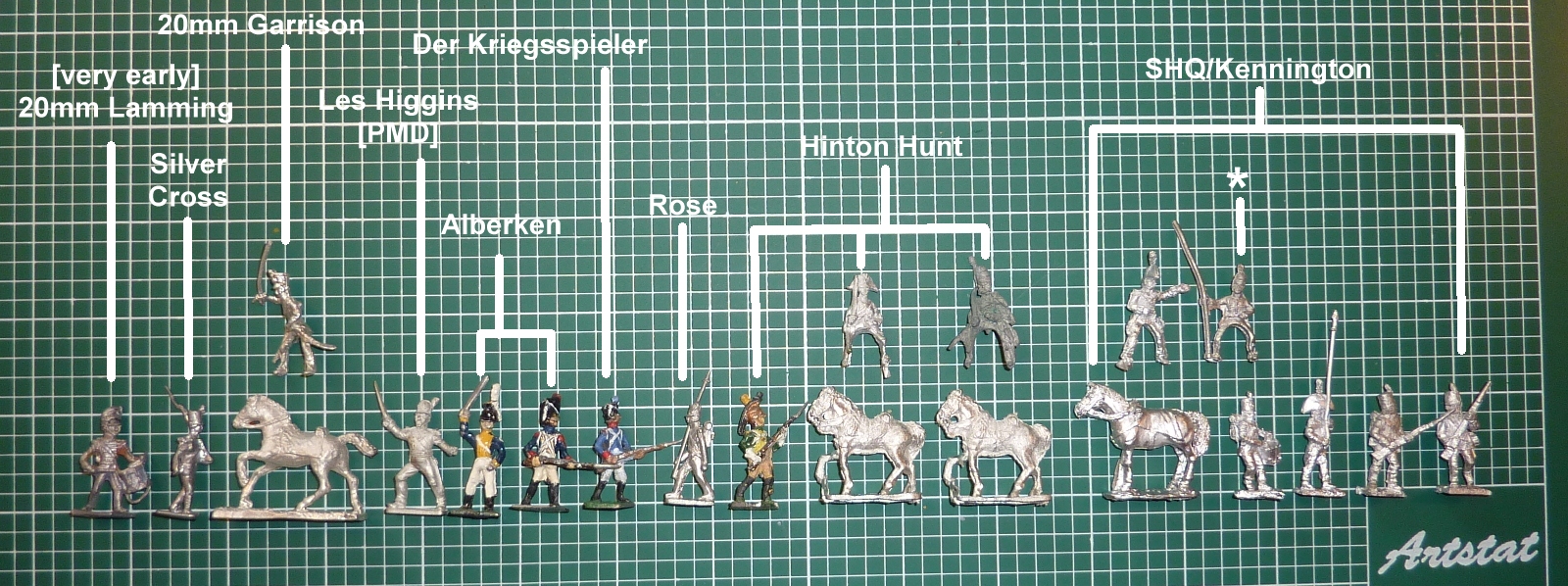
20mm Figure Comparison - vintage Napoleonic figures vs SHQ

Mark emailed me on the subject of size compatibility of various 20mm and "true 25mm" figures, so I have knocked up another of those strange green comparison photos. Since I often get involved in this kind of conversation (and since my view is as subjective as everyone else's!) I thought the pic might be of wider interest.


The particular thread in my correspondence with Mark has been how successfully SHQ/Kennington figures might blend in with (for example) Hinton Hunt. As the photo shows, I think, they match pretty well, though you have to beware of the occasional midget, such as the Spanish hussar marked with an asterisk - for some reason I never understood, all the Kennington Spanish Napoleonics are a bit small.

Sunday, 12 November 2017

A Couple of Follow-Ups... old figures, old scales

Today's post is a bit of a quick revisit of a couple of recent topics. If there is a common theme, then it might be the subject of "the way we were", which will hardly be a first for this blog.

Old figures, old magazines - must get a cup of Horlicks...
First off, I received a very nice email from France, courtesy of Jean-Marc, which was sparked by the discussion of 5mm Minifigs troop blocks.

J-M included a reader's letter from the December 1983 issue of Military Modelling, contributed by Roger Styles, the main man at Heroics and Ros. Apart from the fact that he was obviously very close to the subject of very small figures, it is not lost on me that this letter is pretty much contemporary with the 1984 Claymore show which featured in my earlier post. It also emphasises my point that Peter Gouldesbrough's efforts to popularise the 5mm blocks were at a time when the blocks were OOP and - according to Mr Styles - 5mm as a scale was "moribund if not defunct".

I hand over to Jean-Marc at this point...


My [J-M's] remarks : 

1) I have never seen these 5mm blocks "in the flesh", only pics. But I have, in the past , looked for  them with determination.
2) As far as I know, the moulds are now in the US. [if they are, then one hopes they have the masters, because the moulds were shot to bits before the blocks went out of production - the problems of missing heads and generally unrecognisable artillery becoming major show-stoppers - MSF]
3) The 5mm blocks were produced in 1972. Heroics and Ros company was launched in 1973. 
4) By 1983 Roger Styles (owner and sculptor of H&R) considered that 5mm blocks had ceased to exist, a comment made in a letter to Military Modelling that I reproduce here.


MILITARY MODELLING DECEMBER 1983  (Readers' Despatch)

Question of scales    

Dear Sir,

We were most interested in Charles S. Grant's article on scales for wargame figures (Nov. 1983). Although we agree with his general remarks on 15mm and 25mm scales, we would like to correct some details about 1/300 scale.

There has been a tendency to call figures in this scale ''5mm''. This has its origin in the regimental blocks of figures which were produced by Miniature Figurines some 12 or more years ago. These have not been available, we believe, for some years.

The figures produced by Heroics and Ros have a different beginning. In the USA several firms began making model tanks some 15 or so years ago in a scale known as 1/285. In the UK, soon afterwards, model vehicles began to be made in '1/300 scale', The difference in the two scales is minimal, of course, and 1/300 was chosen because it is easy to understand and work to. One foot is almost exactly 300mm (304.8 actually), so that 1/300 scale means one millimetre on the model represents one foot in reality. Except in models of very large items indeed the fractional difference between 1/300 and 1/304.8 comes within an acceptable margin of error. Models of vehicles made in 1/285 are often considerably larger than those made in 1/300, but I am not aware of the reason for this.

Whilst several firms produced WW2 tanks in this scale, Heroics and Ros began to make figures of the same period to match. If 1 mm equals 1 foot, it follows that a model of a six foot man would be 6 mm in height. This is the scale that we have always worked to.

So when Mr Grant says ''5mm figures are very approximately 1/350 scale (although they are sometimes referred to as 1/300'' he is, we are sorry to say, confusing the issue more than somewhat. Our 6mm figures are very accurately 1/300 scale, as are our vehicles and equipments of all periods. The scale of 5mm is moribund if not defunct, and there is no-one working commercially in 1/350 scale to our knowledge. The wargaming hobby has been plagued by the scale problem since the early days. Terms such as''15mm''or ''25mm''are said to mean the height of a man from head to foot without equipment. Some men are indeed smaller than others, so variation in figure size is permissable, though this does not excuse the seven, eight and nine foot men that are often made in 15mm and 25mm scale. If figure makers adopted an accurate scale, as we have in 1/300, customers would know where they stand and each company's figures would presumably match, size for size all others.

Mr Grant brings up the point of painting 1/300 figures. He says ''painting is quick, there being little detail''. In fact our figures compare favourably for detail with larger scales, and have if anything, more detail than many 15mm figures. But painting is quick, not because the models cannot be made as colourful and striking as in other scales, but because there is less area of bare metal to cover. A whole unit of 1/300 figures may have less metal to be covered than one 25mm figure, and so takes less time to paint. Many of our customers paint them exquisitely, though, and take much trouble over them. As far as wargaming with the figures is concerned, there are no problems either for ''beginners'' or for old-timers. Conventional rules can be used by simply quartering all ground scales. The figures can even be based on single figure bases for Micro-Skirmish games. But the small scale allows enormous advantages on full-size tables. Unit sizes can be increased to give more realism, and units can be manoeuvred without falling off the edge of the table so often. I should point out that 1/300 scale is the choice of many wargamers, and they have been in existence as long as 25mm, and much longer than 15mm, and are still expanding into new periods.

R. B. Styles, Heroics, & Ros Figures.


Apart from the fact that his letter is an unashamed plug for his figures (and quite rightly so), Mr Styles is in some danger of getting us all back into the eternal "how tall is a man?" and "height or soles-to-eyes?" debates, which in turn will get us back into the traditions of the German flats industry and all points south. J-M mentions in passing that Styles is wrong about the existence of 1/350 as a viable scale, since Helmet Products made 1/350 aircraft from about 1975 - some visible here.

The important point (if there is one) is that the letter gives a manufacturer's view of scales from the same period as the Claymore show I referred to.

Since I am nothing if not persistent (or, alternatively, since I am a relentless bore when I feel the urge), I have come up with the original article by Charles S Grant, from the November 1983 issue. It seemed that it must have said something fairly controversial, judging from Mr Styles' response. So here it is - in fact it is pretty bland (with all due respect) - it also reminds me, now I come to think of it, why I stopped reading Military Modelling a couple of years before this - too many interests covered too thinly, too much vanilla, too much courtesy offered to the advertisers.


Still on the topic of very small men, I received an email from the Jolly Broom Man (who is also in France, as it happens), with some pictures of his 6mm Baccus ECW troops. I like them - they have a determined, jaunty look which is very pleasing - don't mess with these boys!


JBM was inspired by my guest picture of Steve Cooney's Hinton Hunt ECW cuirassiers to make the point that headswaps in 6mm scale are a daunting idea - though I'm sure someone has done it. In fact, if anyone has ever done it, I would suspect it might have been my good friend Lee, which gives me an excuse to show some old photos of his 6mm Baccus ECW troops, which have subsequently moved on to a new owner (and I, for one, miss them!).


To enlarge the view to 20mm, I was encouraged by Stryker to give a progress shot of the batch of vintage Der Kriegsspieler Napoleonic French infantry I am currently restoring. I am rarely embarrassed about publishing photos of my armies, but I produce these with some trepidation, since they are really just a recruitment exercise, and not really the sort of thing I would choose to expose to the risk of supportive criticism and the tender mercies of Dr Raul and assorted other worthies and reluctant friends of mine at a certain American-based miniature modelling forum whose name I am not fit to mention. Perhaps I shall be spared this time.

I am working on generating 5 line battalions from these old DK figures. These are heavily converted, old figures (certainly 12 or 13 years older than the magazine I have just been discussing), and the paint needs a bit of attention, to correct yellowed whites, faded reds and the general ravages of time and the spares boxes. I have still to source a full complement of command figures. I have retouched half of the fusiliers (who are now mounted on their bases, just to keep things tidy and organised), the other half of the fusiliers are in the official Next in Queue box, and the flankers are waiting for the next shift after that.

These photos may give an idea what is involved. Some of the chaps who have been finished are in the picture at the top of this posting. Some thoughts:

(1) Retouching is always - repeat always - more work than I think it's going to be, partly because I change my ideas on what I'm going to do once I see the effect of the new painted bits

(2) A half-batch of 30-odd fusiliers seems a lot when you're painting them, but they don't look like very many when you stick them on the bases!

The second half of the fusiliers are ready, in the Next in Queue box - scheduled
to start on Monday evening

The flankers and various command odd-bods are in one of the big store
boxes, along with the finished chaps, who don't cover much of the base area yet!

***** Late Edit *****

I received a rather apologetic email from Steve C, who supplied the big shipment of DKs, lamenting that he might have given me a huge amount of work to do to get them into shape; somewhat shamefaced, I've been re-reading my post, to check I hadn't accidentally been rude about them!

It is kind of Steve to get back in touch with me, but I have to emphasise (to him and everyone else) that I bought them knowing exactly what they were, am very pleased with them, and really wouldn't have started on the job if I hadn't thought they were worth the effort. I'm sorry that I sometimes express myself imprecisely - enthusiasm rather than malice! - and I shall attempt to be more careful in future. Thanks again Steve - no worries, mate!

********************


Friday, 17 February 2017

Scenery Scales - Quick Sanity Check...

Different period, same problem - the troops look OK with buildings in a slightly
compressed vertical scale, but the greatly compressed horizontal scale means that
they are always crammed into far too little space. 
While I was constructing my representation of Newcastle, on Wednesday, I observed that the number of towers on the contemporary map is far higher than in my simplified model. Of course, I would expect this, but my attention was caught by a comment in one of my books - it refers to the medieval walls being built in accordance with "best practice of the pre-gunpowder age" - in particular, adjacent towers should be within bowshot of each other, to provide adequate cover.

This reminded me that I had previously run a ruler over my "15mm" Vauban defensive pieces (different period, same idea, similar logic) and been delighted to observe that the lengths of the bastion faces, the straight walls and all that matched up well with the official best-practice numbers out of Chris Duffy's Fire & Stone, which is most convenient, yet a little puzzling in view of the fact that my wargames, like most people's, are a mish-mash of different scales. In short, I'm pleased it works out, but by rights it probably shouldn't, so I had another think about it. There is something conceptually different about grouping representative clusters of buildings into a given area (the area is correct, but the number of houses is not) and placing a wall or a gate (the wall, or the gate - there was only one) in its correct place.

Let's see now - my soldiers are roughly 1/72 scale - what in a more innocent age we used to refer to as "true 25mm" (a phrase as smug as it was meaningless). To help a little with the look of the thing, I use 15mm scale buildings - 15mm is about 1/100 scale, which is the old TT model railway gauge, so the buildings are deliberately undersized compared with the men, but the distortion in the vertical scale is not too bad, and the saving in footprint size (and cost of the buildings!) more than compensates. As I've said before, a small cluster of small houses, to me, looks more convincingly like a village than a single 1/72 scale building. Whatever, I am comfortable with it, though it doesn't suit everyone.

When we speak of scale distortions, of course, all this fades into insignificance against the appalling liberties we take with horizontal distances. My ground scale - the one against which my Vauban bits and my medieval fortifications all fit tolerably well - is one 7-inch hex represents 200 paces. A bit of finger-in-the-air rounding gets us to something like 1/900 scale. So I use 1/72 men, 1/100 buildings and a 1/900 ground scale. Hmmm.

I was looking at the PaperTerrain website, and they offer pdf files of groundplan templates for (for example) a Vauban fort. Scaled appropriately to make the heights fit with 15mm, these templates are massive compared with my little fortification models. This is not a surprise, really, but it always takes me aback when I see it. It's OK - I understand it - the models of town walls and bastions and so on are not the sort of objects you "cluster" to represent a more numerous group. There was a wall, and there was a bastion, and they were here, and they are expected to fit the map and the tabletop - the matter of how many towers, of course, is not quite the same thing, but to get some version of the town of Newcastle to sit sensibly in a realistic footprint requires some cheating. The walls are the right height for 15mm (1/100 - which is not too unreasonable for 1/72 scale toy soldiers), but they are the right length for 1/900 - and yet it looks all right. I am forced to assume that, by luck or accident, the manufacturers have used the same numbers as I do, and their compromise works for me. If I used proper, proportional 1/900 scale walls then the soldiers would be in danger of tripping over them, and that really would be laughable.

So I've thought about it, yet again, and it works out all right - yet again. I knew it would, yet it is reassuring. I'll have to remember to check it all again in a few weeks. We all need all the reassurance we can get.

***************************

Late Edit, following Archduke Piccolo's comment:


This is an alternative map, an extract from a sketch plan prepared by Sir Jacob Astley in 1639. I have reproduced this by photographing it from Charles Sanford Terry's The Life and Campaigns of Alexander Leslie - a book which I have enjoyed immensely and which I was terrified I would wreck if I opened it wide enough to put it on the scanner! It shows the suburbs outside the Newgate and Pilgrim Street Gate, and also at Sandgate on the river, and gives a fascinating key to how it was proposed to place the artillery to defend the place. Note that Astley's 1000 foot scale is a bit different from the 200 pace scale shown in the William Mathew map I included in my previous post. I do not claim that one map is more accurate than the other - Mathew's is derived from John Speed's map, while Astley was the man who had to prepare Newcastle for defence against the Scots during the Bishop's War(s).

Sunday, 4 September 2016

ECW - Guest Spot...

Steve Cooney very kindly sent me a note with some more pictures of his ECW troops, focusing on conversions. As far as I am concerned, this is a key topic, since the illustrations show a mixture of 20mm Hinton Hunt and Les Higgins cavalry figures (of which I use quite a few), and Steve explains the steps he has taken to improve the compatibility of these two makes.

Steve writes:

"...thought you might like to see some figures I tidied up recently....

They are Les Higgins and Hinton Hunt ECW Royalist and Parliamentarian Cavalry, I have attached a couple of photos. I snip the joints between the base and the horses forelegs on the Higgins figures, raise the front of the horse, and re-solder it so that the finished figure is slightly higher than it was originally.  

That way the Les Higgins figures are very compatible with the Hinton Hunt figures and are lovely models in their own right.

Hope you like them."


Thanks Steve - informative and inspirational!

Saturday, 21 March 2015

New Napoleonic Spanish Cavalry - Size Comparison

At the request of Mr L Gunner, here's a quick comparison. My new Foy Figures men are made to 1/72, so are a tad larger than Hinton Hunt (which are not). As enthusiasts for plastic will testify, "1/72" is not an exact global standard either, but these fellows will all serve happily alongside each other in my army, so as far as I'm concerned they are near-enough compatible.

L to R: NapoleoN, Foy/Hagen, Hinton Hunt x 2, Falcata x 2

Hinton Hunt horses a bit shorter in the wheelbase, but that's normal

Links to the Hagen shop are in the previous post.


Saturday, 15 February 2014

The Scales of Injustice? – figure sizes, yet again


This is going to get me dangerously close to obscure worlds such as railway modelling, of which I know nothing, and where I am likely to get slapped down mightily if I use the wrong terminology, or offend the international standards (whether they are universally obeyed or not).

I’ve always been puzzled by the mapping of modelling scales like 20mm, 25mm, 28mm, 40mm and so on against  the more intuitively scientific (and understandable) concepts like 1/72, 1/64, 1/300 and similar. I have moaned on about this at some length before, so will try not to waste too much time going over the same ground.

Basic problem is that figure manufacturers call visibly unequal figure scales by the same name. If we discount the possibility of different sized millimetres being in use simultaneously (although it might happen), the matter boils down to

(a) which bit of the man do you measure? – there are disciples of soles-to-scalp (i.e. how high is a figure), sole-to-eye (which sounds like a convention, but which generates a lot of passionate support – most of the lectures I get from the bearers of wisdom seem to follow this doctrine) and even bottom-of-base-to-eye (which just seems plain daft).

(b) (and this makes a bit of a nonsense of (a)) how tall is this man anyway?  

In response to a previous post, I was directed to this diagram from Jack Scruby, no less, which would appear to be authoritative unless you happen to disagree with it.


What has brought this to mind of late is that I have been involved in purchasing and studying some of the old Hinchliffe 20mm equipment range – the non-WW2 bits of which vanished without trace many years ago. It says on the packet that these are manufactured to a scale of 4mm to the foot, which is near enough 1/76 scale, which is the OO model railway scale. I’m not sure, but I think this scale is widely used for WW2 models. 4mm to the foot would make a 6-foot man 24mm tall, and a 5-foot man 20mm, so where does the “20mm” nomenclature come in?

As far as Hinchliffe are/were concerned, I also have some of their 25mm artillery range, and in there is an information sheet, which explains that their 25mm range uses a scale of 4.75mm to a foot (which I reckon is 1/64), and goes on to state that the human figures in this range are designed to represent men 5 foot 8 inches tall, which means that (assuming Hinchliffe’s manufacturing standards complied with their own house rules), those strange ectomorphic soldiers that turned the wargaming market upside down in the early 1970s must have been 27mm from sole to scalp. Does this mean 25mm to the eye? – whatever it means, this is the official lowdown on how Hinchliffe interpreted “25mm”, and we know for a fact that this is different from what Miniature Figurines and Les Higgins were doing. The information sheet I have, by the way, appears to date from September 1971 – I’m not sure if it is still the same sheet which goes out with the 25mm equipment today – this range, of course, is still in production.


OK – back to Hinchliffe’s 1/76 “20mm” men – assuming the same logic applied, a 5 foot 8 man would be around 22.5mm tall – which is consistent with Hinton Hunt and current Kennington figures – would he be 20mm to the eye? Could it be that the eye-measurers have been right all along?

I don’t buy many plastics – I’m not at all hostile to them, but I have grown accustomed to not buying them, to being concerned about paint-shedding, and discouraged by the proportion of useable wargame poses in a box, considering these are no longer the pocket-money option they once were. At this point someone may feel urged to miss the point of my post, and put me straight about the merits of plastics – please don’t bother – I’ll take your word for it. Honestly, I will.

The relevance of plastic figures here is that 1/72 is the universal standard – how well it is observed and how the manufacturers compare is not the point. No-one can argue about what 1/72 means in mathematical terms, and thus, over the years, I have got used to regarding my Napoleonic collection as being “approximately 1/72” – some  of my figures are described by the makers as 20mm (Hinton Hunt, Kennington, early Lammings, early Garrison, very early Minifigs), some of them are old 25mm (Higgins, Scruby, some S-Range), from before the world got bigger, and some of them are explicitly 1/72 (NapoleoN, Falcata and Art Miniaturen). My in-house rule is that if the hats match, they are the same size. Ideally, my chaps should be around 22-23mm tall (without headgear), though a taller man might be OK if his hat looks right!

25mm Soldiers, as purveyed by Hinchliffe (L) and Scruby
I have now confirmed that the much sought-after 1/76 Hinchliffe artillery are a tad underscale for plastic figures, while their 1/64 cousins are visibly too big. Confusingly, considering the precision which went into the research and sculpting, Hinton Hunt artillery appear to be even smaller than the Hinch 20s, so maybe there was an internal inconsistency there too.

I’ve always tended to avoid Newline 20mm figures – too small for me, though they are lovely – I have no idea what the official scale is, but I have it on good authority that some of their artillery pieces are a good fit with Hinton Hunt, for example, which is useful, but, again, a bit confusing. RSM and Irregular have an even smaller interpretation of 20mm, but at this point I am getting well outside my area of knowledge.

It looks as though my target Napoleonic recruit is somewhere in a ball park between 1/72 and 1/76, with guns and wagons to match. And the devil take the decimal places.

Wednesday, 7 November 2012

ECW - How big is an inch, Jack?


I had a hard day yesterday – it doesn’t matter why. Honest toil is a fine thing, I’ve just got out of the habit, but one consequence is that today I’m taking it easier, and am less focused than usual.

Thus I shall start – fleetingly – with a digression [now there’s a surprise]. This is what I was thinking of writing about today, but when I looked into the matter I decided against it. My mum recently heard (or watched?) a BBC programme commemorating the fighting in Libya in WW2, and El Alamein, Tobruk – all that. At one point, they were interviewing an elderly veteran, and they asked him, what was the most frightening thing he remembered from the war in the desert?

Spiders, he said. Camel Spiders were the most terrifying thing he experienced there – all the soldiers lived in fear of them. When my mother mentioned this, I had an idea that it might make an appropriate post, with a back reference to my previous Hooptedoodle on the adventures of Max Spinnejäger, my bold, spider-killing alter ego. However, when Mme la Comtesse and I checked Camel Spiders on Google, we were forced to run around the house for a little while, screaming and waving our arms. If you wish to look them up, please feel free to do so, but do not tell me about them. I wish to know no more of the subject. Mighty Max S has just retired to a sealed rest home, as far from Libya as possible.

Jack Scruby

To the main topic, then. I have already bounced this off a few of my usual expert sources, but none of them could help, so this is a general appeal to anyone who has any useful ideas.

Recently I have been interested in obtaining 20mm figures for billmen, clubmen - peasant hooligans, really – for my ECW armies. I’ve had some good suggestions, involving converting plastic figures, or converting Les Higgins artillery figures, and I also have an interesting sample figure, a militia pikeman  from Tumbling Dice, which is (to be fussy about it) a little chubby for a perfect match with the rest of my chaps, but still worth serious consideration.

Thereby, you see, hangs the problem. My 20mm ECW figures are quite small – mostly Les Higgins and Hinton Hunt, with some SHQ in the mix, they are too small to combine comfortably with Art Miniaturen, or the forthcoming Falcata 30YW figures, or even with 1/72 scale plastics. My figures, I guess, must be smaller than 1/72.

So I spent a little time looking at the possibilities of borrowing figures from other periods, or from makers I hadn’t considered. And I thought of Scruby.

I checked out Historifigs catalogue online, and I see that the Scruby Thirty Years War range (which might be just what I’m interested in, and which is still in production) are described as “1 inch” scale. There is an interesting article by Jack Scruby himself on the website at Historifigs, in which he describes how he came to re-issue the 30YW range in this scale, the implication being that they came from an earlier period.

I could take this literally, and assume – since 1 inch is almost exactly 25mm – that these are the same as Scruby’s 25mm, which (as everyone knows) are about the same size as Hinton Hunt’s 20mm. Interesting. That would fit. On the other hand, 1 inch might mean something different.

If, at this point, anyone feels moved to send a comment about the correct way of measuring a wargames miniature, then please don’t bother. I appreciate the thought, but I tend to fall asleep while such explanations are going on. The only criterion which matters is, do they look good alongside other figures which they are to be used with? I don’t care whether we should measure a miniature soldier from the toenail to the eye socket, or to the scalp, or to the bookshelf behind him. Accuracy, like beauty, is in the eye of the beholder.

So what I’d really like to know is, does anyone have any experience of Scruby’s 1” 30YW figures? Anyone actually got any? How big are they? How big is an inch, in fact? As a general guide, anything which is a little smaller than plastic 1/72 would be in the ball park. I could, of course, order some samples from Historifigs – in fact I probably will – but I thought someone might have been down this road before. I don’t think any other range in Historifigs’ very large catalogue is advertised as 1 inch. I am intrigued.

But don’t mention spiders. I don’t dig spiders, man.


Paul Glickman's take on the Stan Freberg take on the classic 1950s hit.


Late Edit: many thanks to Ross for a very useful link to the Historifigs site, which shows this extract from the 1968 Scruby catalog. This seems to indicate that 1-inch figures are somewhere between the  25mm and 30mm ranges in size. If the drawing is to scale, it suggests that Scruby had a house standard inch measuring about 28mm, which was an astonishing piece of foresight, and is similar to the conversion ratio used by my local hardware store, as  discussed in my recent blog post on Hardboard.

From 1968 Scruby catalog (thanks to Historifigs)

Tuesday, 14 February 2012

ECW 20mm - Another Figure Comparison


I've now received figure samples from SHQ (Kennington) for their 20mm ECW range, and I like them. They are somewhat chunkier in stature than Les Higgins or Hinton Hunt, but the height is pretty close, and (very importantly!) the horses and the hats match the other two ranges.

The logic may seem a bit oblique, but the more compatible ranges I can find, the happier I am with my choice of Higgins as the main basis of my proposed armies. I have spent too many of my Napoleonic years backed into corners, stuck with little or no choice, and dependant on a small number of extinct manufacturers! Choices are good for covering gaps in ranges, and for maintaining welcome variety and interest in the armies.

Thus far, I reckon that SHQ, LH and HH cavalry can mix without problem. LH and HH infantry can mix pretty well, and SHQ infantry would be OK on the same table, though maybe better in separate units - in truth, it appears to vary between individual figures, so a bit of judgement will be needed (uh-oh, that might be a problem...)

So? Pleased with what I've found so far - all I need now is to firm up my ideas on unit organisation and basing, to work out quantities and shopping lists, and I'm in business. Well, sort of.

Monday, 6 February 2012

ECW 20mm Figure Comparison


Here are figures from Irregular (their Restoration range), Hinton Hunt and Les Higgins. The figure marked with a carat on the right hand end is one of the first batch of LH officers, which are smaller.

Hinton Hunt probably very slightly larger than Higgins, but the hats and horses match - near enough for me, I think.

Wednesday, 16 November 2011

Falcata - size comparison

Ian sent a comment, and I've had a couple of emails from people wondering how Falcata's idea of 1/72 scale or 20mm lines up with other makers.

I cannot speak with any authority on the new figures, since I haven't seen them, but it is pretty clear from the yellow-coated dragoon figure in the pics in the last post that his horse is very recognisably one of the previous lot of Falcata horses - so I guess they are the same size as they were. In fact, I would guess that any sets of figures which match the old 34-in-a-box sets will be from the same masters - e.g. Spanish line infantry in bicornes.


Here's a size line-up from my Cupboard - from left to right are some Falcata French infantry (from the old series - presumably the same size), some Hinton Hunt Cacadores and some Les Higgins riflemen. On checking the picture again, I think the officer in the second row on the extreme left is Kennington, so there are more types in here than I intended! Falcata are maybe a tad bigger, but they stand on pretty chunky bases, so some thinner MDF would square things up a bit.

I'm quite interested in what has been announced thus far - particularly the cavalry - but my real interest is in the militia, guerrilleros (quite a few different regional types), generals and "personality" figures which appear to be in the pipeline. It would be a big help to us poor customers of dinosaur banks if La Flecha Negra could take PayPal. If anyone successfully obtains some of these new figures, please let me know how you get on - severe shipping costs are sometimes a problem to the UK from Spain (viz Hobbies Guinea).

Wednesday, 26 October 2011

Qualiticast - Size Comparison


I find myself a bit hot-&-cold on the subject of Qualiticast. Sometimes I am very enthusiastic, then I'm not so sure. No doubt about the lovely sculpting or the casting (unsurpassed in 20mm, in my experience) - the figures are little treasures, but the sizes can be a problem for me. Some figures I have obtained - especially cavalry - are a bit small to match my armies. In particular, the hats on some examples are small, and this is always a favourite hobbyhorse of mine when it comes to judging size compatibility. At other times they are perfect for my (23-24mm man-size) armies, and I am left none the wiser.

Recently I was so impressed by a load of Qualiticast British riflemen that I was moved to add a 3rd battalion of the 95th to my British army. This is certainly 1, and possibly 2 battalions more than I ever intended to have. The Qualiticast boys will form a battalion of their own because, though they will be fine alongside Higgins and Hinton Hunt figures in adjacent units, the Rifles figures are just a bit small to mix completely comfortably with other brands within the same unit.

On the other hand, the "Qually" (invent your own jargon) Spanish guerillas I have are an excellent match for my other troops - no problem at all. The mystery lingers.

Today I received a couple of Qualiticast French light infantry command figures via eBay (which, you may recall, I do not do any more), and I've provided a side-by-side comparison scan with a Les Higgins figure in the middle. Perfect - they will mix without any problems, and will accordingly go to the painter so mixed.

I am obviously happy about this, and am left to accept that figures will have to be judged individually. As I have said before, real armies contained big men and small men, but the big men were not equipped with bigger hats or longer muskets!

Wednesday, 22 June 2011

Corpulence in Wargames

A neglected theme, which is maybe a surprise given the average physical condition of the attendees of the last wargames convention I visited. Maybe we need rules to cover the fact that the second battalion are too out of breath to get up that hill in one move, or that the cuirassiers' horses are struggling to cope with the load?


This officer came to me via eBay, in a rather nice battalion of Minifigs S-Range "Valencia Light Infantry", which were in good enough condition to form the Ligero del Reino de Valencia in my volunteer/militia brigade with very little extra work. The officer illustrated is clearly the correct one for the unit, but is from MF's current range. I rejected him - he does not get a gig in my army, sorry. This is not because I am prejudiced against the circumferentially challenged - not in the slightest - but because he simply doesn't look right among my other troops. If you have a wargame army consisting entirely of Minifigs' current products then I'm sure they look splendid, but out of that context this guy is awful. He isn't going to do a lot of brisk skirmishing, or even retreating at the double quick, is he? You can't tell me this chap has been existing on campaign rations.

Monday, 1 November 2010

Kennington


Unusually among the figure manufacturers I have featured in this series, Kennington are still in business. The figures are available in packs from SHQ, and they are inexpensive and have a very decent range. They are at the smaller end of the size range I can use - maybe 22mm average height - but have acceptable proportions, apart from a tendency to big hands(!) and tiny bases. Hands apart, they are a good size match for Hinton Hunt, for example.


I like them - I don't have many complete Kennington units, but they are an excellent source of command figures. I decided quite late in my collecting career to add mounted colonels to most of the infantry units, and Kennington have been very useful, especially for the French. They make a little French infantry colonel on a rather tubby horse who is a pleasing little character, complete with bristling moustache - I have a lot of these. Kennington are also the only 20mm source of rarities such as proper flank-company Highland skirmishers - their range is certainly worth checking out.


French light infantry - these are pro-painted, as you can probably tell.


Nassau infantry (the colonel is a mixture of bits - Minifigs horse, Art Miniaturen figure with an old Garrison head).


Portuguese artillery - the howitzers are by Scruby.

Saturday, 9 October 2010

Lamming

Lamming are one of the great figure makers from the classic 1960s-70s period, so, if this seems like an inappropriately sketchy treatment of them, it is entirely because I have never really bought much of their stuff.


Lamming British infantry, with giant mounted colonel and Minifigs ensigns

For one thing, rightly or wrongly, I always regarded them as specialists in medieval subjects. For another, my local shop (Archie Alexander's Toytub in Edinburgh) didn't stock Lamming - certainly they didn't do the Napoleonics, so it wasn't untill the eBay Age that I got to see any. For a sensible presentation of Lamming's output, visit VINTAGE20MIL or The Old Metal Detector - this is just going to be a peek through the keyhole, which about sums up my experience of this manufacturer.

For reasons which I can't quite put my finger on, I subconsciously group Lamming with Garrison. Apart from the fact that I actually had some Garrison figures about 30 years before I had any Lamming (though they were roughly contemporary in anyone else's real world), there is the scale creep thing which was quite similar for both. Later Garrisons, from about 1975 on, got bigger and bigger, presumably to cope with the general inflation of the Wargame Millimetre, as 25mm came to mean something entirely different. Lamming appear to have done the same thing, only their later figures got fatter as well (there is a nice pictorial demonstration of this aspect of Lamming's history in Lazy-Limey's blog). I tend to avoid the two makes, not because there is anything fundamentally wrong with them, but because I don't understand the ranges well enough to be able to predict whether a specific model is going to be of a suitable size. I have made a few blunders on eBay.


53rd Foot, with ensigns and mounted officer by Art Miniaturen

I like Lamming's very early 25mm Napoleonics - the French have hats which are too big for me, but the advancing British infantryman is a nice little, ectomorphic figure which stands nicely alongside Les Higgins men in stature. I have, I think, 3 battalions of these chaps. I don't care much for the very tall standing officer that goes with them, but the drummer is fine, and it seems right to keep them together where possible. Right from the outset, there is a recognisable facial style - thin faces with high cheekbones. As time passed, this family characteristic (because they are clearly all related) developed into the full, and very distinctive, "Easter Island" look. My cousin used to say that the early figures reminded him of the Treens, from the Dan Dare stories in the old Eagle comic - it goes without saying that my cousin must have been far, far older than me.


Apart from the infantry, I once had a (now rare) mounted officer to go with them, but he was far too big, and a couple of batteries of RHA, which were very nice but so obviously different from everything else I had that I sold them on.


That's about all for Lamming, really - I very much like the look of their cavalry (nice horses!), but fear of the unknown and my eBay experiences have prevented any closer acquaintance - thus far, anyway.

Friday, 8 October 2010

Size Comparison


Since I was asked, here's some size comparisons - from left to right, in each picture, Les Higgins/PMD, NapoleoN, Hinton Hunt.


I have to say that the NapoleoN infantry are bigger than the HH by more than I thought - I think the British infantry may be a bit taller than some others in the range.

Sunday, 26 September 2010

Minifigs


Miniature Figurines. As long as I’ve been involved in wargaming, they’ve been around. Trying to say anything about Miniature Figurines Ltd is a bit like trying to say something significant about the Ford Motor Co – mostly, it’s been said before. They have frequently been on the receiving end of criticism, their products are not usually regarded as shining examples of anything in particular, and they are generally an easy target for abuse.

The one thing they certainly do not get is a fair show of respect. MF have, in their unspectacular way, put miniatures wargaming within the grasp of anyone who became interested during the last 40-something years. Whatever your likes and dislikes, they are a major part of the history of the hobby. If you take a look at the current movement of wargame figures on eBay, you get a feel for how they have dominated the market for years. In the periods and scales which interest me, I reckon that some 75% of current eBay listings are for Minifigs, and more than half of those are from the current ranges of figures, which have survived pretty much unchanged for 30 years.

My start in the hobby was too late for the early 20mm figures; S-Range was what they were selling at that time. They were readily available in local model shops, the range was vast, the quality of the castings, somehow, was always pretty good, and - if you liked them - they represented good value for money. Unusually, in a hobby full of suppliers who were enthusiasts and well-intentioned dreamers, they were always commercially sound - good marketing, good supply to the retailers, and constantly aware (and supportive) of trends and fashions in wargaming.


I confess that I really cannot understand the early history of the marque - which figures were Alberken, which were the figures which got them into trouble with Hinton Hunt - all that stuff - too complicated for me. You can get good background from VINTAGE20MIL, from the Old Metal Detector and related blogs, and from Lazey-Limey - there are areas of debate, but that is where to look. I prefer to group them under the general heading of “20mm”. The earliest such figures appear to have been a bit crude , but they very quickly became very similar in style and quality to Hintons. I am especially taken by their OPC 20mm generals and personalities.


By the time I started wargaming, this was all in the past, and they had moved onto the famous S-Range. These are regarded with a deal of affection by collectors. They have a style of their own, deliberately different from HH. The proportions of the figures are distinctive – slightly-built men with rather short, slim legs, and a tendency for oversized hats, plumes, swords, bayonets. The French troops in particular have coal-scuttle sized shakos. The S-Range generals are nice figures - I have a few. I also have a good number of French infantry officers, eagle bearers and drummers, with Higgins heads grafted on. I even still have in my collection a throwback to the days when no-one made French Line Horse Artillery (well, HH did, but I'd given up on them some time earlier) - I made up a crew from MF French infantry officers, gave them Higgins heads and PMD artillery implements - you may shed a gentle tear at the thought of my cutting up PMD horse artillery figures to provide parts for MF hybrids... Whatever, I still have them - I'm fond of them, and have kept them long after I cleared out some of their contemporaries.


Recently, I developed a considerable appetite for Spanish infantry, SN1s – no-one else apart from Hinton Hunt (undersize) and Warrior (oversize) makes 1812-style Spaniards in British-type uniforms. I have a number of units of S-Range Spaniards now, but am always keeping a wary eye open for more.


After the S-Range came what I call “Intermediates”. Some of these are very nice – I have a number of British infantry units, and most of my British artillery are from this range. I still had a problem with the big hats on the French troops, so always avoided them or re-headed them. I also have a unit of British dragoons with saddles attached to the riders – they are still with me after all these years, ao I guess I must like them.


And then, as lamented elsewhere, in 1978 or so the figures became bigger, fatter, and mostly I lost interest. Still nicely manufactured, and they were always friendly and helpful people to deal with – I have no personal experience of the new owners, but have heard good reports of them, too, so that tradition appears to have been maintained.


The real parting of the ways occurred for me when I was putting together a Brunswick-Oels battalion in polrock coats, suitable for 1808-9. I had seen a very nice Minifigs unit of exactly the sort I was looking for, and ordered them up from my hobby shop. When they arrived, the officer and the drummer were lovely, but the rank and file had been remastered in the then new “chunky” style, and I was really very shaken by their appearance. These guys were as wide as they were high – nicely engineered and manufactured, but grotesque. Gnomes. If I had had a firm making miniature soldiers, and my master-maker had approached me with prototype figures like these, I think I would have asked him to go back and try again – and to drink less coffee.


Whatever, I choose not to use MF’s current ranges – they do not match my armies, which is really the only thing that matters. I know for a fact that there are huge numbers of wargamers out there whose armies consist entirely of exactly this range, and I’m certain they look marvellous, but for me you can’t mix them.

Respect, though. Fair enough.