Napoleonic & ECW wargaming, with a load of old Hooptedoodle on this & that


Showing posts with label Artillery. Show all posts

Sunday, 27 February 2022

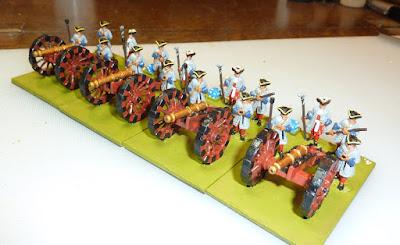
WSS: French Field Artillery

 This weekend I've finished the French artillery for my WSS Project.

Once again, the flash on my camera gives the pictures a bluish tinge, but you get the idea. These are Irregular gunners, and the guns themselves are by Lancer Miniatures.


More troops in the pipeline - infantry waiting to be varnished and based. Watch this space!

Sunday, 23 January 2022

Sieges: Getting Organised (a Bit...)

 For a while I've been intending to take advantage of the strange world of Covid limitations and do some solo work on getting the hang of Vauban's Wars. Siege games are, by definition, very dependant on all sorts of fancy scenery and hardware, and it is always very easy to find assorted reasons why this is not the ideal time to have a go. Well, that's long enough.

I now plan to have a solo bash at a Napoleonic siege game, so I'm scratching around trying to collect all the bits and pieces I need. Some of this is trivial work, to be honest, it's just a question of getting down to it.

Today I have a case in point. The starting set-up for my proposed training game requires the British to have a couple of heavy mortars. Now I have odd bits of artillery around the place, and I have some spare soldiers, so it was a simple matter to put together the required mortar battery from some old Hinton Hunt gunners and a couple of very scruffy Hinchliffe mortars I got as a make-weight in an eBay parcel. Here they are - not beautiful, but absolutely fine - cross them off the to-do list. Ready for duty.


There is a new approach evident here - previously I put a lot of effort into making up smart siege trains for the French and the British in the Peninsula. I now also have pieces for a proposed Spanish train, including some fortress guns, and I'm starting to collect items for WSS sieges. My new approach is that I shall paint the ordnance pieces in nondescript colours wherever possible, and make up crews of various nations who can "borrow" spare kit as needed. This is the first such - the scabrous mortars here are simply BluTacked onto the bases, so they can be loaned out to another army, in a different period if required, or they can even be replaced by more beautiful examples if the dreaded Creeping Elegance ever catches up with my siege projects.

Anyway, enough said. I retouched and based these chaps (ex Eric Knowles gunners, by the way) while listening to the Crystal Palace vs Liverpool game on the radio. Easy peasy. The British now have siege cannons, mortars (both heavy and Coehorn), various howitzers and sappers. I even have some new, specially sized and based units of foot, rescued from spares boxes for duty on sieges. And still the wonder grew.

I'll put some notes here on the starting set-up for my Vauban's Wars solo game in a day or two.

Thursday, 11 November 2021

WSS: British Artillery Finished

 These chaps had been hanging around unpainted for a while, but my British Artillery is now complete (for Phase One, that is). I always find artillery slow and fiddly to paint up - lots of odd pieces of equipment and inconvenient poses - but I took a couple of late sessions over these and here they are. Last night, respecting the lateness of the hour, my painting music was an album of harp concertos performed by Marisa Robles, so I may always associate these fellows with some delicate and tinkly noises - maybe a little incongruous for the Ordnance Men? Suitable Artillery Music suggestions welcome...


The figures and the guns are by Irregular. I find their 20mm products useful, since they are about the only Marlburian range which will mix at all well with my Les Higgins armies, they provide a useful touch of variety, and often they are the only source of certain things. From a compatibility point of view, I wish their horses were just a little bigger, but a number of their horses will soon come into their own for mounting my French dragoons - at last the differential horse sizes will come in useful!

My new gunners are appropriately bright, shiny and toy-like - such are the rules for this project! I have to say that sometimes the Irregular chaps look a bit sketchy at the outset, but they invariably paint up well. Very useful, anyway. I can also use Lancer's artillery pieces and carts, which are very nice, but definitely not their 20mm figures.

Still on the bottle-tops are Webb's Regt of Foot, a refurb batch - they should be ready Saturday or Sunday; no particular hurry, I tell myself. Getting there. By Jove - getting there.

Saturday, 22 May 2021

WSS: Some British Guns

 I've been working away at a mixed batch of WSS painting - British artillery and horse, all new figures. I picked this because it made a nice-sized piece of work, and made a welcome change from my last job, which was a big Napoleonic refurb batch. On that job, at one stage, I had two days of white paint, followed by a day of black, so I promised myself a mixed batch next. Seemed a good idea.

And so it was - except that the sequence of paint colours is different for the artillery and the horse, which makes the work a bit fiddly, and - more seriously! - I ran out of space on my wet palette because of the number of colours. Accordingly, yesterday, when I was very nearly finished the whole lot, I put the cavalry in a box of their own, and set about finishing off the artillery bases.

They still need their magnetic sheet for the bases, but here they are.

 
Three battalion guns - the gunners are by Les Higgins (circa 1970), the galloper guns by Irregular Miniatures. Under my rules, battalion guns are attached to those infantry units which have them, so these little bases are really markers rather than units in their own right

 
A field gun and crew - this time, all castings are by Irregular. There will be another two of these to accompany Marlborough's lads in action. Coming along soon. [The Irregular gunners are very slightly shorter and chunkier than the Higgins, but they are fine - I may choose to keep them in separate units as a house standard. In the mounted arm I mix Irregular command with Higgins troopers rather more freely, but my use of Higgins horses throughout helps a lot with the scale compatibility.]

 All being well, I should get the unit of horse finished by tomorrow, so they will be appearing shortly. One thing I have to sort out (now I think about it) is my printer - the cyan print-head appears to be playing up, so I'll get that fixed (i.e. I'll ask the printer to heal itself) so that I can print off a flag for them. The unit, when it appears, will be the Queen Dowager's Regiment (also known as Hugh Wyndham's Horse).


Friday, 21 August 2020

WSS: Cheap & Cheerful - "Limbered" Markers

 It became obvious during my recent playtest session for my WSS rules that something needed to be done about artillery limbers - there aren't any in the game, and my batteries (unusually for me) each consist of only a single gun. I had thought in general terms that I could merely place the gun back to front and that meant it was limbered up. Certainly I have no appetite at all for building proper limber teams, but the back-to-front convention proves to be untrustworthy, and it looks daft anyway.

So I've come up with a cheap, easy solution; there are now markers which can be placed next to the gun when it is limbered up - the gun has to be reversed, so that the trail is towards the horses, but it is now obvious what is going on, and in which direction the contraption is travelling. 

At first I thought, "Oh gosh, I'm going to have to get proper limbers, in 20mm scale, and that means they will have to be painted correctly for each nation - oooh - etc etc". Further, since cannon in the early 1700s each weighed about as much as your average Gothic cathedral, a proper limber team would need enormous numbers of horses, and I really was beginning to hate the whole idea. Amongst the spare figures I have from the Eric Knowles Hoard, there are a decent number of suitable draught horses, so my wizard wheeze was that a simple pair of horses, on a separate base, could be stood next to a gun, and that would suffice. 

Next I went through a tense couple of hours while I decided whether I could be bothered making up some drivers to look after these teams. There is a very useful Hinton Hunt ECW gun crew member who isn't actually doing anything, and I have some of these, so I decided I could hack a few heads off, replace with Irregular tricorn heads, and so on. Again, the job was getting fiddly. So I went back into the Spares Boxes and found enough odd artillery figures to fill the bill. I chose figures armed with sticks or poles of some sort - to encourage the cuddies. Already painted (thank you, Eric), all they and the horses needed was a bath, some gloss varnish and a nice new base - the aim, by now, was to have generic counters which would do for anyone. The driver, of course, may be dressed in any old uniform, but I don't care. The reasoning is:

(1) the artillery train and drivers were mostly civilians, so the driver may be wearing some unknown livery used by the contractor, or may be a soldier helping out, or may be wearing captured clothing, or anything, really. It's only a bloody game, for goodness sake.

(2) the limber is there somewhere, you just can't see it. 

(3) if you hang around for a while, when the gun comes into action the counter will be removed and is unlikely to be seen again - this would be a sad fate for an 8-horse limber team painted to museum standard.

Anyway, the whole project took me about 3 hours and was entirely supplied by existing spare parts - I even used my standard 50x45 MDF bases, of which I have bags (literally). Job done. Scrooge McFoy Productions triumph again.

Here you go - a supply of generic "limbered" markers. Available to all-comers

And here's one in use, contracted to the Imperial Army - yes, that's correct, the unit is obviously travelling to the left; the gun crew like to watch to see where they've been


Sunday, 12 May 2019

Bavarians - Quick Succession

Yesterday I finished off a second Bavarian artillery unit, within a day or so of the first - clearly Bavarian artillery batteries, in the time-honoured traditions of the No.27 bus, travel around in widely-spaced pairs.

Kennington gunners, Franznap guns - Hauptmann Peters' battery
All ready to keep the Austrians off our terrace
Extra picture, included for anyone who is enthusiastic about waste-management systems
I'm pleased with this. This is a battery of Fuss-Artillerie, that of Hauptmann Peters, according to my official OOB, and they are equipped with a 12pdr and a howitzer. The figure castings are Kennington, and instantly recognisable as such, and the ordnance, as with the previous unit, are splendid little pieces by Franznap - correct Manson pattern and everything. I painted these chaps myself, as you may be able to tell (!). Kennington figures are businesslike and cheerful - this lot show a good attitude, though I am not sure about the officer. It could be that he is disappointed to find that he has been drafted into the artillery, since he had been intended for the infantry for a while, but he looks rugged enough. What's all this shouldered-sabre stuff, though? Is he intending to add some emphasis to his commands to the gunners, is he just posturing, or is he preparing for the enemy cavalry to come too close for canister shot?

In passing, I have read recently that Peter at SHQ, who sadly has some major health problems, is proposing to cut down his activities to concentrate on the core WW2 ranges, so the 20mm Kennington Napoleonics and ECW figures will be looking for a new owner. I certainly hope that goes well. Kennington figures are rather taken for granted, and seldom eulogised, in my experience, but they are good little sculpts, for the most part, they are cheaply and readily available (they have been absolutely invaluable to me in my constant search for 20mm figures over the last 15 years or so) and Peter and his colleagues offer a quick, friendly service. If they become unavailable - and I certainly hope they do not - I think we would (yet again) come to realise what we have lost. A familiar story?

Topic 2 - adventures with highwaymen

This one may ramble about a bit. Recently, Prof De Vries noted my references to Bob the Postie (our mailman), and wondered what had happened to Jamie the Postie - was he all right? Had he moved on to better things?

That's easily answered. Bob the Postie is, in fact, one and the same bloke as Jamie; he now wishes to be called Bob. No idea why - none of my business - perhaps his name is Jamie-Bob - who knows? We have known Bob for a long time now - when we first knew him (as Jamie) he must have been about 20, I guess. He did once blot his copybook by crashing into my wife's car, but that was a long time ago now, and we are friends again. He is cheerful, and reliable, and a good guy to have on our side.

Yesterday lunchtime I did remarkably well on the mailing front. The Bold Bob brought me packages from Uncle Tony Barr at ERM (who had performed heroics, despite the flu, in making me some custom-sized MDF bases, cut from his last-ever sheet of 3mm) and from Wonderland (the Edinburgh model-shop, who got some paint to me within 12 hours of my having ordered it online). The direct result of this fine service is that I managed to complete the Bavarian battery featured in the first part of this post. Really can't complain at all about that.

Less happily, I now realise that my shipment of posh new paint brushes from Cass Art has been committed to the tender mercies of Hermes, the infamous courier. Every day I am invited to refer to the continuing online tracking record for my parcel, which is, as usual, bullshit.

Let me say right away that I realise that the individual delivery drivers who work for Hermes are all self-employed, and the job must be a nightmare, so I am not completely unsympathetic, but our situation here does not lend itself well to operators like Hermes. I live on a farm, in a rural area. In the time it takes to drive a couple of miles out here with my single parcel, the driver can earn far more by delivering a cluster of packages to a larger village, so we tend to get bounced off the end of the day's job list.

Cass Art were prompt, and courteous, and informed me very quickly and correctly when they sent my order out. The downside is the appearance of the word "Hermes" in the detail. Hermes offer a comprehensive tracking service, and their drivers are equipped with a terminal (smart phone?) so they can update the records in real time. Out here in the sticks, that is just an irritant. There is much reference to "attempted delivery", or to people not being at home. On occasions we have stayed in specially to receive a parcel - often, I suspect, the driver has no intention whatsoever of coming around here, he simply enters junk into the system to keep the courier firm off his back. Our current record is about 1 week elapsed, when Hermes promised (and failed) every day to deliver some clothes my wife purchased from a well-known online shop (no - not that one). Every day there was a new line added to the story, and all of it was untrue.

A work of fiction - this is the eBook version, of course. The driver has never been near my house, nor has he had any such intention, I guess
Of course, this is not really a big problem at all. If Cass Art had said to me "we'll try to get your parcel to you sometime next week" I wouldn't have batted an eyelid, but if someone from Hermes tells me a lie every day about how he has bravely been defeated in his attempt to reach my house, or how I failed to be in (although I have supplied safe-place instructions to the seller and I can see the complete length of the lane from the Real World from my windows) then that is just silly. We never see the Hermes drivers, by the way. If and when they ever get as far as our door, by the time we answer the doorbell the driver is gone - there is just a package on the doorstep. They can't spare the time.

This means, of course, that if we happen to be on holiday in Florida and it is monsoon season here, my parcel of (say) expensive books will lie there undisturbed, unless Bob the Postie very kindly puts it safely in the woodshed.

The pros and cons of the "gig" economy. Discuss.


Thursday, 9 May 2019

Bavarians - Light Artillery

Thanks to some splendid paintwork, very kindly carried out by Count Goya, the first artillery presence in my Bavarian 3rd Division is now ready for action. This is a battery of Leichte Artillerie, commanded, I believe, by Hauptmann Tausch.

The figure castings are by Franznap, as are the guns, which are Manson pattern 6pdrs (the gun masters were produced by 3D printing, I understand).


Some foot artillery are also coming along - currently they're on the bottletops. After them, I have to complete a regiment of dragoons and add a few staff and that is the 3rd Division complete - limber teams and a Wurstwagen will follow on after a respectable interval.

Saturday, 22 July 2017

More French Command - on a run now...

And here are some more. This is the missing artillery command stand - they can also be in charge of the French Siege Train if and when it gets out of the box. The standing figures are from TM1815's set TM-F0002 - French Staff Officers - which are available online from Hagen; the mounted chap is Hinton Hunt FN224, because I have a couple of spares, because it's a figure for which I have a long-standing affection and to get the Old School brownie points score up a bit.


Pleased with these - I'm still not quite sure what artillery commanders do in a wargame, but they can stand around and look smart, I guess. You will observe that they are based on one of my new-house-standard 50x50 jobs (which, strictly speaking, is the size for a Division Commander) and they have the regulation black border, which is used for artillery, engineering and logistics command stands.

Those French ADCs are fun to paint. I must say I do enjoy painting these odd command figures - they don't numb the brain to the same extent as, say, two dozen identical fusiliers.
Wednesday, 14 December 2016

French Siege Train: More Gunners

Thanks for positive reaction to the painted SHQ siege artillerymen from last week. I quite enjoyed the "factory" process of painting up the first lot of gunners for the Siege Train, so was happy to bash on ahead this week and get the rest of them done. It went well enough (though my current favourite brush seems to be moulting), and I got them finished quite quickly.

Two batteries of howitzers and two of Gribeauval mortars, to add to the siege cannons
I have to confess to a faint unease about this little project - I'm happy to have made such good progress (eventually), but there is something about it which maybe says something about me which I don't really care for. Online, one sees all sorts of projects which are beautiful, or which make use of rare and glorious figures, or which represent the height of the figure-painter's art for us to relish. This is none of these things - it is just BIG. Having decided to do it, I have gone about it (relentlessly?) and got it finished - it's kind of industrial. Never mind - I guess it's a personal style or something.


All right then - let's have a look at what's in this box now...

...all right, that's the whole lot
That's the guns ready for the French siege train, then - I may paint a couple of water buckets or ammo chests to make the bases more interesting, and I have some officers and some digging soldiers to paint - all looking quite promising. Another major gap in the Napoleonic siege effort is I still have to obtain some of the special MDF buttresses to enable guns to stand on my Vauban walls - it's in hand - the drawings exist, I just have to meet Michael from Supreme Littleness for a coffee next week and we are back on track.

Good. I'll tidy the brushes away until after Christmas.

Separate Topic - more pottery buildings.

I have obtained a couple more buildings for my ECW town...

On the right, The Priory, Lavenham, on the left a rather odd church...
...it's flat-backed! What in model railway circles I believe we used to call
low relief - this is a church to stick in the distance, against the edge of the table. 


Thursday, 8 December 2016

French Siege Train: A Little Progress

The guns were painted up months ago, but recent diversions in the Real Life Dept have meant that the siege train has been stuck in a siding for a while.


You wish to lose a wall? a bastion, perhaps? These are the boys for you

The first batch of gunners are now painted and ready - I'm pleased with them. As ever, they are finished in my simple old toy soldier style, and the unpretentious little SHQ/Kennington crewmen are absolutely fine for purpose. These are the 3 batteries of 24pdr siege guns (old La Vallière pattern models, as is historically accurate for the French in Spain, though the purist might object to the rather later style of jacket...). The crews for the mortars and howitzers are undercoated and on the bottletops, so they should follow shortly.

The siege train also merits some senior officers to go with it, so I'll see what I can come up with.

Jean-Marie ponders - dolphins? why dolphins?

Friday, 22 July 2016

French Siege Train - Ramrod Enhancement

Ramrod salesmen really don't want you to know about this neat trick.
Kennington gunners in 1813 uniforms, all ready for sieges in 1810 - no wonder they are smiling.
I do have some OOP NapoleoN gunners available, but, since I need big numbers, and since the Siege Train is probably going to spend the vast majority of its time in its box, I am intending to man my French siege equipment with cheap and cheerful (and underrated, in my opinion) SHQ/Kennington crews.

I've still got one small shipment to come, but most of the figures are here, and I've cleaned them up and put them on the regulation bottletops, ready for painting. I also took the opportunity to carry out some modest conversion work, equipping half a dozen of the gunners with ramrods of a suitable size for the 24pdr behemoths.

My photo includes an unadjusted specimen, front centre, for comparison. A razor saw, a pack of needle files, a pin vice and some (accelerated!) superglue and I am a happy chappie - no doubt about it!


Separate Topic

Since today is the 204th anniversary of the Battle of Salamanca (that's Los Arapiles to you European fellows), I am feeling rash enough to do something naughty...


I'm not supposed to show anyone these, but here's a "leak" of some photos of the masters of some new Portuguese Cacadores I have commissioned (in 1/72 white metal) from Hagen Miniatures. In due course they will appear for sale on Hagen's website, but I thought I'd sneak in a quick appetiser. These are to be marketed under the Foy Figures name, to join the Portuguese Line infantry and 1809 Spanish line cavalry which are already on sale from Hagen. The website is here.

Special message to Armand (Tango01) - please do me a favour, and don't link this to TMP...

Thursday, 21 July 2016

French Siege Train - Heavy Metal


I've painted the guns for the siege train now. They are varnished, based and stored away in a new box (titled "French Siege Train" - how's that for organisation?) to wait for a small matter of 52 gunners plus (maybe) one or two senior officers.


This may be the least colourful photo of the year so far. I maintain a house tradition of 2 model guns per battery - the reasons for this are fading into obscurity, but as I recall they included:

* it is possible to field a half-battery (if you need one)

* 2 model guns have a definite front, and there is less scope for crafty spinning on the spot 

* I prefer the look of the thing (important)

* somebody (Charles Grant Sr?) recommended 2-gun batteries years ago, and I duly obeyed (even more important)

You can see here 3 batteries of Vallière-system 24pdrs (heaviest guns were the last to be converted to the Gribeauval system, since advantages of weight saving and standardised spares were less relevant - French siege train in the Peninsula had some very old guns) - models are Minifigs; 2 batteries of howitzers (different types) one lot are by Finescale Factory and the other are Hinchliffe 20mm; 2 batteries of Gribeauval 10" mortars (recently repatriated from the British and repainted - see "oops" reference in previous post) - these are also Hinch 20mm.

On the general topic of drab appearance, I was asked recently why I had adopted brown bases for siege equipment and personnel. I ignored any faint suggestion that it was not such a great idea, and explained that, since siege guns and sappers and similar people would spend most of their working time in specially-dug earthworks or sitting on (muddy) timber platforms, a nice shade of mud was felt to be appropriate for my Old School bases. At times, I confess, I have had doubts about it, but it would be a major project to change it now, so brown bases it is. Certainly, a siege battery sited on a beautiful croquet lawn, like my field artillery, would look spectacularly daft, so I'll cheerfully stick with this. However, olive green guns on a brown base are a bit dowdy, so I'll have to make sure the artillerymen get plenty of red plumes and so on, to brighten things up.

Sunday, 17 July 2016

French Siege Train - Mortar Swap!

There is a law of Nature which I've been affected by on numerous occasions in the past, though I've never fully understood it and I've never seen it written down anywhere. Perhaps it is Foy's missing Fourteenth Law.

It works like this: you wish to (say) replace a tap-washer, so you go to the hardware store and purchase a pack of the things, and you dig out the bag of tools and find that the spanner you need has been misplaced, so you go to the garage to check the bicycle tools, and while you are in there you realise that there is a new wasps' nest under the roof, so you go to find the wasp spray and you spot that a mouse has chewed through a pack of lawn seed, which is likely to attract more of its friends, so you go to find a plastic detergent jar to put the lawn seed in, and so on and so on, and you collect a growing list of upstream tasks which eventually require you to move the house 4 feet to the left before you can do anything at all. As likely as not, the tap will still be dripping tomorrow.

To my surprise, my work on the French siege train suddenly involved some work on the Allied siege train yesterday. I have recently acquired some very nice Hinchliffe 20mm French 10" mortars, and when I assembled one I realised that it looked strangely familiar - in fact my British mortar batteries are already equipped with them. Oops. This, of course, will never do, so I decided that I would sort this out before anything else happened.

Re-equipped RA mortar batteries. Yes, you're right - the gunners are Warrior
figures, over-acting as usual.
As luck would have it, that splendid fellow Old John recently sent me some S-Range Coehorn Mortars, which would be just the thing to re-equip my Royal Artillery boys. I painted up the Coehorns, re-based the crews (taking the opportunity to remove those embarrassingly redundant chaps with ramrods - 3 figures is plenty for a mortar team anyway...) and put the French mortars carefully aside for repainting and reissue in the near future. So here are the British mortar batteries - units 345 and 346 in The Catalogue, with the regulation siege equipment brown bases - ready to go back in the box.

Meanwhile the guns for the French siege train are complete and just about ready for painting, so I hope to make a start on that tonight. If I find my olive green paint has solidified then there will be a short delay while I move the house a few feet to the left.


Separate Topic


Yesterday we visited The Hirsel, near Coldstream, the ancestral seat of the Douglas-Home family, and had a very pleasant walk in the grounds. In the course of our walk, we passed the Cow Arch (pictured), which intrigues me because there was a similar one at the old (ruined) mansion house here at the estate where our farm is. As I understand it, these things were to allow the cows to cross the driveway without spattering it with unmentionables. This was practical, I guess, especially in the days when people wore more ornate finery than we do now, but - strangely - the riding horses and coach horses of the gentry were free to spatter everything in sight with impunity. This was somehow acceptable - in fact it continues to be acceptable to this day, as anyone visiting my house (on a farm with an active riding stables) will testify.

Two generations of the Foy dynasty pose beneath the ancestral Cow Arch of
the Douglas-Homes. Not a cow in sight, by the way.
If you are not familiar with the idea of something being spattered with impunity, it is not especially pleasant, particularly under the wheel-arches of your car on a hot day. Enough - I hope I have not put you off your pain au chocolat this morning.

Wednesday, 1 June 2016

1809 Spaniards - Some Welcome Progress

After charging ahead with my 1809 Spanish Army for a while, everything screeched to a halt in November - to a large extent this was simply because an illness in the family left me with very little spare time, but it was also a consequence of what I am now rather ashamed to refer to as The Great Sulk - of which I shall say more later.


Today I am delighted to welcome the first newly painted Spanish unit of the year - this is the 3rd of what will be 4 Foot Artillery batteries suitable for 1809. These were excellently painted by my rather shadowy friend Francisco Goya (does he paint in a mask? - hmmm), and they are not only a valuable addition to the available forces, but also (I hope) an important step towards ending the Sulk.

The figures are mostly by GB Miniatures, one of the Hagen family of 1/72 makers (mastered by the estimable Massimo), with a couple of NapoleoN boys and one Falcata. The guns are Hagen's own.

One slightly tricky aspect of putting together a gun-crew is the combination of poses - I try to make this sensible, but manufacturers are very enthusiastic about having the rammers ramming, the firers firing etc - everybody depicted doing what it is he does - but having them all do it at the same time would upset the Health & Safety boys more than a little. I'm not too fussy about this - I have enough artillery crews of old Minifigs and similar which made a point of having the rammer portrayed making an attempt to have his arms blown off, so getting snippy about it at this stage would be rather silly. I do try to keep an eye on things, though.

The Sulk.

Ah, well. You see, last year I suddenly found myself in the position where I was going to have to go back to doing all my own painting, and this after a period when I had been using the services of painters who were both quicker and far more skilful than I. I decided the only thing to do was to bite the bullet and crack on, by myself, so as not to lose momentum (momentum, at my age, being a precious thing).

I did pretty well, painting away, good-style, and listening to a lot of Fauré, but I was obviously going to need more outside support in the painting department. I renewed my acquaintance with Philgreg, the painting service based in Sri Lanka.

I had previous with Philgreg - I had found that they produced an acceptable result (unbelievably cheaply, even allowing for postage costs) if I provided an exact painted sample of what I wanted - I would get back pretty good facsimiles of what I sent them. The occasions when things went a bit wonky were when I required them to work from verbal descriptions, or - I suspect - when they were unusually busy, when an observable dip in quality suggested to me that some of the painting crew were less experienced, or fringe players in a team pool. My first attempts to get Philgreg involved again last year went pretty well - I required them only to provide rank-and-file, in fairly simple uniforms, and the amount of rework I had to do to get the finished figures to a decent quality was acceptable - the cost of the outsource work was good for the effort saved. If they produced 85%-finished figures, it was worth the money.

Their approach is businesslike, and the main man (Philip) is helpful and easy to deal with. The idea is that they send you photos of samples, to show you how your shipment is progressing, to make sure you are happy. Apart from a rather high proportion of broken figures, this went OK - for the first such shipment. Then - lulled into a foolish over-confidence - I sent a rather more complicated job.

First ominous sign was I got no sample pictures, and got no progress report at all until I chased them. The figures arrived back, painted, and they weren't good. One battalion took me about a week of evenings to rescue, but it turned out well. The other battalion that came back was worse. In all honesty, they aren't really so bad - I reckon that another week of fairly dedicated evenings would put them into very good shape indeed, but somehow I haven't been able to bring myself to do it. I have been more depressed by this (relatively minor) reverse than I should have been - I have put the figures, on their bottletops, carefully in a box, ready to start work, and then I have hidden in a hole in the ground. I have found Other Things to Do. Sulking. Lamentable behaviour.


With this new artillery unit I hope I can get myself motivated again - a good slap around the head, a cup of decent coffee, some appropriate painting music on the old Bose and I should be back in business. There you are - I've said it on the blog - I'm duty bound to shape up now.  

Friday, 27 May 2016

Sieges - The French Siege Train in the Peninsular War

One of the fortress gates at Almeida
My previous post identified the 25mm scale model I propose to use for Napoleon's 24pdrs in his siege train in Spain. So the next obvious question I have to ask myself is, "How many of these will I need?", which leads on to a pile of more general questions about what the siege train consisted of in real history.

Having thought about it for a while, I have decided that a rather pleasant way to educate myself on this topic is to re-read (and this time complete!) Donald D Horward's wonderful Napoleon and Iberia, with extra detail and nuts-and-bolts OOBs and equipment lists supplied from an ebook of Belmas' Sieges which I have here.


I am still assembling the bits and pieces to set about this, and am doing some preliminary poking about - just to get a feel for the subject. The French siege train is not brilliantly documented, unless you really dig for it. Horward's book is concerned with the French sieges of Ciudad Rodrigo and Almeida in 1810, but if you look up the siege of Ciudad Rodrigo on Google all you will find is Wellington's successful siege in 1812.

In 1810, the French force before Ciudad Rodrigo consisted of Marshal Ney's (augmented) VI Corps, comprising the three infantry divisions of Marchand, Mermet and Loison, with a minimal cavalry force of one small light brigade under Lamotte, and with VI Corps' own artillery, commanded by General de Brigade Charbonnel, of 3 foot companies and 2 of horse - that's one foot battery for each infantry division, one horse battery for the cavalry and one horse battery as a reserve.

Charbonnel - commander of VI Corps' own artillery
In addition, attached to Ney, was the siege train of the Armée de Portugal, arrived from France, and equipped with 50 guns.

General Eblé - in charge of all the artillery of the Armée de Portugal,
including the siege train 
Here's the French OOB:
Belmas gives a lot of detail about the siege train - including the returns of it's commander, General Eblé - this covers how many roundshot and shells were fired, how many kilos of powder used, how many gabions used and so on and so on. For the moment, I shall merely note that the 50 guns consisted of 10 canons de 24, 7 canons de 16, 12 canons de 12, 8 obusiers (24pdr howitzers, I deduce from the returns of consumption of ammo), 4 mortiers de 12p, 3 mortiers de 8p, 4 mortiers de 6p and 2 pierriers (did they really fire rocks?). Again, I'm feeling my way here, but I gather the mortars are measured in pouces, so that a mortier de 8p is an 8-inch piece (approximately).

The siege train has seven identified companies of Artillérie à Pied - I have no idea (at this stage, anyway) whether these were kept as distinct "battery" units, or whether the personnel were mixed. Seven companies would be a sensible way of organising 50 guns anyway, so I have assumed that the artillery of VI Corps was available over and above the 50 pieces of the siege train.

I was surprised at the high proportion of 12pdr guns in the siege train - this suggests that the 7 companies might break down into something like:

2 batteries of heavy siege guns (24pdrs and 16pdrs), 2 of 12pdrs, 1 of howitzers and 2 of mortars. Adding a large sprinkle of wargamer's licence, I propose to make that 3 units of big guns (at 2 gun models per unit), 1 of howitzers and 2 of mortars. I already have plenty of 12pdrs with my field army, if they are needed - this would also make the French siege train a bit smaller than the Allied one.

That's a first stab, so I should order a further 5 of the big MALA3 castings from Miniature Figurines for my 24pdrs. I may change my mind again, once I get another chapter further into Horward. This is the sort of little project I like - books with post-it tabs sticking out everywhere, lots of scribbled notes - excellent.

The siege train of the Armée de Portugal didn't last very long - it was captured as part of the 158 French and Spanish guns taken in Ciudad Rodrigo when Wellington took the place back in 1812.


Monday, 23 May 2016

Sieges - French 24pdr


Thanks very much for the various suggestions received for siege gun castings. Special thanks to Mr S Wargamer, of Hampshire, who drew to my attention item MALA3 in the current Miniature Figurines 25mm catalogue - officially described as a Marlburian siege gun.

So I imported one to try it out. It looks as close to a 24pdr Vallière system gun, such as would have been used by the French in the Peninsula, as I think I'm going to get without having something specially made. The wheels are 21.5mm diameter, which is correct for 1/72 scale - I included some spare NapoleoN gunners to give the idea. Looks pretty good, I think? The Vallière guns were some 75 years out of date by the Napoleonic wars, but the big siege bangers were well down the queue for modernisation - the Gribeauval principles of light weight and standardised parts didn't really suit the heaviest stuff. Which means, I guess, that this gun could take part in a siege at any time from about 1690 to 1830, for any number of nations - a coat of dirty olive green paint and no-one will know the difference. Once I have it painted, I'll photograph it next to one of the British iron siege guns, for comparison - but don't hold your breath.


I have to say that the gun was fiddly to assemble - casting was not brilliant, so a lot of cleaning up of the pieces was needed, and supergluing the little plates to attach the trunnions is exciting - do not sneeze. Mission accomplished, anyway, so if a klutz like me can manage it, it must be plain sailing.

I'll have a look at this for a few days - if I still like it, I'll order up another seven of the things - that's enough for 4 batteries, and I'll start looking around for howitzers and mortars to suit - better read up on my pdf copy of Belmas to check what they had in the train. I'll also need more gunners - I have some spares, but not enough. I am a little shaken to see that the Art Miniaturen range seems to have been cut down a bit - at least it looks that way on the new website - so I may be looking at multiple sets of the cheap-and-cheerful Kennington gunners to make up the crews.

And yes - thank you - I do realise that the silly little rammer/sponge is not going to serve that monster very well, so less of the vulgar humour, if you don't mind...

Friday, 13 May 2016

Artillery Wheels

Gentlemen - if you please, a small request for some guidance....?

Nice illustration of Vallière-system 24pdr from the 18th Century, which would
not have been wildly out of place at Zaragossa or Ciudad Rodrigo 80 years
later - picture by Christian Rogge, used without permission.
Now that I have a pile of new siege equipment, and am therefore running out of excuses, I hope to make rather better progress with my proposed French Napoleonic siege train. My scale requirements are what I like to think of as 20mm, but in fact they are really old-fashioned "true 25mm" - i.e. men about 21-22mm to the eye - which is, as near as you like, 1/72 scale in scientific money. No-one makes anything like a proper French siege gun in this scale, as far as I know, so I have been doing a little poking around. I fancied the idea of an overscale 12pdr cannon mounted on my size of wheels - I have purchased a test casting of a cannon which is actually made in 28mm scale, but it would pass for a Napoleonic 24pdr if I could get some better sized wheels.

Most of the French siege guns in the Peninsula, for example, were pre-Gribeauval - old Vallière pattern guns. My test casting would pass for one of these, but it came with 30mm, 12-spoke wheels - far too big, man.

According to the information I have to hand, the diameter of the wheels on the French 24pdr should be either 58" or 60", and the discrepancy may be due to the confusion caused by the pesky "Paris foot" measurement used by the French - 1 Paris foot is/was equal to 325mm. I reckon that at 1/72 scale I am looking for wheels of 22 or 23mm diameter, 12-spoke, pretty chunky build. Thoughts of Lamming come to mind, but I'm not sure of the size of Lamming wheels.

I still have some more research to do, obviously - does anyone know of a firm who sell suitable artillery wheels in white metal? If I could get my hands on an odd wheel of the right size (out of copyright, of course), I could probably commission a small supply for my French siege guns. It does seem to me, though, that a wheel casting is an obvious spare part for someone, somewhere to have in production as a stock item. Haven't found anyone yet, but I'd be delighted to get some ideas.

Monday, 11 April 2016

New Trotman Book - and a nerdy question

Delighted to say that Jamie the Postie brought a parcel today which turns out to be the keenly-awaited new Spanish Army title by Gerard Cronin and Dr Stephen Summerfield, published by Ken Trotman - this one covers the cavalry, foot guards and artillery of the early Peninsular War.


Haven't had a proper read yet, but it looks just as good as the infantry title. Excellent - very pleased.

Subject 2 - I recently acquired a few of these chaps - this is a British Artillery driver, as you will see, from the Minifigs S-Range series (long, long ago...), and the particular reason I was quite excited to get these, along with their limber horses, is that they give me a chance to further the constant struggle for Creeping Elegance, and replace the draught teams from my British ammunition caissons, which are all Lamming castings at present - nice, but just a touch overscale. Such a change would mean that I could feel much more comfortable parking the caissons near the limber teams. Slight fly in the ointment is that you will notice that this driver has a pistol holster on his right hip. I hadn't really thought about this, but it has been suggested to me that only the drivers in the Rocket Troop had pistols like this, and that the driver castings might be from the S-Range Rocket Troop set.


Now you may feel that I could just brass this out, and claim that it is a well-known fact that caisson drivers wore pistols too, but I thought I would check if anyone knows about this. Any thoughts? It would be a dreadful thing if an army which is already stuffed with errors and anachronisms were to drift any further from the true path. That would not be proper Creeping Elegance at all.

Subject 3 - this was borrowed shamelessly from someone's Facebook page, and I apologise for the low-res picture, but I liked it - seen on a Glasgow baker's van...