Napoleonic & ECW wargaming, with a load of old Hooptedoodle on this & that


Showing posts with label Spain. Show all posts

Sunday, 6 February 2022

Sieges: The Siege of Toro (1811) - Part 1 (of several)

 Another solo practice game with Piquet's Vauban's Wars. I have a few days to work with this, so I took some trouble today to set everything up and play through the first couple of turns.


This time I've carried out (committed?) a few changes to the rules, to give a better fit with my idea of how sieges in the Peninsular War operated. I'm interested to see how these work out, and may say something about them as I go through this. Some are changes to the basics of the Piquet-style game - nothing too outrageous - some are behavioural things for the armies.

This siege did not trouble the writers of factual history, but it could have done if it had happened. Toro is a town on the River Douro. The fort is a classic hybrid for the Peninsula, with the medieval walls and towers of the town and with it's 10th Century citadel, Alfonso III's El Carrañaco. In an attempt to cope with the arrival of gunpowder warfare, the side of the town away from the river has been improved in the early 18th Century by the addition of two hornworks (named Pablo y Pedro locally), which offer platforms for fortress artillery (there is no space for guns on the walls themselves), and the whole section is protected by earth banks to shield the base of the old masonry wall.

The French commander is General Thiébault, better known as some-time governor of Burgos, and his energetic 2inC, General Valladière. The British besiegers are commanded by Sir Thomas Graham, and his chief engineer is Colonel Daniel Fogarty.

 
As I did last time, I set up a segment of the fortress on the edge of the table, with the remainder off the table on extensions (floating in mid-air!), to provide space for the garrison troops and also a little gratuitous scenic content. The old castle on the right is entirely scenic here, being the ancient citadel from the time of Alfonso III, but it doesn't get out to play very much, so I decided to give it an outing. Made by ECO, of Bavaria, in the 1970s. The smoke puffs are Boots' finest cotton wool, and these are not just for show; they indicate which guns have fired and have not been reloaded, and then when the Reload card comes up I count the puffs to assess powder consumption
 
 
To get things off to a brisk start, I used one of the options suggested in the rule book, and set the game up with the Second Parallel complete, but with no gun emplacements added to it. Here, a little way into the action, the British have brought some guns up into new emplacements, and it is apparent that everyone is banging away in fine style. At this point the two front lines are still some 700-800 paces apart, and cannon fire is not especially effective at this range. The French have heavy mortars mounted on a couple of the ancient towers, and they did some damage to British infantry sheltering in the 2nd Parallel


You can just see in these last few pictures that the French commander has turned up a Trench Raid card, and - having learned how useful these are in the previous test game - the elite infantry companies have been sent out to cause a nuisance...
 
 
Since this is supposed to take place at night (each turn represents about 3.5 days), I dimmed the lights to give a suitably murky view of the Trench Raid action. The smoke is a bit incongruous here - the mortar is not firing at the raiders, it is just marked as unloaded. In this case, the raiders were driven off with loss, which is a fine show for an unsupported mortar crew
 
 
The other Trench Raid on the same night, however, caused some damage to a 24-pdr gun, which was withdrawn for repair and solace
 
 
Much firing going on, but very little in the way of casualties or damage - that will improve as the guns advance into the 3rd Parallel, so Graham's way forward is to start work on this parallel, and do as much damage as possible to the enemy guns from his position in the 2nd Parallel


A couple of teams of Sappers set off to advance the zig zag saps - the brown felt saps provide good cover, as we are reminded by the little sets of gabions, but the Sappers themselves are really wishing that the British guns had been more successful in quietening the French artillery, long range or not
 
That's as far as I've got thus far - there was a brief outbreak of disease among the British troops - like desertion, disease generates losses which cannot be recovered, though the numbers are not high. Tomorrow I'm headed for the 3rd Parallel - things should get correspondingly nastier for the fortress gunners, but I have to say I really don't fancy the sapping job!


Saturday, 15 May 2021

Battle of Santiago Martir, 11th April 1809

 Peninsular War Zoom game took place yesterday - I was the host and the French commander (Marshal Victor), trying to capture the crossings over the River Mezquino, defended by a force from the Spanish Army of the Centre, commanded by Stryker (Conde de Belvedere).

 
Gentusa - history makes little mention of this fellow, but he and his irregulars performed well at the Spanish defence of the Mezquino

The Spaniards had a hybrid force, including a contingent of irregulars under the command of the (little-known) Don Pedro de Gentusa. The French had Sebastiani's (French) Division and Leval's (German) Division, plus an attachment of cavalry from Latour Maubourg's reserve.

Commands & Colors rules, with my Ramekin modifications. I'll append the player instructions and scenario notes at the end of this post (if I remember). 10 Victory Points for victory - the French had bonus VPs available for capture of town hexes, bridge and fords at the town of Santiago.


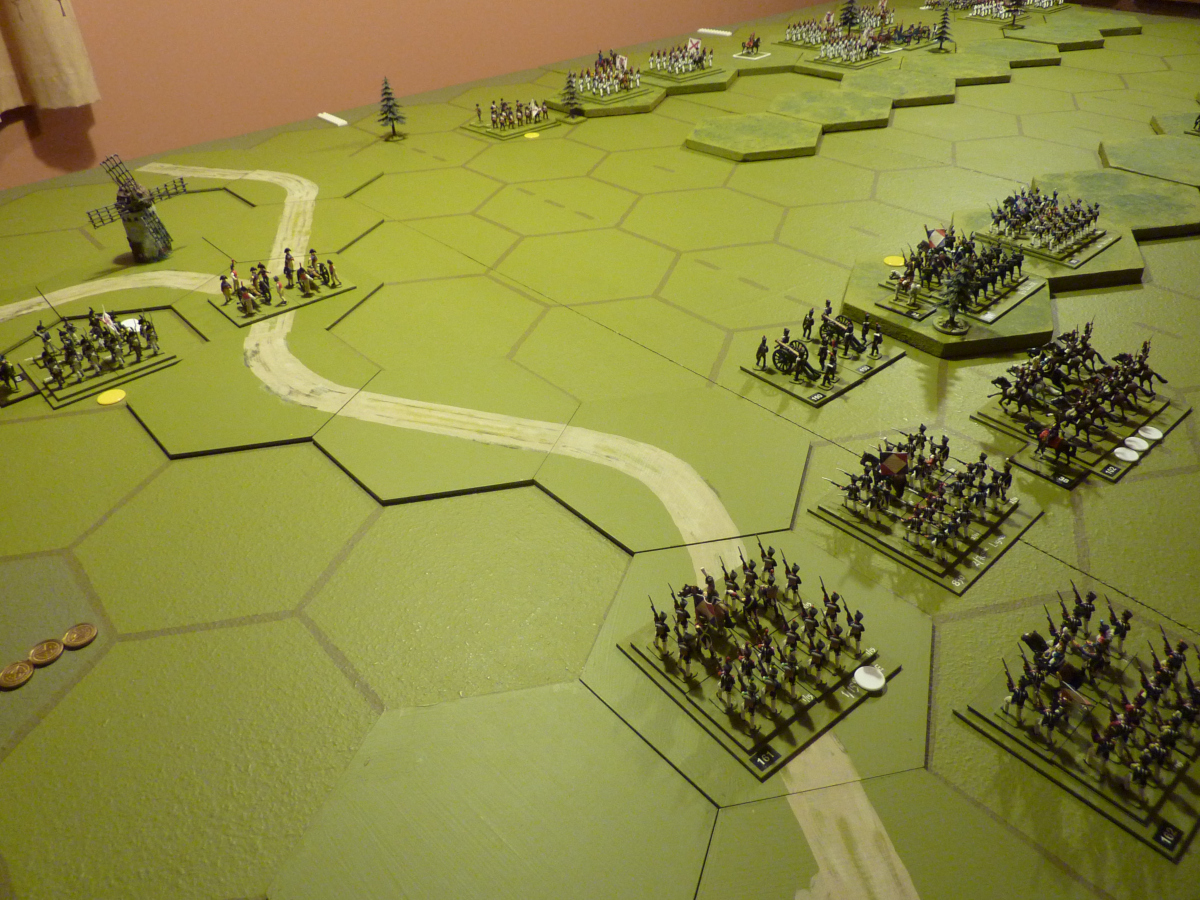
Initial view from the French right flank. The French have the Confederation of the Rhine troops at this end, and the French troops at the far end. On the other side of the table, the Spanish left is rather improvised, with irregular troops supporting line and light infantry; at the far end, on the Spanish right, two battalions of Milicias Provinciales are tucked safely away behind the line.


First action (to everyone's surprise) was an opportunistic attack by the Spanish cavalry, on their right, which discomfited the French 15eme Chasseurs, but was driven off with heavy loss by the 4eme Dragons.


On the Spanish left, the guerilleros were brought forward early, to plug gaps in the line at the fords. At this point, a group of the irregulars is placed next to the elite Guardias Walones, which must have caused some disquiet to the guardsmen. Note that we used big red counters (for Zoom) to denote elite troops, black counters to denote the irregulars and the militia. Note also that the fords are a lovely shade of sky blue, as mentioned in Tripadvisor.
 
 
Back on the Spanish right, Colonel Ramos da Silva has brought his rather battered light cavalry back into the line.

 
The French cavalry, having won their first scrap (on points?), are now shaping up to have a second round.

 
On the French right, Leval's voltigeurs are not doing particularly well against the Spanish light regiments of Cataluña and Campo Mayor. The Spanish troops were shooting particularly well at this stage of the action...
 
 
Leval's line troops move up - Nassau troops to the fore (yellow flags), with Frankfurters (oh, how we laughed) and Hessians in support.

 
By some miscalculation, the 1st Battn of 2nd Nassau arrived at the fords all on their own...


They were duly pulled back a little, then suffered 3 retreat flags to enemy fire (no losses, just 3 retreat flags), so their retiral was increased to 4 hexes (that's 800 paces) in one turn, ending up behind a hill, very much out of breath. This, as far as I recall, is an all-comers' record for running away in my C&C games (that's for non-Spanish line troops, of course...) 

 
Here's a quick view of the town, which the French made a point of not attacking. In the town itself, you see the Regimiento Irlanda (light blue jackets) and a combined battalion of grenadiers. To the immediate left of the town you can see the Walloon Guards, who took some losses but were successfully rallied on two occasions, thanks to the presence of General Portago (a noted orator, apparently)
 
 
Now the Spanish left flank was re-organised, to prepare for a heavy attack from Leval's Germans, who were finally coming up to attack the fords
 
 
A drone shot of the 1/2nd Nassau, recovering their composure after their record retreat.

 
At this point, over on the French left, Latour Maubourg paid the Spanish cavalry a return visit, and eliminated them, and also forced the 1/Africa into square, but they were driven off by musket fire.

 
The French pulled back on the left flank, and did little further in this area - though a couple of battalions were sent to support Leval's men on the right.

 
It had taken him a while, but Leval now put together a co-ordinated attack on the Spanish left. By this time, the Walloon Guards had lost interest in General Portago's rallying speeches, and had left the field. The Spanish left was getting very stretched.

 
This little unit did a fine job on the Spanish left - the Lanceros de Carmona. Stryker made a series of little raids over the river (usually when the German advance had forgotten to keep back some spare Order Chips so that they could form square...). Like the guerrilleros, these lancers were a real nuisance, which is exactly what the Spanish commander was looking for. 

 
Here's a general view from behind the Spanish right flank at this stage of the action - at the far end, you can see the lancers being a nuisance, an activity in which they excelled.

 
...and now they've retreated again, behind the river.

 
Same moment, different view.

 
Now, as the guerrilleros do their best to cover the fords, the French bring forward some more cavalry - 26eme Dragons - to try to chase them away.

 
In the background, the dragoons have taken one of the fords. More of the irregulars prepare to meet them (note that the guerrilla units include priests, bagpipers, women, all sorts!) [Assortment of Qualiticast, SHQ, Falcata and HaT figures]

 
This is desperate defending now.

 
From the Spanish right, you can see the action is all at the far end...(!)

 
The dragoons now chased away the lancers, and the French had won the day.

 
Leval worked hard to keep bringing fresh units into the attack, but this final view shows how much punishment the Confederation boys had suffered (each white counter is 1/4 of the unit eliminated).

 
11.5 VPs to 4 sounds like a more comfortable victory than it felt like at the time! My compliments to Stryker and his army for putting up a gallant defence. An interesting game. It was an educational reminder of what the guerrillas are good at (being a nuisance, sniping at people, moving about quickly in difficult terrain) and what they are less good at (frontal combat with regulars, and sustaining heavy loss).

My sincere thanks to Stryker for an enjoyable game. I said I'd include part of the scenario notes, so here they are:

French Force (Marshal Victor)


From IV Corps

Division Leval

2e Nassau (2 bns), Régt de Frankfort (1), 4e Badois (2), 4e Hessois "Gross und Erbprinz" (2), 2 bns converged voltigeurs

Division Sebastiani

15e Ligne (2 bns), 66e Ligne (2), 70e Ligne (1), 82e Ligne (2), 86e Ligne (2), 2 bns converged voltigeurs


2 cos Art à Pied


Cavalry

From Division La Tour-Maubourg (from Reserve)

4e Dragons, 26e Dragons + 15 Chasseurs à Cheval (attached)


Total: 16 line bns [LN], 4 light bns [LT], 2 dragoons [HC], 1 light cavalry [LC], 2 foot batteries [FA]. (approx 15000 infantry, 1000 cavalry, 16 guns)


Spanish Army (advance guard under MdC Belvedere)


Division Del Parque

Africa (2 bns), Reina (2), combined grenadiers (1 - Africa, Reina), Ligero de Barbastro (1), Provinciales de Cordoba (1), Provinciales de Granada (1)


Division Portago

Burgos (2 bns), Irlanda (1), Guardias Wallonas (1), Ligero de Cataluña (1), Ligero de Campo Mayor (1)


2 foot batteries


Cavalry (Col Ramos da Silva)

Husares de Maria Luisa, Voluntarios de España, Lanceros de Carmona


Attached irregulars (Don Pedro de Gentusa)

4 "battalions" of irregular infantry raised by the Junta de Aragon.


Total: 7 line bns [LN], 1 bn grenadiers [GR], 1 bn foot guards [FG], 3 light bns [LT], 2 bns Provincial Militia [MI], 2 light cavalry {LC], 1 lancers [LA], 2 foot batteries [FA], 4 small units of irregulars [GU].

(approx 10400 infantry, 1000 cavalry, 12 guns + 1600 irregulars)


Scenario Narrative

It is April 1809. A number of well-known events from the Peninsular War have not happened, and as a result a French army is advancing from Madrid towards the Spanish Army of the Centre, which is commanded by Marcial de Campo Gregorio Garcia de Cuesta, and is camped in the region around Cuenca. Cuesta is 68 years old, and in poor health, and is in any case well-known for his difficulty in making decisions, and for concocting grandiose strategies which waste time and achieve little.


His army is in good shape, but his senior officers are mostly inexperienced and lacking in talent. The army is brave and well equipped, but many of the troops are new recruits, understanding of battlefield drill is generally weak. The particular weakness of this army is an inability to manoeuvre in action. Thus they will fight well enough in a defensive position, but are at a disadvantage if they are required to attack, or maintain any kind of effective fire while advancing. The Provincial Militia units are the worst, and the irregular "guerrilleros" provide by the local Junta are unreliable and usually incapable of any action more formal than a simple ambush.


[One odd quality that the Spanish soldiers have is that they do not expect to be victorious, but if defeated they will retreat from the field and be ready to fight again within a week or so. The French will constantly be embarrassed by this resilience. They are used to defeated enemies committing to a formal surrender, not dusting themselves off for the next round.]


The French army is under the command of Marshal Claude Victor-Perrin. On  the road to Cuenca, there is a crossing over the Rio Mezquino at the small town of Santiago Martir. The river is, for the most part, deep with steep banks, but at Santiago the road to Cuenca crosses the river over a good stone bridge - the only one for some leagues in either direction - and a couple of fords, and the river may be crossed for a mile or so on either side of the town (though not by artillery or wagons). The French are capable of constructing temporary bridges, but it will save them time if they can secure the crossings at Santiago.


Keen to secure the bridge before the Spaniards can destroy it, Marshal Victor himself leads an advanced guard - he has good quality German troops from the Confederation of the Rhine and veteran French troops of Sebastiani's IV Corps, and he has a small contingent of cavalry. His army is confident, since they are superior in most respects to the Spaniards, and their commanders are incomparably better. [The French despise the Spaniards, the Spaniards hate the French.]


Acting with uncharacteristic haste, Cuesta sends the Conde de Belvedere with a vanguard to seize Santiago before the French can get there, and to protect the river crossing, and so, when Victor arrives, he is surprised to find the little town and the hills beside it are already occupied by the enemy. Belvedere's force has been augmented by the addition of about 1600 irregular troops under the command of the little-known Don Pedro de Gentusa, a local land-owner - these irregular soldiers are fiercely patriotic, but erratic in performance - many of the "officers" being priests or community leaders.

Monday, 10 May 2021

Battle of Santiago Martir - deleted scenes...

On Friday I'll be hosting a Zoom wargame. This is a re-run of a scenario I used 3 years ago or thereabout, which I thought had some promise and was worth another shot sometime. The action featured never actually occurred, though if it had it might have been in April 1809.

I finished setting up the battlefield this morning, and was taking a few preliminary photos when it occurred to me to try a little video. I've recently enjoyed some very nice home-made wargaming movie clips on Youtube and elsewhere, and felt I should try one. I hasten to emphasise that I had no intention whatsoever of publishing my attempts, but in fact it's maybe worth a look. If you click HERE, the movie should appear from somewhere - at the moment, my chief priority is to avoid putting vast movie files on storage media I can't afford!

 
Standing-still picture of the battlefield, all set up - French and their Allies on the left, Spaniards on the right
 

The clip was filmed on my digital camera, which is not exactly the very latest tech, and I have now taken due note that I should pan more slowly, think about what I'm going to say before I start, and try to do something about the loss of picture quality resulting from file compression. However - it's no too bad, as they say around here, and it serves to give a quick walk-through who's involved on Friday. I propose to have another go, using my phone, which is more modern and should give better results. However I have now had a first attempt, and would not be frightened to try again!

If you are appalled by the experience, there's no need to rush to let me know!

More on Friday, though I don't think the movie crew will be in attendance!

Monday, 3 May 2021

The Armourer Visits - another stream of consciousness...

 I was sorting out The Cupboard the other day, to get the French soldiers into a logical order (which helps a lot with setting up and putting away - any Chief of Staff will tell you), and to make space for new and impending arrivals. While thus employed, I removed a couple of small trays of odd bits and pieces which some untidy beggar seems to have left in there, and I found a little stand of Spanish guerrilleros, which has been in there since September 2018 (I checked), waiting for me to repair a sword that I broke.

I have to say at this point that breakages here are very few and far between - probably because I am extremely timid about roughing up my troops (a legacy of being the owner of delicate Les Higgins figures for so many decades), and they spend their lives glued onto MDF bases, which are magnetised and mounted on permanently allocated sabots; I don't remove casualties and the armies spend their off-table time locked in The Cupboard or in specially-prepared A4 box files. [I think I was severely traumatised at the beginnings of my wargaming career, when at my local club it was considered macho behaviour to shove handfuls of figures around in heaps - fortunately they were mostly S-Range Minifigs, as I recall, which can stand a great deal of rough handling.]

 
The repaired sword - Alfonso is as pleased as anything. His neighbours, I think, are SHQ - there are also Falcata figures among the partida bands. Qualiticast alloy does not bend, I learned.

 Anyway, I had a breakage in 2018, and I remember doing it, and I've been wondering ever since what is the best means of repair, since this is not a strong part of my act. The basic problem is that the broken figure was a Qualiticast casting; they always seem to have used a hard, brittle alloy. Normally they do not break, but I caught a sword with my finger when I was tidying away one evening, and it just snapped off. Didn't bend, just went "ping" and snapped off, about 2mm from the hilt. [Before everyone rushes to tell me how I should fix it, thank you, but please read on...]

I eventually developed a plan for fixing it after reading an article from Archaeology Today about Bronze Age weapons someone had dug up. Glossing over the fact that Archaeology Today seems a strange title to me, what struck me was that these bronze swords were cast with a tang (aha!), a pointy bit which was fixed into the handle. That could be the correct approach for repair of a White Metal Age Qualiticast sword, I decided, though of course it took me a couple of years to get around to it.

Anyway, that's what I did. I filed the broken stub of blade off the hilt, drilled a hole (rather bravely, I thought) in the hilt, heading up into the chap's wrist, and spent a while filing the broken end of the blade into a short tang, as described, such as would fit into the hole. Some superglue, then an extra couple of thin coats of superglue to build it up a bit, paint and varnish and you're done - next gentleman, please. I shall look after it, of course, but you can't really tell it was broken. Good. Result. 

I remembered that the game when Alfonso got his sword broken was a demonstration for the benefit of my aunt (no, really), and was one of two pre-production runs-out for what became the Ramekin mod I use with Command & Colors. Ramekin started life as a simplification of C&C, for the benefit of novice generals. It became rather awkwardly obvious that the simplified game, for a large battle, ran a lot faster and was at least as much fun as the official rules. And the rest, as they almost say, would be history if only anyone knew about it and was interested.

I also remembered that this Battle of Alfonso's Sword was a fictitious game which I've always intended to revisit, so that may be coming up shortly. Watch this space.

Thursday, 8 April 2021

Sorauren (French Left) - the Game

 Today Stryker and I played the game which I set up on Tuesday - as mentioned, this is a scenario lifted straight from the Commands & Colors user site. It gave us, not surprisingly, a close game. I was Marshal Soult, and Stryker played the role of Wellington, and we used Zoom. 

The game features no cavalry at all, and not much artillery, and the French, who have a decent advantage in numbers, have to set about a defending Allied army on a couple of ridges - seem at all familiar? There is a central (8-hex) hill in the centre of the table - occupying more of this hill than the enemy gets 1 extra Victory Point for the Allies, but it's worth 2 to the French. We agreed that 8 VPs for the win would give the French, with their greater numbers, a fair chance to wear the Allies down.

My troops started well - my intention was to have Maucune's Divn make a demonstration attack against the ridge on the Allied left (which did not offer bonus VPs), and push home a decisive offensive against the main hill in the centre, which was occupied initially by Spanish troops.

We used my Ramekin version of C&CN, which does away with the Command Cards (which makes the game possible to play via Zoom), and used the "strategic movement" add-on, whereby any unit which does not come within musket range of the enemy (2 hexes) during a turn may add 1 hex to its move - just the thing to allow those reserves to nip up to the front...

 
The French (on our right here) get their attacks under way - the one at the far end was supposed to be a demonstration, to keep the Allied left pinned there. To help with identification on a Zoom screen, we've used some large coloured counters - yellow for light infantry, red for Spanish troops. As usual, we are using white loss counters, since they show up well on Zoom.

 
The 24th Foot are installed in the only village, which was also worth a potential bonus VP to the French. They had a very quiet day, apart from some chaps firing cannons just next door.

 
The French attack on the central hill didn't go smoothly at all - in fact the feint on the right looked far more promising at this stage, which encouraged Soult to change his mind about the priorities, though he would probably have done better to concentrate his orders on bringing up reserves for the main attack.

 
This is the intended demonstration on the French right - the British 58th Foot are taking heavy losses from the French fire. Maucune fancies his chance here - he led a charmed life - while those around him fell in heaps, he escaped unharmed, though his laundry bill may have been substantial.
 
 
The main attack is getting bogged down - Soult really needs Reille and Lamartinière to bring those fresh units up from behind the stream.
 
 
A general view at this stage, from the French right. In the foreground, the British 58th Foot have gone, and the 79th are suffering as well. Maucune is incoherent with excitement.
 
 
Still not much success in the centre for the French - at this point the Allies have 5 units on the main hill, the French none at all, though they are working on it.


Soult's main problem - behind the stream, he has 5 completely fresh battalions - more than enough to win the battle if he could just get them up to the front [they were still there, still fresh, at the end...]
 
 
The French finally have a foothold on the main hill!
 
 
Now there is a glimpse of what might be - for the first time in the day, the French achieved parity on the main hill - 3 units each, so the Allies lost the VP which they had held throughout for controlling it. 
 
 
In the distance, the Great Scoreboard of History tells us (blurredly) that the score is 6 each - 8 needed for the win. Soult and his staff plan to get some reserves up, and finish off a classic victory.
 
 
No need to get excited - the British 88th Foot now routed the 1/50eme Ligne, which event also restored the Allied control of the hill, so the bonus VP came back into play. The French had eliminated 6 Allied units, the Allies had eliminated 7 French, and also got the extra point for the hill. Allied victory - 8-6. Soult was disappointed, of course, and will start work on his report...

I really enjoyed the game very much. My thanks, as ever, to Stryker for his uplifting enthusiasm and good humour, and my compliments on his very skilled defence. Next time, d'Hubert...

[Footnote: this game was not without some tension, as you will appreciate - at the end of each turn, Stryker would kindly remind me to take photos. After one such photo-shoot, I noticed that I had left my camera on the battlefield, and just for a moment I was concerned that it might have got into the last batch of pictures - only for a moment, mind, and there was a war on at the time.] 


***** Late Edit *****

Soult duly submitted his report to the Minister of War, and claimed all manner of misfortunes, not the least being the insubordinate and clueless behaviour of Reille and Maucune. By the time it reached the Emperor, who was in Saxony, and who was beginning to appreciate that the Sixth Coalition had worked out how to defeat him, it definitely did not improve his mood. In fact he was so upset that he had to get his surgeons to give him a rub-down with tripe and vinegar (traditional Corsican remedy for apoplexy).


In truth, Soult could have won our Sorauren game - there were a few occasions when he could reasonably have expected to win. The last few photos do show that his reserves were advancing at the end, but it was too late by this stage. At the point where the numbers of units on the central hill became equal, he only needed to march one more unit onto the hill to win the day - one more turn would have done it - two at the most.

The fundamental issue for C&CN - including its Ramekin cousin - is that the number of available orders is small each turn - it is variable, but it is always small, so that the commanders are encouraged to focus on real priorities. The turns are short, but they come round quickly. Soult used precious orders to attack the Allied left - his supposed diversionary attack; the problem was that it was fairly successful, and he felt obliged to continue to push, though in fact he could have held the diversion back, out of musket range, and still kept the enemy left pinned. With those extra few orders each turn, he could have brought his reserve up more quickly. Yes - quite so.

Even at the stage when the VP score was 5-all, 6-5, whatever, Soult's superiority in the centre was proportionally greater than it had been at the start, and he could actually have stopped the first attack, replaced the worn units with fresh ones, and started again - he should still have won. He was tantalised by the fact that his first attack seemed to be on the edge of success - for a long time - and frittered his orders away in trying to maintain some imagined momentum. Idiot.

***************************