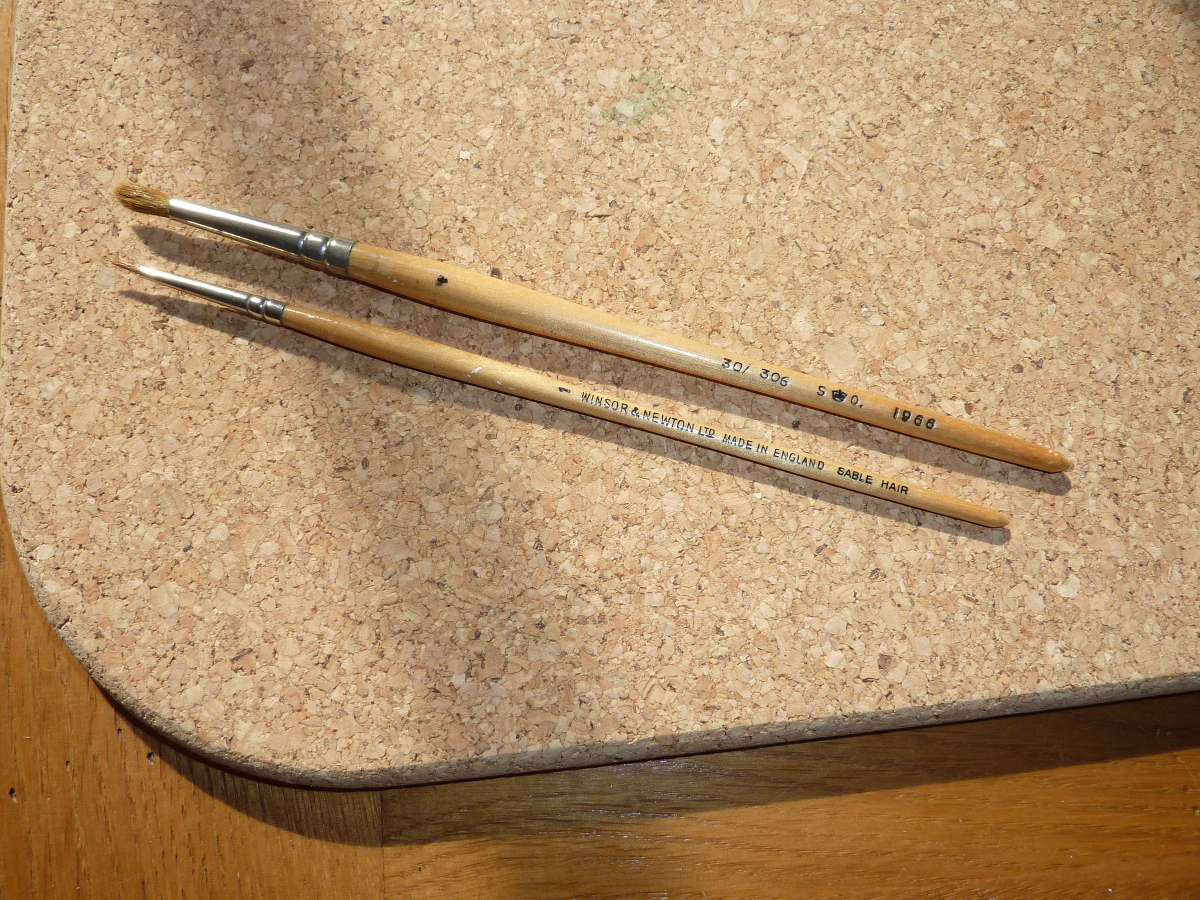
I’ve been intending to do a post on painting for a while. I thought of breaking this down into a number of pieces, but some of them would not be interesting on their own, so decided just to go for it. As usual, this is going to be a general tour rather than anything particularly useful, and, as usual, it’s all a very personal view.

There’s a particularly sound reason for this, since my painting is not especially good – a fact of which I am reminded more and more forcibly by continuing exposure to the wonders of the internet. I have always regarded painting as a means to an end. I need to have my armies painted to a satisfactory standard (my definition) so that I can use them, and I have found that painting is certainly the biggest bottleneck (and source of stress!) connected with the hobby. I have never been able to look at mounds of unpainted figures and feel actual pleasure at the prospect of getting them ready for action, though over the years I have successfully (again, my definition) painted many thousands. I suspect that, deep down, I don’t really enjoy painting, either – I do like tinkering with the odd general or command figure, but the idea of painting a complete battalion is not attractive. It’s a little like interior decoration – it’s really satisfying when you have finished, but it can be pretty grim getting to that point!
This has become more pronounced as I have become older and less patient, as my eyesight has dimmed a bit, and as the plans and the organisation of the armies have became gradually more grandiose. There was a time when I could happily paint a battalion in a week, working at it in odd moments, so that I could confidently expect to have maybe 4 or 5 new units a month. I have been thinking about what (apart from myself) has changed. Firstly, I suddenly found, on my return to wargaming after a long interruption caused by other priorities, that I felt an urgent need to make up for lost time, the implication being that 4 or 5 units in a month was never going to be enough. Secondly, and this is maybe less daft, my early days were in the Age of Enamels – at that time painting a battalion was ideal – by the time I had done all the red jackets, my Humbrol paint would be dry enough to start again at the left-hand end with the next colour. The concept of sitting down to paint a celebrity general in a single evening is really quite new-fangled – definitely a consequence of using acrylics – it surprises me a bit to recall this, but I guess it’s a fact.
My view of my own painting reminds me of something a jazz saxophonist friend said to me years ago. He was regarded locally as something of a hero, but he dismissed the idea with a chuckle – “No,” he said, “I am certainly not a great player, but I have been an average-to-good player for enough years to get to understand my own strengths and limitations, and I’ve learned how to bluff my way out of tricky situations!”.
That feels about right – I have been an average painter for long enough to know how to get decent results.
Painting Style

In the very beginning, I read (probably in Featherstone’s
War Games) that the objective with wargame figures was that they should look good “in the mass”, and that the quality of the paintwork was of secondary importance. Good enough – I took this is as my guideline, or maybe excuse, and cracked on.
My only previous experience of painting models had been on HO/OO Airfix railway buildings when I was 12 – I recall a house of which I made a pretty rough job, and the famous half-timbered inn, which I abandoned after I got half-way through painting the beams. If I remember correctly, the unfinished inn featured in the railway layout for some years, with its unpainted side turned to the wall. The real problem, apart from my lack of ability, had been the heartbreaking awfulness of the paint. I had bought a set of Airfix paints (in very distinctive little screw-top glass jars – square section, tapering toward the top – great design for paint, eh?). They were gloopy, uneven, had dreadful colours – the sort of colour you see now in the washable poster paints they give to kids at nursery school. I know it is not acceptable to say anything bad about Airfix, but I have to say those paints were rubbish.
Back to the soldiers – I bought in some tinlets of Humbrol, and got working on some units of Airfix ACW Union infantry. My grand plan was to leave the dark blue plastic for the tunics and kepis, slap some sky blue on the trousers, some flesh on the hands and faces (approximately) and then (the hard bit) pick out firearms, belting, boots and equipment with brown and black. My ignorance was so complete that it wasn’t until the 3rd or 4th unit that I realised that if I took a little more trouble to stir the sky blue then it would go on thick enough to stop the blue plastic showing through. Ri-i-ight. I went back and repainted the previous (n – 1) units to match, and then bought in some dark blue and re-did the tunics, and after that I improved as I went along. Block colours, meeting accurately at the edges – what else could there be?

My idea of unobtainable perfection at that time was provided by the illustrations out of the glossy magazines, and the Charles Grant books in particular. I was aware of a completely separate discipline in the painting of 54mm figures to an ornate, collector standard, but it never occurred to me, even for an instant, that my little wargame figures could be treated the same way.
By the time I returned to wargaming after an enforced break, the world had changed almost beyond recognition. Everyone now seemed to buy 28mm castings which featured incredible detail, acrylics had arrived, and a whole new style had developed. Figures were now painted with multiple levels of highlighting and shading, and every single casting, as far as I could tell, now had to have a personality. I was very impressed, though I was less comfortable with the tendency toward caricature and the grotesque which seemed to have become an accepted norm in both sculpting and painting. Certain manufacturers seem to have been particularly influential in this, but I was never quite sure why a style which seemed to have its roots in Fantasy gaming should have spread to bog-standard horse & musket. No matter.

Mostly out of gentle mischief, I have occasionally rattled a few teacups with comments on the blogs of others – especially on the subject of shading. Three-dimensional people do not walk around with shadows painted on them – the fall of the light does this on its own. I don’t want to stir up a pointless debate here – it’s all been done before, anyway, and what you like is what you like – but shading seems to me to be a useful thing to apply to flats, for example, but the more detailed and rotund the castings become the less the need for it. My view is unfashionable, I know this, and my style is stuck in a time-warp anyway because I need to make new additions to my armies compatible with the existing figures. I love to see figures painted in more detailed styles – the guys who did not grow up with Humbrol are less constrained by the traditions of those days, and so much of their work is terrific, but I can’t do it myself, and probably would choose not to if I could. I am comfortable with my own paintwork, I’m proud of my little soldiers, though I would never seriously offer them up as an example to be copied or even to be politely desired.
I also never got the hang of what I think of as the “stained glass” style – black undercoat, with colours applied leaving a small margin between. Looks pretty good. One of the pro painters I have used in the past does this very effectively, but when I do it, it looks scabrous – not properly finished at all!
So I’m happy in my style – the figures suit me and I couldn’t change now anyway. The main changes in my approach over recent years have been:
(1) Use of acrylic paints and varnishes – a mighty step forward.
(2) To compensate for the old Tempus Fugit in the eyeball department, I now use a prescription jeweller’s loop, which is a great thing, and a daylight-type reading lamp of the kind used for embroidery and tapestry-making.
(3) From eBay, and various purchases of private collections, I have bought in a lot of second-hand vintage figures, so I have done a lot of re-touching and refurbishing, which is quicker and easier and more productive than I thought it would be.
(4) And, of course, I have now come to realise that my plans are only possible if I pay for the services of other painters – of which more later.

Before I move on to discuss the paints I have used, I might mention that I have recently had a lot of fun painting buildings for wargames. Since I am a madman, and since I need buildings to have a small footprint to avoid ground-scale paradoxes, I use 15mm buildings with my 20mm/“true 25mm” figures. I have acquired some very pleasing little buildings, from Hovels, SHQ and numerous other makers, and had an absolute ball painting them up. It’s very liberating – almost the opposite of figure painting, in that a very rough approach is best. I use household emulsion paints, slap the stuff on, lots of vigorous dry-brushing. The amazing thing is that the quicker you do them, the better they seem to look. I wish I could get that much fun out of painting soldiers! – I’m sure that the amateur psychologists out there could offer an explanation.
PaintsThis could be a long and tedious list – I’ll try to avoid that. I started out with Humbrol enamels – all sorts – I used gloss paints with a flatting agent added if necessary. The railway colours gave a huge range of subtle shades, and then – later – came the tailor-made military series, which were excellent. I ended up with a massive collection, stored away in old shirt boxes. They were fiddly to use, but gave good results, and I don’t think I’ve ever had any colours fade, though some of the units are now 40 years old. Being enamels, of course, eventually they all solidified in the tins, so I threw a whole pile away.
I also used Testor paints, in little bottles. Bernard the miserable hobby-shop man recommended the Testor shade “wood” as a flesh colour for Ancients, because, he said, “men were real men in those days”. But were they wooden men? I only had a few of these.

Plaka were a radical departure. I grew very tired of red jacket colour bleeding through into white belting, and a local art shop recommended the use of Plaka acrylic, since it would not reactivate the solvent-based enamels. The Plaka white was a great find, for exactly that purpose, and, since I have recently found that the stuff is still available, I have thought of maybe getting a pot, for old times' sake! I also used their mid-blue shade for my Portuguese infantry, which was closer to electric blue than I had intended, and Clive recently refinished them in a less psychedelic shade.
All my figures, right from the outset, were finished with an acrylic glaze, and I have never had any problems with it, either with yellowing or with peeling. I used Cryla Matt Medium for years, which went on milky blue but dried clear.
After the Extended Break, I got involved with acrylics. I have to come clean here, and admit that mostly I have used Games Workshop paints. They are cheap, I can buy them locally, I like the practical little pots, and they are absolutely fit for purpose. I have some problems with opacity of a couple of shades – notably yellows and crimsons – but generally have been pleased with them. I also use Vallejo for specific shades and colours, but always begrudge the waste involved when my puddle of paint on the cooking-foil working palette turns out to be far too much, or dries out prematurely. One of the problems out here in the wilds is that a number of well-known and highly regarded makes of paint are not available locally, and I am always nervous about buying paint on-line.

For varnish, I have become very fond of Winsor & Newton’s
Galeria Matt Varnish, which I get very cheaply from a local art shop in 75ml bottles. It is easy and clean to use, you can flop it on and, as long as you invest enough time shaking the bottle before use, it dries to a nice, slightly satin finish.
And that’s about it. I don’t dip my soldiers in anything, I don’t buy co-ordinated sets of matching highlight colours. It’s a pretty humble effort, really. I still use, mostly, Humbrol matt white as a base coat. I sometimes use black acrylic undercoat for a dark uniform, but my eyesight means that I have to dry-brush with a lighter grey so I can see what I’m supposed to be painting. I also have a problem if, for example, I paint navy blue on top of black undercoat – I can’t tell the colours apart!
Painters – Getting the Job Done
It took me a long time to come to terms with getting someone else to paint my soldiers. For a start, I come from a long line of skinflints, but I also have felt for many years that your armies are only really yours if you paint them yourself.
My first experience of this was with the owner of a model shop in a neighbouring town. His shop was the usual haven for the deranged, and he filled in the quiet spells in his day by painting Wood Elves and so forth – superb. One day we agreed that he could do some cavalry for me – as a try-out. He had painted lots of Napoleonics in the past, and would do a decent job for me, very cheaply. It was worth a try, definitely, so he set about my KGL dragoons. It took a long time. Eventually I got them back, with a long story about bad luck and disaster, and I paid up and took my figures home. First, and obvious, piece of bad news was that he had apparently convinced himself that KGL stood for King’s Dragoon Guards, and had modified the uniform accordingly. Also, there were a number of other aspects of the paint job which I wasn’t quite happy with, so I did a fair amount of re-touching and then I had a nice little unit. I was disappointed that there was such a lot of rework needed, but overall the effort saved was well worth the money. I had a few more dalliances with the model shop man before I got tired of always having to chase him, but I’d succeeded in changing my prejudices a little and I had learned a couple of valuable lessons.
I had learned that – like any tradesman – a hired painter will not necessarily do a better job than you could have done yourself, and that you may have a certain amount of refinishing to do to get the figures just the way you want them. On the other hand, as long as you are not paying through the nose it can be a decent investment in convenience.
My next venture involved a fairly well-known pro painter, who is a superb craftsman. He is a friend of a friend, and I agreed with him that he would do a wargame-standard job on my figures, in a style which suited me, and he should bear in mind that I might in any case do some touching-up at the end. He quoted me a cheap enough price and he did a number of excellent units for me. Bad news this time was that the man earns his living at this stuff, and he gets paid most of his money for doing very serious collector-standard painting for the website of a leading figure manufacturer. Accordingly, work for me was a bit of a background activity, and the turnaround was too slow. My main reason for using a painter, after all, was to keep things progressing. I got some really nice figures out of that arrangement, though.
Then I got a number of batches of figures painted in Sri Lanka. Another new ball game. My experience of the paintshop I dealt with was a little mixed, to be honest, and that was partly my own fault. All correspondence and negotiation is carried out with the main man, who was always professional and very helpful. The operation works entirely through him, whereby hangs a potential weakness. He translates all uniform data and all instructions into the local language, and the painters work just from his translation. If the instructions are incorrect, they will not know. All quality control is also routed through the same man at the end of the job, so there is an awful lot of critical stuff depending entirely on one link in the process. If they are busy, things can go a bit wrong, and I got a couple of orders returned with some of the facing colours transposed, and with detailing carried out which I had specifically asked not to be done. I had a fair amount of rework, though, once again, the overall cost was probably justified by the effort which the exercise had saved me. Left to themselves, the Sri Lankans will default to a style of painting which involves an amount of shading, painting of creases in clothing, eyeballs (aaaargh!), and application of dark wash to faces. The best way to use the service is to send your own painted samples of exactly what you want, in terms of uniforms and style, and that is what you will get back. They are efficient and businesslike, and the painting is well done – they’ll even clean up the castings for you if you wish. At present I am not using their services, though I might again in the future. After the episode of the transposed facings, I felt they could have done a little more to offer me a cheap deal on future work. No go. It never occurred to them, and I’m too proud to beg, honey.

Eyeballs!
So I am now using a good painter in England. He does a pretty low-spec job for me – old school wargames style – charges me relatively little and gives me back figures which are probably 90% finished – suits me – I’ll finish them to suit myself. If I paid the full £10-a-casting collector-standard fee I’d almost certainly have the brushes out when they came back, anyway!
The important thing with using painters is having a clear idea what it is you want them to do for you, making sure your instructions are spot on, and, of course, deciding whether it’s worth the cost.