Napoleonic & ECW wargaming, with a load of old Hooptedoodle on this & that


Showing posts with label Basing. Show all posts

Tuesday, 19 January 2021

Dondaine

 Moving swiftly on (before I get a glimpse of Mr Trump's pardons and have an aneurism), here's a workmanlike wargaming picture. My original reasoning for my WSS basing scheme was that, since the units only have 3 bases and they'll be doing some Old School tactical manoeuvring, I wouldn't bother with sabots, though I've become very used to using them of recent years.

After just a few test games, I confess I have changed my mind. Sabots there will be. They will not be magnetised, and - since my cunning WSS base sizes give a standard footprint (approximately) - I have adopted a one-size-fits-all plain sabot. Current thinking is that sabots will be a resource for the battlefield, and will be issued when needed. My Napoleonic units each have their own magnetised sabot, and they spend their lives on them, so this is a conscious departure from my standard system.

Because the sabots are a bit long and narrow, I was worried that 2mm MDF might warp if painted on one side only. I ordered in some samples from Uncle Tony Barr at East Riding Minis, and am pleased to find that they give no problems, so a bigger order will be on its way.

 Here's a quick photo, to give the idea. These should save time and broken bayonets.


Infantry and cavalry in line or column of march - even one of my strange limbered batteries 


Oh yes - dondaine. One of the many French nursery rhymes my mother taught me when I was an infant was En Passant par la Lorraine, a lengthy tale of a peasant girl who may or may not have captured the heart of the King's son (the song has a quirky, uncertain ending) through her fetching appearance, complete with clogs. This song contains the chorus hook-line:

avec mes sabots, dondaine,
oh! oh! oh! avec mes sabots

I have never been able to find out what dondaine means - and still haven't really got to the bottom of it. I am assured by one of my French relatives that in fact it means nothing - it is just a song-filler expression (equivalent to "tra-la-la" or, I suppose, "hey-nonny-no"). That's kind of an anticlimax after all those years of wondering, but I guess life is a bit like that.

If anyone knows different, please shout.

Here's a noble rendition of the song - just to prove it exists. I am confident you will not last to the end of the clip, but - take my word for it - this version only uses about half the verses my mother taught me. Obviously French kids had a good attention span in the days before Instagram.


Monday, 30 November 2020

Creeping Elegance: Everyone Switch Units (Musical Sabots)

Creeping Elegance is a general classification here - any odd sorting-out or reorganising jobs which are not obviously a high priority, but which still irritate me when they don't get done.

It's easier to get on with it when there are several reasons all pushing in the same direction - i.e. the planets align (which doesn't happen very often).

For a while I've had the following in mind:

(A) There are a few units in my French army which acquired a 3rd battalion at some point. My improvised house standard for these French 3rd battalions seems to have stipulated that they have no mounted officer and no eagle - I can't remember why, maybe I was short of command figures at the time. Yes, quite. Subsequently I changed my mind - I decided I already had a real, serious house standard, which is that the infantry of my French army in the Peninsula will consist of divisions, each of which has 2 brigades and a battery; each of these brigades will comprise 2 regiments, plus a converged mini-battalion of voltigeurs from these regiments; each of the regiments will have 2 battalions. Not 3, 2. 

(B) Some of my battalions do not please me, because their appearance does not match up to the rest of the army. A case in point is provided by 2 battalions of old 20mm Garrison fellows, some of them recasts, which I've had since 1971 or so and which I've always thought I should upgrade sometime.

(C) Fairly new idea - I need to raise some more little 12-man battalions for my developing siege games.

So I've decided that I can rationalise much of this in one go - thus:

(i) The 1/50e Ligne (apart from their command figures) are of these old Garrisons - if I combine the Les Higgins rank and file from the unwanted 3/50e with the command from the 1/50e then they can become a new, rather smarter 1/50e, and the Garrison troops thus released can be reallocated (very appropriately, in fact) to siege duties. Good. They'll be happy there. The idea of making the 3rd battalion into the new 1st battalion works for me, but I suspect that the 2nd battalion will be furious when they find out.

(ii) Similarly for the 59e Ligne, except that they previously did not have a 3rd battalion, so the replacement Higgins troops for the 1/59e will come from the (unwanted) 3e/15e. The Garrison boys will go for siege basing, as for the 50e.

(iii) The 3rd battalions of the 6e and 25e Léger can also be released, to be allocated to forthcoming Divisions which are in the Refurb Queue.

This is the revamped 1st battalion for the 59e Ligne - the command figures were previously surrounded by Garrison men for many years, and the replacement Higgins rank and file have arrived from the (now defunct) 3/15e.


Here are the troops released to be rebased for siege games - mostly Garrisons - some old friends here!


So I've done the necessary basing adjustments and unit labelling, I've taken new photos for the Napoleonic Catalogue, and I've adjusted the sabot numbering slightly so that the battalions may still be placed consecutively in The Cupboard. So far, I seem to have done everything correctly, though I am half expecting to find two units with the same catalogue number in The Cupboard.

Time to have a cup of tea and read for a while. Nice sunny day here - freezing cold, mind you. 


***** Late Edit *****

Pensioners: some grenadiers from the old Garrison battalions, now re-based and ready for siege duties.

***************

Tuesday, 14 April 2020

WSS - Things I Need to Find Out - (1) Grenadiers

The sudden arrival here of a collection of miniature soldiers for the WSS at the end of last year was partly because I had always had a (vague) interest in that time-frame for wargames, partly because such a collection had become available and, importantly, because it seemed a relatively easy way into a new period - not exactly buying a new war off the peg, but certainly getting off to a flying start.

Since then I have been busily reading and refurbing and painting - all good fun, but no games yet.

My original plan was to attempt to develop the Bavarian and Austrian armies at equal pace, so that I could start playing with them as early as possible, and develop my rules as I went along. That's what I did, with some success, for the ECW a few years ago. So for the WSS I started off like this, but it soon became obvious that I could make quickest progress if I concentrated on the Bavarians first.

Various reasons, in no particular order:

(1) The miniature Bavarian army, for some reason, was in better shape - less breakages, less paint deterioration, less men AWOL.

(2) The Bavarian army seemed a lot less complicated - less daunting - organisationally and as a painting challenge. Also, the Bavarian troops I had bought in represented just about the whole of the historical army, so there were no tricky decisions about an OOB. The Imperialist set-up is a lot more tricky, I would have to make some decisions about the OOB, to give some kind of historical context (though in fact my planned OOB has more to do with the facing colours of the existing collection!).

(3) There are some aspects of the Austrian organisation which I haven't yet got a grip on - though I am acquiring some impressive-looking books. I just have to read the beggars now.

(4) The whole subject of WSS flags is a lot more complicated for the Imperial side. This may seem trivial, but for me it isn't.

I've now reached a suitable moment for a bit of a sanity check. I have two big batches remaining of troops to refurb for the Austrians, then my Phase One plan is pretty much complete, if I can get the numbers of staff figures up to scratch. I'm due to start painting again on Thursday, and I'm not sure that painting and thinking at the same time is as easy as it used to be. There is, though, a need for me to do something about grenadiers.

So today's subject is grenadiers. How did the Austrians arrange their grenadiers? How shall I paint and base the grenadier element in my Austrian army? I'll start this by interrupting myself, and returning briefly to describe what I'm doing for the Bavarians.

Bavarian Leibregiment grenadier - plate by Anton Hoffman
Thus far, for the Bavarians, I have arranged a few grenadiers in the right-hand base of each battalion, to indicate that there was a grenadier company present, but they serve no real purpose beyond the important one of looking nice. My games are unlikely to operate at a tactical scale where the grenadier company is detached to do something specific. I still do have the job of painting up two proper grenadier battalions for the Bavarians, though. My understanding is that the Leibregiment had two battalions of fusiliers (which I have painted already), and one of grenadiers (which I haven't) - this grenadier battalion was a designated unit in its own right, wore a slightly different uniform from the fusiliers and had its own flags etc.

OK - good so far. In 1703 or thereabouts, a regiment of (supposedly) French emigrés was to be set up, organised the same as the Leibregiment. According to the autobiography of Jean-Martin de la Colonie (who had expected to be the colonel of this new unit, but eventually was appointed lieutenant colonel), the fusilier battalions were never formed, though the grenadiers certainly were, and can be found on the OOB for Schellenberg - the Boismorel Grenadiers. The inhaber, Monsieur Boismorel himself, was a Frenchman (his name, I think, is a kind of forest mushroom, which is not important at this point, but is the kind of nonsense that interests me), and his personal ambition, according to Colonie, was to stay as far from any warfare as he could. The Boismorel boys have the appeal of offering some variety in the uniforms - dark red, in this case. Some of them wore grenadier caps, some wore tricorns - a welcome bit of colour on the wargames table and - again - they were a distinct, permanent grenadier formation with their own flag.

Righto - so that's what I'm doing for the Bavarians, now, for goodness sake, let's get back to the Austrians.

Austrian Grenadier on the left - image used without permission
There was a grenadier presence in the Austrian bit of the collection I bought in, but I am intending to change it. Based on what I have established so far (which is not very much), the Austrians would group together the grenadiers from the regiments within a brigade, thus the provisional battalions formed would be separate from the fusiliers, but would not have flags, and the facings and so on would be a mixture of the contributing regiments. This is kind of familiar to me, since this is what I have tried to reproduce for my Napoleonic Spanish army of 1809.

So my first question for this new Age of Reason is, did the Austrians organise their grenadiers by brigade, in this way? Am I right in assuming that the battalions thus formed would have no flags of their own, since they were informal groupings? Which leads me on to the practical issue of how I should base such units. My Foot battalions for the WSS are organised as 3 bases of 6 figures - each base is two rows of three men, the centre base holds the command presence - colours, mounted officer, drums - while each flank base includes one officer on foot. The bases can be used to denote the formation, but they do not operate independently, and are not removed for losses.

This is now getting into thinking out loud (or in print), but if I were to combine the grenadiers from two regiments for a brigade, for example, I could have one base of grenadiers painted for each regiment (I could even include a drummer in each such base) - not sure if I need a command base, nor how such a base would be made up, but now we are getting into fiddly detail. I could make a grenadier battalion from just two such bases - I'll have a look at the numbers in the books and see if that would make sense.

At that point I think I've conveyed the nub of the problem. Beyond that I'm going to embarrass myself with my own lack of knowledge! If you have experience of the WSS on the tabletop, I'm keen to learn how you think the Austrians organised their grenadiers, and how you set this up in miniature. All ideas welcome!

If this goes well, my next questions will be about the nippy issue of Austrian flags in 1703!...

Wednesday, 22 January 2020

WSS Project - Some Bavarian Heavy Cavalry


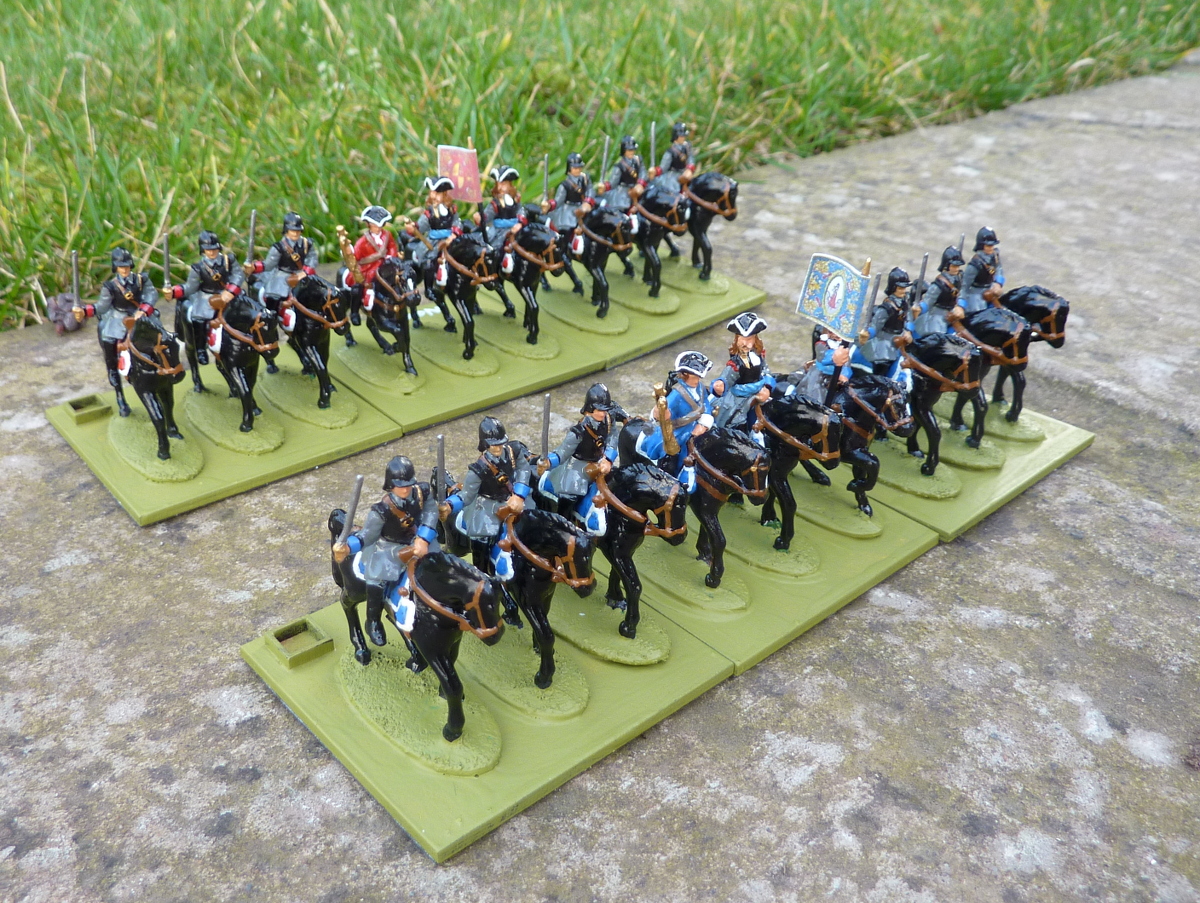
More units smartened up and re-based - here are the Cuirassier regiments Arco (front, blue facings) and Weichel (rear, red). The 20mm figures are all 1970s Les Higgins castings, with a few additions from Old John, who still markets these old figures. Building up the armies continues - next up is to prepare missing mounted colonels for a bunch of infantry units, then the Bavarian artillery, then the dismounted companies for 3 dragoon regiments, then I shall continue to crack on with the infantry and cavalry (of which there is a lot).


It's not quick, but it's going nicely - first objective is to build a couple of approximately equal armies, so I can get on with playtesting. Watch this space...

Monday, 6 January 2020

WSS Project - Plodding Along Steadily

I'm still working away on my WSS soldiers - retouching and re-basing - there's a lot to do, but it's going along nicely, and I'm aiming to have enough forces to do some rules testing before long.

Here's a humble photo of some recent work - nothing ground-shaking, just some more nice toy soldiers!
Imperialists - still short of a few colonels and all the flags (which I'm working on separately) - here are some recent additions - 3 battalions of the IR Lothringen (Bishop of Osnabrueck's regt), 2 regiments of cuirassiers and the first of the artillery
Figures are all 1970s Les Higgins 20mm - I can't remember who made the cannon, but they're not Higgins

Thursday, 19 December 2019

WSS Project - Quick Update

I've been tinkering away with my Bavarian forces - mostly the infantry, since, as is the case for the Austrians, for the cavalry I am waiting for some more reference materials on organisation and uniforms to arrive via the Xmas post.

I have to acknowledge a lot of valuable help and advice from Old John, who also sent me a load of sample figures and some handy uniform info. I'm waiting for the postie to bring Anton Hoffman's The Army of the Blue King, plus the CD version of the Robert Hall book on the Austrian Army (from Baccus), plus a couple of other odds and ends. I was also lucky enough to find a pre-owned copy of Mr Hall's little booklet on the same subject in the long-OOP Kuhn series.

To start with, I am aiming at armies based in 1702-03. For the Bavarians, it looks as though, with the addition of a smallish number of extra figures, the troops I have will provide about 10 or 11 battalions without a lot of work. My final plans for the Austrians - and all the cavalry - will have to wait until I have some better information -  they will end up as a compromise between what I'd ideally like and what I have. Here's a couple of pics of progress to date.

Apart from a couple of missing flags, these boys are retouched, rebased and ready to fight. Here are two Austrian battalions (provisionally from the regts Trautmannsdorf and Lapaczec, though I may change my mind when I'm better informed), plus the Bavarian infantry regiments D'Octfort, Spilberg and Tattenbach, and the Dragoner Monasterol, who still need a couple of dismounted bases to operate as dragoons with my rules
Sorting things out - more Bavarians - on the white tray are the basis of 2 bns of the Leibregiment and 2 bns of the IR Mercy (formerly Haxthausen); lined up on the tabletop to the right are what I have to build up into 2 bns each of Bettendorf and Kurprinz, and 1 bn each of Maffei and Lutzelburg - some extra figures needed, especially command, but it's shaping up. There may be a grenadier battalion coming up as well - thinking about that

I intend the Bavarians to have two regiments of dragoons, one of carabiniers, maybe 3 of heavy horse as a first instalment. I have two batteries waiting to be painted up, and have yet to make up my mind how (or if) battalion guns could be supplied. They also have some French friends to help out - I haven't fully thought this through yet.

I'm pleased with the possibilities offered by extra figures from Irregular Miniatures' Restoration and Marlburian ranges, and from Lancer Miniatures - Newline may offer some possibilities as well - I have yet to try these. Then, of course, the extended range of Les Higgins figures from Old John are essential.

All excellent fun...

Sunday, 8 December 2019

Something Old, Something New

I've been experimenting with base sizes and unit organisation - here's the first glimpse of a new project for me. This is the Bavarian Regiment D'Octfort, circa 1703. I have rebased them, and applied fresh (shiny) varnish and a replacement flag, but as far as possible the paintwork is the original from the 1970s. The figures are ex Eric Knowles, and my plan is to have enough fightable units to get some games going, quickly, and with as little work as possible. I have some Austrians on the bench now.

The figures are Les Higgins, vintage 1971 - small 20mm (about 1/76, I reckon). Old John can supply extra figures from this range, and I have some promising samples from Irregular and Lancer Miniatures - these other makes of figures will match best if I standardise on Higgins horses throughout. Anyway, early days yet - the first battalion is a prototype in a number of ways - so far so good, I think.

The 3-base organisation allows me to use Beneath the Lily Banners rules, but my first effort will be to develop my own rules which - you may be surprised to learn - are hex-gridded. The base sizes will allow a battalion to form a line 150mm wide, or a march column 150mm long - all of this should work well with my 180mm hexes.


Note that the command base has room for a dice frame

Monday, 8 April 2019

For King & Parliament - Infrastructure Prototyping

I have made lamentably slow progress with my solo practice sessions for FK&P - one thing that has been holding me back [dodgy alibi] is the need for a practicable way to keep track of unit information in a simple but effective way, in keeping with my minimalist toy soldier style presentation, without burying the troops in counters.

This morning I have produced something which appears to fit the bill. My sincere thanks to Simon Miller and Gonsalvo for useful suggestions, and especially to Andrew Brentnall and The Jolly Broom Man for actual examples, which I have adapted (not to say stolen) to fit my basing systems.

I had a happy couple of hours fiddling around with MS Publisher, and I've set up a decent infantry template, which I can reproduce and amend quickly and easily. I ran off some trial sheets of info labels, laminated them and cut them to size. Here are the results to date.

Never happier than when fiddling about
Here are the first trial batch - these for some of my Parliamentarian foote. I'd have preferred to use matt plastic laminating pouches, but the glossy ones are better for allowing successful removal of white-board pen annotations. Note the little strip of white steel paper at the top of each label - these strips may need to be larger
Exciting picture of a flying base, showing how the little label attaches. My bases are all underlaid with magnetic sheet anyway, to allow them to live safely in their box files. The sliver of steel paper on the label allows it to attach underneath the base, without glue or anything messy
Here you go - volunteer demonstration by Richard Shuttleworth's RoF (of Blackburn Hundred) - these chaps were originally the Blackburn town Trained Band, and the yellow square on the right indicates that they are classed as "raw". Old Richard in his best crimson coat is proud of them anyway. The 17th Century font is a bit of an extravagance, since I will have to draw it to people's attention, but it is not inappropriate, since my laminating machine must date from approximately the same period
From the front, the new label is quite discreet
Thus far, this looks promising. If it works (or can be made to work) then I should be able to manage without any major investment in sabots, and the labels are cheap, easy to make and easily edited if I successfully keep the template samples handy. In today's trial, movement on the cork sheet (which might be grippier than the painted battle boards) suggests that the label tends to shift a bit in action. It won't come adrift, but it can get a bit - you know how it is - not quite straight [OCD alert]. I was hoping to be able to use the same size labels for the foote, the horse and the dismounted dragoon bases (which last are only half the depth), but I may have to change to bigger labels with bigger patches of steel paper.

I might buy some better quality laminating pouches - I'm down to a pack of Woolworth's own brand, which illustrates the house focus on economy and making things last. Better pouches will stick on the paper more firmly.

Work continues. There should be some pictures of actual test games once the record-keeping labels are working nicely.

Monday, 13 August 2018

Handicrafts Dept - Sow's Ear Research Project

My recent introduction to Picquet's "Field of Battle" rules has got me thinking of all sorts of issues beyond merely playing the game. I've grown very used to Commands & Colors type games, where the presentation of units and the associated information is very simple - I've developed a big stock of sabots, on which the units are fixed magnetically. Since the game is simple (by design), it is possible to get away with placing a few coloured counters on the sabots to denote losses - it doesn't add greatly to the visual delights, but it's not a big problem.

FoB is a bit different - the units change formation, so sabots are out, and a fair amount of information needs to be associated with each unit. I really can't be doing with roster sheets - personally, given the state of my eyesight, I find them very hard work - constantly focusing and re-focusing between the sheet and the action on the table is fatiguing, as is constantly howking the specs off and on (and losing the beggars behind The Ridge). It is easy to add a few extra colours of counters with defined meanings, but the fundamental principles of OWL (the OCD Wargamers' League,  of which I am a founder member) argue strongly against running the risk of reducing the game to a pigs' breakfast.

I've been thinking up some way of making a neat and tidy job of keeping everything I need to know about each unit, right on the tabletop.

Yesterday I had a lot of fun with a bag of MDF strips and some laser-cut dice frames, suitable for 5mm dice. I think I have developed a working design. Still a couple of things to think about, and then it should just be a question of making about 100 of these things.

Dice frames from Supreme Littleness Designs, suitable for 5mm minidice, a pile
of 50mm x 10mm MDF bases from
East Riding Minatures, and a pack of 200
5mm mini-dice from
The Dice Shop - that's my starter
Sticky PVA glue the bits into position, a coat of baseboard paint...
...and I have a roll of 10mm wide self-adhesive magnetic compound strip, plus
some experimental sheets of plain (non-adhesive) magnetic sheet
My units are on MDF subunit bases, which have magnetic sheet stuck underneath, and
they sit on sabots which are topped with steel paper (or whatever the modern
replacement for steel paper is called).
My subunit bases are 50mm wide x 45mm deep; I add a loose underlay of plain mag
sheet underneath one of the subunits - this underlay is 50mm wide x 55mm deep,
which will allow me to attach a 10mm deep info tray behind the troops. 
Attach the magnetic adhesive tape underneath the info tray, trim with scissors to
smarten it up a bit - you can see where it will attach behind the subunit base...
...and here is the modified set-up on the sabot - no actual information on the tray
yet. Note that this is all completely temporary - I can remove the info tray and the
underlay and everything is back as it was.
In a FoB context, here's the same unit deployed into line - the underlay is still under the left hand subunit, 
and the magnetised info tray will hold in place (reasonably well, anyway) for movement around the battlefield. 
Here the tray is equipped with a minidice (to record loss of what FoB calls "Unit Integrity"), with a laminated
label showing the fighting and defensive dice sizes applicable to this unit, and a coloured cube to indicate which
Combat Group (= brigade) this battalion belongs to. My 8mm wooden cubes, which seemed pleasingly small
and neat, now seem maybe a tad big and clumsy - I might replace them, but this gets me operational for the
moment.
The big experiment in this lot was to see whether the existing magnetised bases, sitting on the magnetic underlay, sitting on the steel paper on the sabots, would attach as firmly as the original rig without the underlay. The answer is "not quite", but it's good enough for tabletop use - probably not secure enough for transporting them in the car. The underlays and info trays can travel separately from the troops!

Righto - it works. Fire up the factory, and get a stack of them made up, painted, labelled and stored away for forthcoming battles. OWL in action.

Sunday, 16 April 2017

1809 Spaniards - More Leaders, and a Possible Outbreak of Creeping Elegance

You know you get a sort of half idea, and you quite like it, and before you know what's happened you find you can't get it out of your head, and you have a new project starting up...?

For example - years ago, I once found that I had acquired a couple of mounted infantry colonels from somewhere, so the next couple of French battalions I painted up had a mounted figure in the command, just to try it, and I liked that a lot. It looked just like the pictures in the old Charles Grant book - splendid. It was really just to use up the spare figures, but I knew almost straight away that eventually I would end up rebasing all my Napoleonic armies and adding mounted colonels throughout. It took ages, but I got there in the end, and now I never think twice about it - it's a house standard.

This time it's generals. I have my generals based individually, except for army commanders, who are on a rather larger stand, and have an ADC attached. I have a growing box of attractive staff-type castings waiting to be painted - generals and aides and adjutants and all that - the availability of new figures from Art Miniaturen and elsewhere makes this hard to resist. I like painting generals and ADCs - small jobs, lots of fiddly bits - ideal for short paint sessions, and I am looking at painting up a special new staff group for Marshal Suchet, and I have some more Spanish generals on the bottletops at this very moment, and - O Lord - I've just seen the latest post from History in 1/72. I think I would like to have a little collection of celebrities and other oddballs to grace a suitable occasion. I already have a Spanish division commander who is based with an ADC, which is non-standard but looks pretty good (not least because Goya did the painting...). As of this morning, I am beginning to sense that a new house standard is sliding in from left field. I think I'd really like to move to brigadiers based on their own (as at present), division commanders with a single ADC, and army commanders or other special bods based with 2 supporting staff. Brigadiers will be on the standard 30mm x 45mm bases, division doubles will be on 50 x 50, and I need a new size for the triples - maybe my ECW 60 x 60s would do for that.

Three new Spanish generals - two brigadiers (one in his regimentals) and a
division commander (with the gold lace) - in fact they look a bit shiny - better get
the next coat of varnish matted down a bit.
So - anyway - it looks like a period of progressive rebasing and sorting out (and painting) is coming, to get my staff to the new standard. It doesn't have to happen all at once, of course, but I have some very nice unpainted ADCs just looking for a gig somewhere, and I have some of Jorg Schmaeling's latest Art Miniaturen French generals and aides, itching away in the French Command box. Yes - it feels like a good idea, and it's not too disruptive in the short term. Rebasing generals is a doddle, really. If I order in a supply of pre-cut MDF 50 x 50s from Uncle Tony Barr at ERM then that will get me started.

No rush. Looking forward to it. Creeping Elegance - you know it makes sense.

***** Late Edit *****

Now have the chaps based up, and have added a converted Hinton Hunt ADC to the division commander. ADC is in non-regulation uniform, you're right. Some quick pics in the garden...


This brigadier is dressed as colonel of the Regto de Africa (Antonio Senra)

Wednesday, 13 July 2016

Death by MDF Bases - a stocktake

Sorting out the MDF bases - first find them all, then sort them, then count...
I’ve become very used to my laser-cut MDF bases now. There was a time when I would happily cut up my own bases with the trusty Stanley knife and a steel ruler, and I still do this (obviously) for any odd sizes that I need, but – however hard I try – the home-cut ones look scruffy next to the bought-in laser jobs.

As part of this move towards decent bases over recent years, I made a valiant attempt to standardise on my base sizes, to limit the confusion and make stock control easier. I’ve mentioned my base sizes before – it probably wasn’t interesting then, either, so I’ll assume I’m safe to mention them again!

When I think about it, my Napoleonic frontages come from old WRG rules. I can’t remember which rules, or which edition, but 15mm per figure for close-order infantry, 25mm for heavy cavalry and 30mm for light cavalry became rooted in tradition here, and – for obvious reasons – once the base size has been in force for a while, as long as it works OK, it’s not a great idea to change your mind about it.

So I have made a conscious effort to go for a small number of standard base sizes. I won’t go on at great length about this, but there is always a subtle pressure towards increasing the number of sizes – just one more new standard…

I use large numbers of the following (all measured in mm wide x mm deep):

50 x 45           line infantry (2 rows of 3 men) and heavy cavalry (2 figs wide)

60 x 45           light cavalry (2 wide)

25 x 45           single heavy cavalry figures

30 x 45           single light cavalry figures, also generals & staff

and then there’s

80 x 25           infantry skirmishers (open-order line of 3)

80 x 20           alternative skirmisher bases – used in mixed order units

60 x 80           field gun + crew (2 guns to a battery)

and then there are standard sizes for different kinds of unit sabots, and bases for artillery limbers, caissons, wagons, mule trains – and this is where the number of variants keeps increasing. When I started collecting siege guns and equipment, some new, more compact sizes appeared, to keep the footprint down, and because the siege pieces have smaller crews. I’m currently preparing some guns for the French Peninsular War siege train – there will be 3 batteries of 24 pdrs, 2 of howitzers and 2 (maybe 3) of mortars – I am reminded that for the big siege guns I use a base of 45 x 90, and for the mortars (apparently) I have adopted 45 x 65, which is an odd size but seems to be a bit more roomy than the existing 60 x 45. I conducted a proper stocktaking exercise (the first part of which was identifying the 4 separate boxes which contained random mixtures of fresh bases). I’m proud to say that I have now an official note of how many of each size I have and need, so an order will be going out today. I have promised myself that I am going to keep the spare bases in properly labelled boxes, so stock control will be much easier [what do you think? – do you think I’ll keep it better organised in future? – no?...].

I’m going to be working on the French siege stuff for a while – I have lots of gunners to paint up and everything. I’ll put some pictures up as and when items are finished.

For a while I had a brilliant idea that a French siege train, with appropriately nondescript colouring of the equipment, could also serve as a Spanish one, since the artillery uniforms are very similar. When I thought further about it, though, I couldn’t remember the Spanish army actually besieging anything, so this might not be a very high priority. [Please don't anyone mention Frank Sinatra and Sophia Loren.]

Over the next few nights I will be putting together 20mm scale cannon kits, so I will get a chance to try out my new superglue accelerator. This should be an exciting advance, you would think, but I find I am mostly apprehensive. Of what? I’m not sure – I think I must be worried that the accelerator will not work; I find these little disappointments loom larger as I get older…

This post is quite long enough, but I realise that I have not mentioned my ECW basing system, which is different. Only comment I might make is that I cunningly adopted 60mm square bases for both foot and horse, and this has been a great success, except that sometimes, when I am being especially honest with myself, I wish I had chosen 55mm square, which would have fitted my hex-grid tabletop just a bit better. No matter – everything is fine. I promise I am not changing anything.

Friday, 7 March 2014

Unsung Heroes of Wargaming - Tony Barr


Apart from the high-profile master makers and rule writers, and the great names of Old School wargaming, there are a lot of chaps in the hobby who don't get the credit they are due, I think.

One such is Tony Barr, at East Riding Miniatures, who supplies me with a lot of laser-cut MDF bases, sabots and scenic tiles. His pieces are more accurately made than those of some of his more expensive competitors, his prices are very reasonable, his website is easy to use and well maintained and - above all else - he is helpful and personable and prepared to indulge all the oddballs like me who want weird shapes and custom sizes.

Such a faultless service becomes an easy thing to take for granted, and I am very sorry to learn that Tony has been unwell and in hospital, and will be convalescing for a while. I'm ashamed to say that it is at such times that we remember to appreciate properly the amount of help and support we get from our regular suppliers - I hope you will join me in wishing Tony all the very best for a full recovery.


Friday, 15 June 2012

Avec Mes Sabots – the attraction of magnets


This follows on from the Magnetic Spaniards post from earlier this month. So impressed was I by the sturdiness of wargame units fitted with magnetic sheet (stuck underneath the bases) standing on steel paper (fitted, and painted, on top of the "sabots") that I have immediately set about a whole new project (distraction) to extend this system to my entire Napoleonic collection.

This little sub-project breaks at least 3 well-established rules from Foy’s Book of Wargames Lifemanship for Boys, viz:

  • do not change your bases, and especially do not change your basing standard for an existing army – this is the road to heartache and depression
  • do not allow any fleeting idea to fire up a project which  diverts time and effort away from something you really wanted to do
  • if your collection contains something which you have had for a great many years, think carefully before you throw it out or replace it
However, I have convinced myself that it is worthwhile on all counts, so am going ahead. Thus far, I’ve done all the Nationalist Spanish, and am now about half-way through the French army. To illustrate what is involved, consider this example - I have my line infantry units mounted as 4 bases of 6 figures measuring 50x45mm standing on a 110x110 sabot, which sit well with my 7" hexes. Neat patches of mag sheet, cut to size with scissors, fitted to the existing bases, and a 100x90 footprint patch of steel paper on the sabot, painted in the baseboard/tabletop colour, requires a small investment in materials and time, but greatly simplifies handling both on and off the battlefield.

Naturally, any self-respecting hobby project has to sprout arms and legs, and in this case the add-on task is to replace the tattier specimens of sabot. Most of my troops have been rebased within the last 7 years or so, so the bases are very good, but the sabots are variable - recent ones are good MDF, but the older ones are horrible curly cardboard, and it would be foolish indeed to put steel paper onto these. So I ordered up some custom sizes of laser-cut MDF from the excellent East Riding Miniatures (which arrived within 24 hours, as always) and am taking the opportunity to replace any sub-standard sabots I come across while I am fitting the magnets.

My sabot sizes? I have 4 standard sizes:

Type A   (line infantry)        110 deep  x 110 wide
Type B   (skirmish units)     110 x 90
Type C   (light cavalry)       110 x 160
Type D   (heavy cavalry)    110 x 135

Each of these gives me 5mm spare on either side of the troops’ bases, to make it easier to pick up units by the sabot. There are other odd sizes, but I just cut those myself as required. Why no artillery sabots? – I don’t use sabots for artillery, and all the artillery has already been fitted with magnets in order to store them in box files.

In pricing this little “improvement” project, I am not going to include the cost of the replacement sabots, on the grounds that this is something that needed doing anyway – thus I estimate that the cost of the magnetic materials, including wastage, works out at rather less than £0.75 per unit on average, which seems very reasonable.

Because I promised to do it, I’ve featured a picture of some Sideways Frenchmen formed into line on the fridge door. OK - I've done it now - I do not wish to talk about it again.

Tips and things I’ve learned so far – not much, really:

  • you can easily mark the paper side of the steel paper with a pencil, but the mag sheet has to be marked out on the shiny plastic backing sheet, which is resistant to most known forms of writing medium. A very thin Sharpie marking pen does the job, but you have to keep wiping the ruler clean. Holding the ruler still on the slippy sheet is tricky, too, but a steel ruler will attach itself nicely (aha!).
  • the scissors get badly gunked up with the adhesive, so it’s necessary to clean up with Sticky Stuff Remover or isopropyl alcohol or similar every couple of hours
  • only observed practical downside of sturdily mounting figures on the sabots is that if you catch them by accident they will not tip gently in the traditional forgiving way, so watch out for those bayonets – if you have to wave your arms around while explaining a point of the rules, take care!
  • the magnetic sheet is glossy and slippery – if I put magnet-fitted bases on a non-steel-paper sabot, they are even less stable than they were, so this is an all-or-nothing effort 
And, finally, Avec Mes Sabots is the chorus line from an ancient French song, which I seem to have learned in my early childhood. Here you can join in and sing along – it’s through the Square Window, boys and girls.


Friday, 1 June 2012

Magnetic Spaniards - and beyond....?

 
The Sideways Spaniards

Some months ago, I suddenly realised the usefulness of magnetic sheet for storing figures safely. The Cupboard had run out of space, and I decided to rehouse my artillery and support vehicles in A4 box files, lined with steel paper - much like everyone else does, in fact. My units are all based with rigid plywood or MDF, and applying self-adhesive mag sheet to the undersides was a lot easier than I had expected. So I now have 6 boxes full of guns and limbers and pontoon trains and wagons and all that stuff, and the magnets stick so powerfully that on occasion (and it makes me a little faint to think of it) I have shown off by slowly standing the odd box file vertical, so show that the pieces stay firmly attached. I have, I hasten to add, laid them flat again before the applause died away.

I have been very pleased with this exciting new departure (for me - I don't get out much), and, as The Cupboard determinedly continues to shrink, I have come to accept that I need to adopt the same approach for some other units, to free up more space. Next in the queue, I decided, is my Spanish Nationalist army, so I bought smart blue files for them from Tesco, ordered up some mag sheet and steel paper from the most excellent Trevor at Magnetic Displays, and spent an interesting evening preparing the files and applying the mag sheet to the subunit bases. And in the files they go. Excellent.

Now, of course, this requires me to separate the (sub)unit bases from the sabots on which they normally live, and it suddenly became very obvious that if I put a steel paper patch on each sabot, and re-painted them with baseboard green, my newly-magnetic Spaniards would sit very firmly thereupon when they came out of the boxes to fight. So another evening with ruler, pencil and scissors followed, and - by 'Eck - it works!

I was a bit worried that even a thin coat of baseboard paint would weaken the magnetic pull, but it is still fine. I was going to publish a picture of all the units standing on edge on their sabots but I chickened out. It does work, though - trust me – there is a single unit at a near-vertical angle in the photo.

And the point of this further step with the sabots? The point, gentlemen, is that I am a noted dropper of wargame soldiers. It may be the hated varifocals, it may be temporary changes in the Earth's gravitational pull, it is most likely connected with dementia in some form, but I live in constant dread of subunits sliding off their sabots because I have momentarily lost my artificial horizon. As the collection get older and more valuable, and as my own ability to repair or replace them decays, so cruel Nature has me always a little anxious about accidental damage on the battlefield - or on the floor not far from the battlefield. The magnets look like they could be the answer. Certainly I could still drop an entire unit in one go - I haven't thought of a solution for that one other than not playing with them - but with magnetized bases on a steel-paper-coated sabot they are very reassuringly solid.

Downsides? Not much, really - the mag sheet is 0.55mm thick, so the units stand just that much taller, but the bases are a mixture of 2mm and 3mm anyway, so I can't really notice - expecially since I am quite a lot taller than the troops, and tend rather to look down on them (so to speak). This is all so successful that I have now started pondering whether I should treat all the rest of my units the same way. The chaps who are still living in The Cupboard would be much easier to handle safely, and it would be possible to put them in prepared box files (or whatever) if I need to transport them - a facility I have never had before. There is the further problem that I have nowhere to transport them to, but that is a detail, and I might have some friends one day. You never know.

The real thing to think about is the cost and the labour involved. It also occurs to me that I have no idea how permanent the magnetic properties of the sheet are, or - more seriously, perhaps - what is the life expectancy of the self-adhesive coating. It would be a sad thing to invest a lot of time and beer money in converting my entire collection, and then find that the pads all dropped off as the adhesive perished. I could, of course, glue them back in place....

Stop it.

I'll continue to ponder this. There seem to be a lot of advantages, but I'll weigh it up. At present, not yet having worked out the cost, I am gently enthusiastic.

To end with something of a digression, my young son and I have a long-standing private joke about the Sideways People - this stems from a display that used to be in our local IKEA store, which had kitchen tables and desks and similar mounted on the wall, 90 degrees from the vertical, with dishes, cutlery, computers and so on attached to match. Our theory is that the Sideways People come in at night, and live their strange, 90-degrees-out-of-phase lives in IKEA when no-one else is around, though how they could pour milk into the cereal bowls has always been a puzzle. Anyway, my new enthusiasm for magnetic sheet enters into the Sideways People fantasy - in theory, it would be possible to fight a small battle on the fridge door, for example. Not sure I'll rush to try it, but the Sideways People themselves might see this as a further advantage. 

Friday, 17 February 2012

More Stuff Back from the Painter

The significant thing about this lot is that these should be the last five battalions to be added to the French Peninsular War army for the foreseeable future. There are a few limbers to get painted up, and a mule train(!), and a couple of old units of Chasseurs a Cheval which are due to be refurbished and re-based, and that (officially) is that. Oh - and there are a few engineering figures half painted - and then there's a complete 11-battalion division of Kenningtons, command and everything, but they can stay in a box until I decide whether I'm going to paint them...


First picture shows some of the new guys ready for finishing touches to the paintwork, "grassing up" of the figure bases in the statutary house baseboard colour, and then basing - the main purpose of the picture is really to show off a small part of my cherished collection of bottle-tops. You may imagine the volume of Highland Spring that's gone down the hatch to achieve this. Strictly speaking, it will mostly have been Tesco's own brand of bottled water, which is a fraction of the price but comes out of the same hole in the ground in Perthshire.


And here they are a few days later, still to get a couple of flags, but otherwise ready for The Cupboard. Here are a 2nd battalion for the 2nd Nassau, the 4/28e Leger, the Garde de Paris, a battalion of the Chasseurs des Montagnes and the 4th infantry regiment of the Vistula Legion, who - by some bureaucratic oversight - remained in Spain after all their Legion mates were recalled to go to Russia.

I've always wanted a battalion of the Garde de Paris, ever since I saw the illustration of one of their grenadiers in Windrow & Embleton's lovely book. Of course, at that time I was dumb enough to think the whole regiment dressed like the grenadiers. My battalion is, intentionally, very scruffy - mostly Falcata figures, though the grenadiers are old Garrison chaps. They will not be getting a flag - anecdote time...

A few years before my 1812-vintage battalion would have been recruited, the Garde de Paris had been at Bailen, where they lost their eagles and were sent to the prison hulks, an experience which very few of them survived. I understand that the reformed, reorganised regiment of this later period was not issued with replacement colours - units which lost their eagles, however much they might have suffered in the process, were not usually a high priority for the issue of new ones.

Not much glory here, then.

Sunday, 6 November 2011

Catching Up with the Mainstream

Box 1 of the French Artillery - the two armies require six such boxes

Sometimes I surprise myself with my own stupidity. Of course, I realise that everyone in the known universe uses magnetic basing materials to transport their wargames figures, but somehow this particular technological advance has evaded me. Partly because my soldiers live in a big static cupboard, but mostly because I never take them anywhere - except when I move house, of course.

I bought in some mag sheets a couple of years ago as part of a fleetingly brilliant idea connected with deployable skirmishers, but the idea proved to be a poor one. Recent army expansions and my big push to get more limbers completed have meant that The Cupboard is now officially full, and some reorganisation is needed. With thanks to all who reassured me and offered advice on the subject, I have now fitted out half a dozen A4 box files with steel paper and fitted mag sheet to the bases of my artillery, engineering and wheeled impedimenta, and am delighted with the results. Everything cosy and secure.

Allosaurus makes a discovery

I am a little shamefaced that it took so long for me to get to this point, but here I am. Yes - I know that everyone uses this stuff all the time, but there's an act of faith required when it comes to risking precious figures and guns - my experience has been that old Sir Isaac Newton will get you in the end, especially if you are as clumsy as I am. Anyway, Allosaurus has discovered that it is no longer necessary to kill something everyday to stay alive - you just go to the supermarket like everyone else.

My thanks to Trevor Holland at Coritani for helpful, quick service and supplying me with the mag sheets. Excellent.

Tuesday, 14 June 2011

Product Mentions...

Very short post to express my appreciation of a couple of recent purchases, and to draw the attention of anyone (specifically UK residents) who does not know of them. No, neither of these has anything to do with dandelion removal - well, nothing obvious.


First off, a plug for a local Edinburgh business - Harburn Hobbies. Makers of fine model railway scenery, and definitely not cheap, but their cast-resin rivers are superb. I haven't actually used them on the battlefield yet, but I am impressed - they make my home-made rivers look wretched, not to mention insanitary. Only slight problem at present is that their bends are all about 75 degrees, and I'm trying to pluck up a plan and the necessary courage to alter them to a hex-friendly 60 degrees.


Secondly, I got some pre-cut bases from East Riding Miniatures (ERM), of Hull, who now do laser-cut 2mm MDF in any size you can think of. Excellent - they are quick, friendly, very helpful, and surprisingly cheap. My brand loyalty just shifted. Thanks, Tony.

Friday, 27 May 2011

More of the Same

The rest of the new shipment of painted figures have now been touched and revarnished as necessary and based. They too are now waiting for flags.


Very pleased to get back the first two of my proposed 4 groups of Spanish guerrilla infantry. These are a mixture of Qualiticast and Kennington figures.


More Spanish volunteers - these are the Defensores de Fernando VII, an unusually smart looking unit from Castile, who started life as Kennington 1812 American militia (good idea, Mr Kinch - thanks for that). The flag I had intended to do for them is a horror to draw, so I may go for something simpler.


And some volunteer artillery to support them - here we have the Artilleros Distinguedos de Avila. Since I am very keen on the weirder units in JM Bueno's lovely book, these guys could have been wearing almost anything, but it occurs to me that if I dress them more conservatively as slightly out-of-date artillery of the line I get more options for their use. Figures and guns are NapoleoN apart from the midget Kennington officer, who may not actually be visible in the picture.


Lastly, the combined voltigeurs of the fictitious Vorpommern brigade - Scruby and Higgins.