Napoleonic & ECW wargaming, with a load of old Hooptedoodle on this & that


Showing posts with label Danube. Show all posts

Monday, 29 July 2019

The Battle of Neumarkt-Sankt Veit (24th April 1809)

We had a big wargame here on Saturday - we had four generals, no less - Goya and Stryker and I were joined by The Archduke, who had travelled through a tempest, by express carriage, over the mountains from foreign lands, so we were a happy and prestigious assembly, as you may appreciate.

Our event for the day was to be the Battle of Neumarkt, noted as one of Marshal Bessieres' bad days. If you wish to read about the real battle, the best coverage is in the second volume of John H Gill's Thunder on the Danube trilogy, and in the Bavarian chapter in the same author's With Eagles to Glory. Like me, you may be surprised that there is so little written on the subject, but you must bear in mind that (1) Napoleon was not present, and (2) the French lost, which explains a lot.
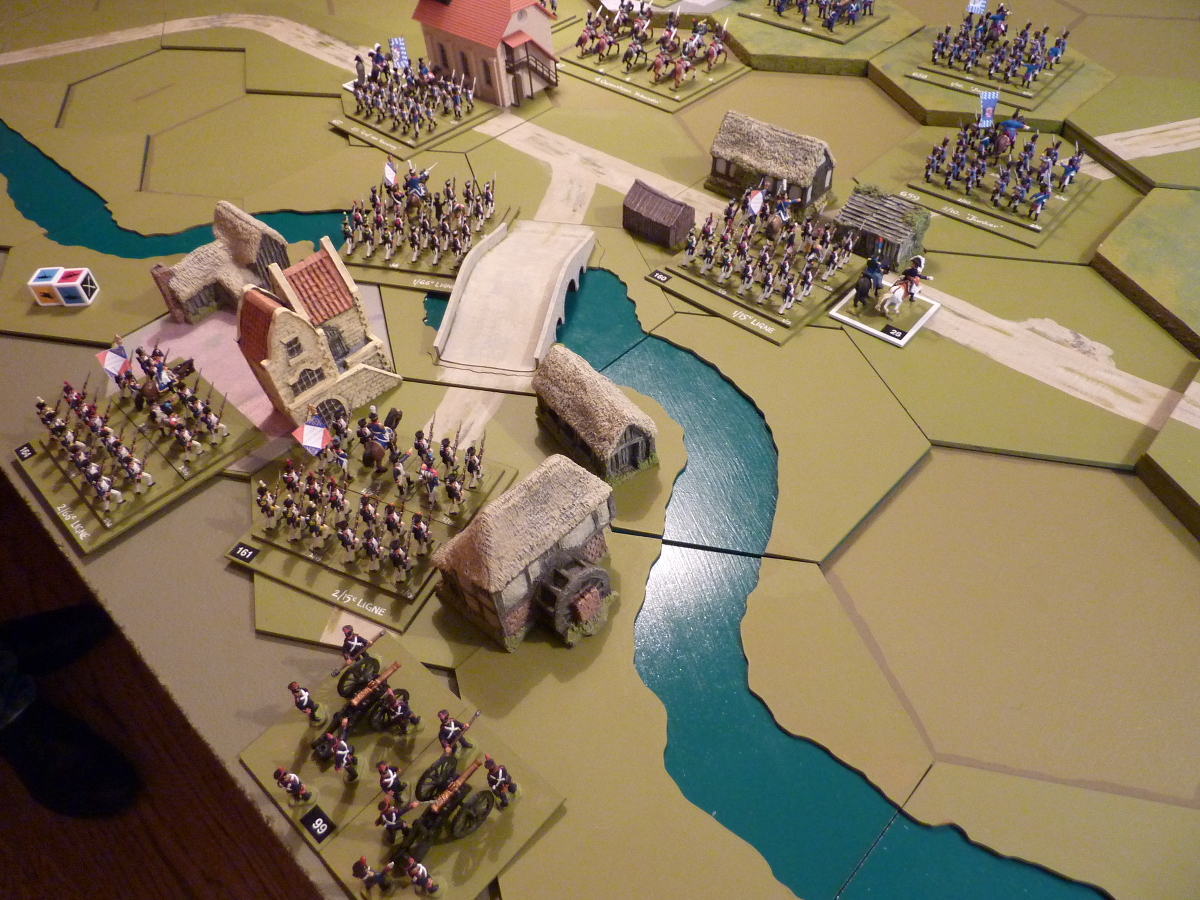
Allied forces frantically pushing the French reserve over the river early on, to support Wrede's Bavarians. A lot of congestion - a lot of tap-dancing and creative orders to squeeze everyone in.
We played to the latest upgrade of Ramekin (the house's tweaked version of C&CN), we played on a 17 x 9 hex table (that's 10'4" long) and as far as possible we fielded armies which were pretty much correct for manpower representation, though the number of separate units was understated to fit [i.e. we used a reduced number of full-strength units to achieve the correct army strength, since that saves space and the rules work best in that arrangement]. Since they contributed the bulk of the Austrian forces - and we had 21 battalions in the Austrian OOB, which is a fine effort - Goya and The Archduke commanded the forces of the Kaiser. Stryker and I were in charge of the Franco-Bavarian army.

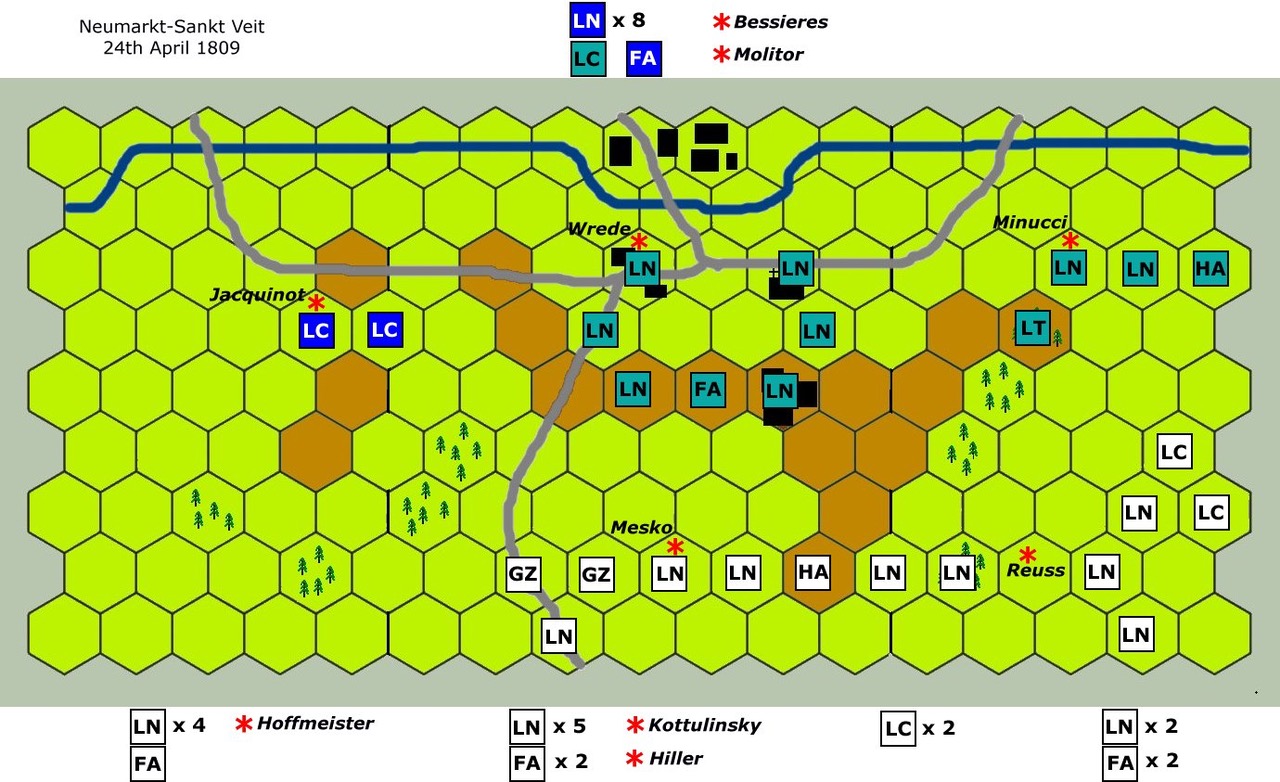
My scenario is due for a bit of criticism at the end of this post, but we'll get to that. The idea was to make use of off-table reserves. At the start, the French infantry (a division under GdD Molitor) were behind the River Rott, and thus off the table (since the river was mostly along the edge of the table). The Bavarians were deployed on the other side of the river, with their backs to it - not a comforting situation. They were placed in and around the south side of the village of Neumarkt and the Abbey of Sankt Veit (St Vitus - yes, that one), with their front line on a ridge by the village of Ober Scherm. The Austrians were arriving on the table in 3 columns. One (the left one - Hoffmeister's) was delayed, and thus had to be cued onto the field by a dice roll of 6 [test every turn!], the other two columns being well established on the table, with the rear of each column being off table but able to march on as orders and space permitted.

In the actual historical battle, the Bavarians defended their position pretty well, until things became impossible, at which point they managed a moderately disastrous withdrawal over the Rott (only one bridge at the town). I had identified that this would make an unsatisfactory game, so for our scenario the French adopted a new Plan B, by which Molitor would bring his infantry over the bridge to reinforce the Bavarians (under Wrede), and the combined force would set about the Kaiserliks before the ends of the columns came up.

Aha.

The game was pretty hectic - and I have to say this was one of the hotter afternoons of the summer so far, so the level of personal courage displayed by the generals was - what's the word? - exemplary - yes, that's it. Extra Victory Points (VPs) were available to the Austrians for every unit they managed to exit over the French baseline - having crossed the river, these units were regarded as having outflanked the French position.

I'll attempt to indicate a narrative of some sort in the captions to the photos. If you can't be bothered reading all that stuff, you need to know that the French lost, and it was not close, so for once there will be no "it could have gone either way" malarkey.

The battlefield, river and town at the far edge, before the soldiers came. John H Gill present and correct - great book, by the way.
And with the first instalment of troops - French light cavalry far left, Bavarians in front of the town and in the Abbey (famed for its lofty tower). On this side of the table, Mesko's advance guard is moving up in the centre, and Reuss's column is moving up on the right. Hoffmeister should eventually appear on the left flank.  
This is Jacquinot's light cavalry brigade - the only French troops on their right. There would have been a regiment of hussars as well, but Bessieres had detached them to go and check on something or other [historical fact]. You will hear more of these chaps later on...
View over the Bavarian-held area - the River Rott to their rear has only a single bridge, and is unfordable - yes - quite so.
Over on the French left, the view across the field shows that Prince Reuss's column is moving up nicely, and getting bigger as the off-table elements arrive. At this point, there was a lot of anxiety about the French left, and a plan was emerging to shift some of the French arrivals over to that side.
General view at this point, with Molitor's troops pouring over the river bridge, and wondering where they should stand
The defence of the southern suburb is looking less sparse, but a lot of sorting out is needed to get them organised. The centre column in the background advances relentlessly. Apart from artillery exchanges, very little combat at this stage, so any chance the French might have had of gaining some early momentum has already largely evaporated.
The Austrians are beginning to realise that they don't need to bring on all the reserves at once - they can use some of their orders for doing some actual fighting. The French took a while longer to get this idea. The soldiers in the woods are two battalions of Grenzers who, along with the IR Benjowsky of Hoffmeister's column, were the stand-out troops of the day.
Ah yes - Jacquinot's cavalry spotted a fantastic opportunity to take out an isolated battery on the Austrian left. It did not go as well as we had hoped. The cavalry units were not eliminated, but were not in a fit state to contribute much thereafter. In earlier conversation, The Archduke had wondered how a cavalry attack on artillery would go under these rules - he had his answer - he may still be grinning.
Part of Hoffmeister's column (with the man himself attached), looking to do the crafty outflanking manoeuvre and cross the river for extra VPs.
The Austrians did not mop up on their right flank, though it looked as though they might, but then they didn't need to.
More Austrian infantry crossing the river for bonus VPs - the end is close. Austrians won 10-5. The 10 consisted of 3 units advanced off the table ("outflank") and 7 French units eliminated. No staff losses on either side, by the way - unusually, apart from the heat, the Generals were all safe.
A moment for the C&C buffs. At one point, an Austrian line battalion attacked a regiment of Bavarian cavalry from the edge of a wood. The cavalry performed the correct Retire & Reform manoeuvre, which means the infantry still get a bash at them, but do not get to count "crossed-sabres" symbols, only "cavalry" symbols counting as hits. Guess what the infantry rolled? - see above. This roll would have wiped the cavalry out otherwise - as it is they suffered no loss at all - very lucky indeed!

[This is the point I reached in this post last night - I am now editing...]

My thanks to my colleagues for their enthusiasm and hard work, and especially their excellent company. Many miles were travelled on a very wet Saturday morning to assemble the troops and the players, so my compliments and admiration all round - The Archduke had a long drive each way to take part, which is an especially splendid effort! Thanks again, gentlemen - I could not hope for better friends.

The Ramekin rules worked well enough (Ramekin has now reached Ver. 2.0, and some more gentle tweaks are probably in the pipeline). The Austrians' appearance at Eggmuehl a few months ago sparked the first adjustment to kill rates. Yesterday we saw some similar situations - those 5-block Austrian battalions secure in woods. The changes in the rules do make things more reasonable, but the Austrian line units still take some stopping!


Ramble about Off-Table Reserves, War Games, Waterloo and All Sorts

Allsorts
Analysis of the scenario design is interesting - I am now thinking hard about the best way to incorporate off-table reserves. That aspect of our game did not go as well as I had hoped - though the game was fine, and a lot of fun, there is something philosophically tricky about reserves. I had spent some time before the game trying to get some insight into how this is handled in "proper" [i.e. other people's] wargames. I didn't learn much that was useful. In particular, I came across lengthy discussions on BoardGameGeek and elsewhere in which a load of guys took the opportunity to spout everything they knew about WW2 boardgames and the correct way to win a real war with bits of cardboard - I regret that I slept through quite a lot of that.

Here's the nub. At the Battle of Waterloo (sorry about this, but please bear with me a minute or two), most of the fighting took place in an area which I could squeeze into my largest table size - well, you might have to exclude Plancenoit. You could have the Allied army at one side, and the fighting would all take place around their position and in front of it - that's pretty much how the battle went, and it makes sense, since the French were attacking. That's how the game is traditionally played. Good.

Napoleon had a lot of troops a fair distance behind his front lines. The big cavalry charges, the final advance of the Guard - all that stuff - would correctly manifest itself in a game as an off-table reserve marching on. What Napoleon did not do on the day was fire a cannon at the start of the action as a signal for everyone to charge at once. When I think about it, this means he used his reserves as, well, reserves. I appreciate that the world of 6mm brings a different dimension to the game, but most wargamers of my acquaintance - especially me - guys with 25mm soldiers and normal-length arms - would, as far as possible, have just flung all the reserves in straight away to try to get an advantage on the table. The advantage is mostly illusory. You have more troops, but you can't do much with them. Napoleon (unlike me) was smart enough to realise that he had too many troops to fit onto the immediate fighting area - good practice was to bring the boys up only when you could use them. I use Waterloo because it is a well-known situation, and even I understand it, and also [whisper it] because we are pondering having a bash at Waterloo sometime.

Right - the problem in the game is partly the instinctive behaviour of amateurs like me, who were brought up on small skirmishes with embryonic collections of toys, and partly is a matter of rules. A standard approach to this might be to artificially restrict the availability of the reserve troops. The rules might say, "you may not stage Ney's big cavalry attack until after 2pm (or something), because that's what happened in the real battle". Now that would stop the beggars charging onto the field at the start, but I really don't like that as a rule. It is scripting the action, which takes a lot out of the game, and it brings you into all sorts of areas of the defenders knowing what is going to happen, how many troops it is going to happen with, and a whole pile of conditioning based on our understanding of the real battle and a load of hindsight which would not have been available to the generals of the day. As soon as your game becomes a scripted walk-through it pretty much stops being a game.

Our Neumarkt game on Saturday involved too many units to fit comfortably on the table, but the military situation was historically correct, and the idea of keeping some of the troops off the table until they could be used is obvious and (I think) authentic. Where the scenario struggled a little is that the French Plan B involved getting their reserves on the table as fast as possible and - in response - the obvious thing for the Austrians to do was to get the rear of their columns on the table too, so they didn't become disadvantaged. In other words (to repeat the message yet again - for my own benefit), the wargaming instinct was to cram everything back on the table as fast as possible - thus defeating the whole purpose of having off-table troops in the first place. Because the supply of order chips is restricted, the need to march everyone into position limited the amount of fighting, and crowded out most of the manoeuvre that could have gone into the early stages.

As I mentioned above, the Austrian commanders realised what was going on and started attacking with what was on the table - they did a nice enough job and they certainly saved the game as a spectacle. And, of course, they won rather easily in the end. If I recall correctly, 9 of the Austrian units were still waiting to come on the table at the end. Meanwhile, the Franco-Bavarian side had a lot of units crammed on the field which had not done any fighting and had mostly consumed order chips by trying to get out of each other's way. Hmmm. Mea culpa.

I have a couple of discussions going on with people whose views I have a lot of respect for, so setting this conundrum out here is not intended to preempt anything they have to say. There is something basic here that I can't get the hang of - how to make off-table reserves available, and have the rules allow the players (force the players? - nah...) to use them correctly.

Interesting stuff. 

Hmmm.


Sunday, 14 July 2019

Scenario Design for Klutzes

There will be a game at the end of the month here. Since I have no sense at all, I have taken it upon myself to design a scenario. My methodology for this involves more of a pantomime than you might expect, but here you see some breathtaking shots of the stages in the development. The rule system is my Ramekin variant on Commands & Colors: Napoleonics.

How to fit the terrain features onto a hex-grid table (start off with 13 x 9 hexes)
Having plotted the terrain (which has now grown to 17 x 9), and having sorted out the OOB, I now work out the starting situation - you will see that both sides have lots of off-table reserves headed toward the guns at the start
And then I set it all out, with the units in place - Battle of Neumarkt-St Veit - not one of Jean-Baptiste Bessiere's best days, as it turned out...
More of this in a couple of weeks...

"I never wanted this stupid gig in the first place"

Tuesday, 29 January 2019

Bavarians - Where I'm at, and What's Next

The next thing to do is to get the 3rd Divn of Lefebvre's (Bavarian) VII Corps of 1809 finished off. I still need two infantry brigadiers, a brigade of cavalry (2 regts - one of dragoons, one of chevauxlegers - plus a brigadier) and two artillery batteries (including one of Light Artillery). That will be the main components - I can add sappers/engineers and limber teams as time permits.

I may have posted pictures of some of this stuff already. Here are the raw materials for the next steps. The cavalry will all be Hinton Hunt based, and the artillery equipment will be Franznap - for gunners I have a choice of SHQ or Franznap.

The cavalry figures set out here are (L to R) an original HH Chevauxlegers trooper, then conversions produced by Wellington Man of a Chevauxlegers officer and trumpeter, and a dragoon trooper (different-shaped shabraque). I am still doing some experimentation for the command figures for the dragoon unit, but the most likely solution at present is SHQ French line lancer command figures, with HH heads and with the uniform detail re-carved as necessary, mounted on 20mm Garrison horses - we'll see how that goes.


The artillery figures are (L to R) two SHQ figures and three Franznap. Though a good height match, you can see that the Franznap figures are slimmer, and I'll avoid mixing the two breeds in any one unit, though the different makes can co-exist on the table in separate units, I think.

Interestingly, Franznap only make gun crews for the Light Artillery, which brought me back with a bump to the small matter of how the Light and Heavy(?) artillery differed. I have not had a great deal of help on this from the better known modern sources, but in fact it's all OK. The Bavarians did eventually have horse artillery, in the French style, but in 1809 the Light Artillery was simply artillery who were equipped with - erm - lighter guns (6pdrs), and the gunners had a tendency to ride around on those splendid Wurstwagen things. Uniforms? - no real difference, as far as I can tell. So that simplifies matters a bit - I might think about getting a Franznap Wurstwagen - sounds like Phase 1(c) to me.

At risk of sounding like the Golden Globes, I thought I'd mention a few people without whose help I couldn't have made the progress I managed to date - not even close, in fact. Flipping back through this blog, I see a first mention of a possible Bavarian contingent in my State of the Union report in August 2017. By 2nd April last year I was experimenting with preparing some Der Kriegsspieler castings for the first infantry. This week I have 10 battalions ready to fight - I'm really pleased with that. For help with sourcing figures, painting, encouragement, consultancy, charitable donations of effort and castings I have to acknowledge sincere thanks to Evan, Stryker, Ian P, Aulus Grammaticus, Goya, David M, David Y, Old John, Matthew, Uwe and Andreas (die Spielzeugmacher, or Brothers Grimm) and to Chuck Gibke in the US for his knowledge of the old DK ranges. If I've forgotten to mention you, then you know I'm grateful anyway - in particular Jonathan, Lee, Peter A, Ray, Aly, Ross and those others who have egged me on by making encouraging comments as the troops appeared.

Thanks very much!

Monday, 28 January 2019

Bavarians - 3rd Divn Infantry now complete

Bavarian 10. LIR "Junker"
The infantry for the 3rd Divn of VII Corps of 1809 are now finished. Both battalions of the 10th line regiment were based and provided with flags and sabots this morning, and photos taken for the Catalogue.

1st Battalion - that'll be Oberstleutnant Von Poellnitz on the cuddy
2nd Battalion
The cavalry are still to be painted, as are the artillery, but I now have the figures in stock. I'll put some photos of the artillery castings up here in a day or so. I still need to paint some brigadiers, and some sappers would be nice. It's all gone rather well thus far - I'm not sure when (or if) the 2nd Divn is likely to get started, but I have figures ready for that as well. One project at a time, if you don't mind.

And because it seemed a suitable occasion, here's a picture of all the finished infantry - here you see General Deroy, with the 5th (Buttler) and 7th (Gunther) Light Bns, and the 9th (Ysenburg), 10th (Junker), 5th (Von Preysing) and 14th Line Regts, all the line units being of two battalions.

Deroy with the infantry of 3rd Divn, VII Corps, all ready for the Danube campaign

Monday, 7 January 2019

Spiritual Support

In my search for 15mm scenery which would suit the Danube campaign, I was disappointed to find that all known previous resin buildings are now OOP - JR Miniatures used to do the Essling Granary and the Aspern Church, as I recall, but no more.

After asking around after a suitable church, I found the best option was an HO model railway church made by Faller, which I obtained online from a supplier in Kiel. I reasoned that a 1/87 model of a small church might just about pass for a 1/100 model of a larger church. When I saw the kit the old heart sank (lots of fiddly bits, optional parts, minimal instructions, glue-in-place stained glass windows, and a general assumption that the user has done this before), but Goya very kindly built it for me, and here it is, with 20mm figures to give a sense of proportion.


There is a plan for a trip up north next week, to fight Day 1 of Aspern, so the church will travel with me. I never go anywhere without a church.

Thanks again, Goya - nice job.

Saturday, 5 October 2013

Eggmuhl Giveaway - Results

I got a total of 13 expressions of interest, if I include a couple of strange pieces of related spam and a threat.

Pleased to announce that Gary Amos wins the battlefield guide (not entirely because of the blackmail attempt), and Bart Vetters wins the German-language version.

If these two gentlemen could contact me with postal addresses I'll get the books  to you.

You can email via the address on my Blogger profile or - and maybe better, since I fear that BtInternet may have screwed up my email accounts again - send a comment to this blog post which I won't publish.

Thanks to anyone who sent an "entry", and thanks to anyone who was interested enough to follow my humble adventures on the Danube.

Saturday, 28 September 2013

Minor League Giveaway - Eggmühl


While sorting out my papers and bits and pieces from my Danube trip, I found that I have a spare copy of the Battlefield Guide for Eggmühl. This is a very nice, A4 sized, illustrated publication, produced by the local tourist organisation in Schierling for the bicentennial in 2009. General editor is Dr Marcus Junkelmann. The battlefield is laid out with numbered information boards, and the guide is designed to enable the visitor to follow the course of the battle (you'll need a car!), but it also contains useful background information.

If I keep it lying around it will get damaged, so I thought someone else might appreciate it. No quiz or anything - please just get in touch, and I'll do some form of random selection on 5th October. To keep the thing reasonable, I'd like to restrict the offer to recorded followers of this blog - so, if you are not a follower and you fancy it, sign up. Bernard and I will only send you junk mail for the rest of your life...


I also have, it seems, a spare copy of the German-language copy of the same publication, so I'll make that available on the same basis. I think I only have 4 German speaking followers, so there might not be quite the same interest level for this one!

Tuesday, 24 September 2013

Danube Trip - Vienna Army Museum


This will be the last blog post for this trip. We fly home tomorrow, and today is a shopping and sightseeing day.

We spent yesterday morning at the splendid Heeresgeschichtemuseum at the Arsenal here in Vienna. I saw a lot, and took a lot of pictures, which I shall have to sort out when I get home. The rest of the day was spent walking around the city - we estimate we walked around 12 miles altogether, which should cancel out a few beers.

I was particularly impressed by the collection of vehicles - not a subject I know much about, but they looked good to me. Some of the following date from the post-war army of occupation. Here's just a selection of photos:

The vehicle in which Archduke Franz Ferdinand had an especially bad day in Sarajevo


But is it art? We are not sure what it is, but it's interesting

Carl Hilpert's in Schulerstrasse - one of the great toy and model shops. Specialist in model railways

Oh well - all right then...  supper at Joma


Sunday, 22 September 2013

Danube Trip - Well, We're Here #3

Inside the private chapel at the palace of Thurn und Taxis, Regensburg
Trouble at Regensburg (Ratisbon) - then and now

First thing to understand about the history of the City of Regensburg is that it is complicated. This is also the second and third things you need to understand.

In 1809, the city, though lying squarely within the Kingdom of Bavaria, was independent of it. Regensburg was an independent city, and please don’t ask me to explain whose it was. I think I knew at some point yesterday, but now I am not so sure. The Prince of Thurn und Taxis may well have had something to do with it, but much of its independence was based on the fact that it was the seat of the Permanent Diet of the Holy Roman Empire. Confusingly, the suburb on the north side of the Danube, Stadt-am-Hof, at the north end of the vital bridge, was part of Bavaria.

These days the city includes this suburb, and they are both part of the region of Bavaria, within the federal state of Germany. No problem there, then, though there appears to have been a little trouble during the recent bicentennial, in 2009. As part of an extensive programme of events to commemorate the unpleasantness of April 1809, a noted local historian and re-enactor was to ride over the bridge, dressed as Napoleon.

All sorts of difficulties were raised to stop this happening. Some well-intentioned soul with pacifist leanings declared that warfare and (especially) Napoleon were not suitable subjects for commemoration, though the counterargument, that approximately 1/3 of the city was destroyed, would suggest that the event had at the very least been significant.

On health and safety grounds, the Napoleon impersonator was banned from crossing the bridge, in case he and his horse fell off into the river – this despite the fact that there are no recorded cases of horses falling off in the previous 850 years. The ban was overturned, but there was a small retaliation in that a strange inscription appeared on the old gate pillar in Stadt-am-Hof, which, translated, says something like

To commemorate the dreadful day in April 1809,
all due to Napoleon, which befell the people of Regensburg.
2009

This piece of official graffiti caused further anger, since

(1)   defacing an ancient piece of the city in this way is inappropriate, not to mention illegal

(2)   the destruction of the northern suburb where the inscription was placed was entirely caused by Austrian artillery prior to 18th April, though the French did cause a lot of damage when they attacked the south side of Regensburg on 23rd April.

(3)   The conflict in the area was initiated by invasion by the Austrian army, not by the French, who were fighting in support of their Bavarian allies.

(4)   Strangely, the local authorities refused to name either the author of the inscription, or the identity of the engraver, in case of reprisals. Hmmm.

We spent much of yesterday touring the city of Regensburg – and a very fine place it is, too – focusing on the key locations connected with the French storming of the place on 23rd April. I was intrigued to note that the French attacked at a strong part of the walls, though a portion of the walls a short distance away had been demolished.

The celebrated tale of Marshal Lannes seizing the scaling ladder and having to be restrained by his aides (notably Marbot, who else?) would have been unnecessary if the attack had been made closer to the palace of Thurn and Taxis, where the walls had been removed as part of works to the gardens – the French should, in theory, just have walked in if they had attacked a little to the west. There were a good many Bavarians with the attacking troops, but it is likely that they came from other parts of the country – Regensburg was, in any case, not in Bavaria, and the main recruiting centres were Munich, Ingolstadt and Nuremberg.

As before, I’ll include some pictures to give an idea of areas we looked at.

Napoleon was decent enough to get wounded within a few metres of our hotel,
though halfway up a wall is an odd place for it to have happened

One of the few areas where the walls can still be seen - here you see the
medieval wall, with the ancient Roman wall behind it. This is in the area where
the French made their attack. The artillery made a hole in the town
which was rebuilt as a street - Maximilianstrasse

The day after the assault, Napoleon appeared on the balcony at the home of his
friend Karl Theodor von Dalberg, erstwhile Archbishop of Mainz and noted
mover and shaper in the Rheinbund. Ths was to show the townspeople that his wound was trifling

The stone bridge - a horse would probably be safe enough there

The gate pillars at Stadt am Hof, where the mysterious new inscription appeared
We are now in Vienna. If we get to the Heeresgeschichtemuseum I’ll try to put a post together. First priority is to get some homemade apfelstrudel.

I am pleasantly surprised to note that my hotel here in Vienna, when it was a private house, was the birthplace (in 1888) of Max Steiner, the composer, who is maybe best known for the scores to “Gone with the Wind” and “Casablanca”. As a sincere tribute from one Max to another, I have to say, “Play it again, Max!”.