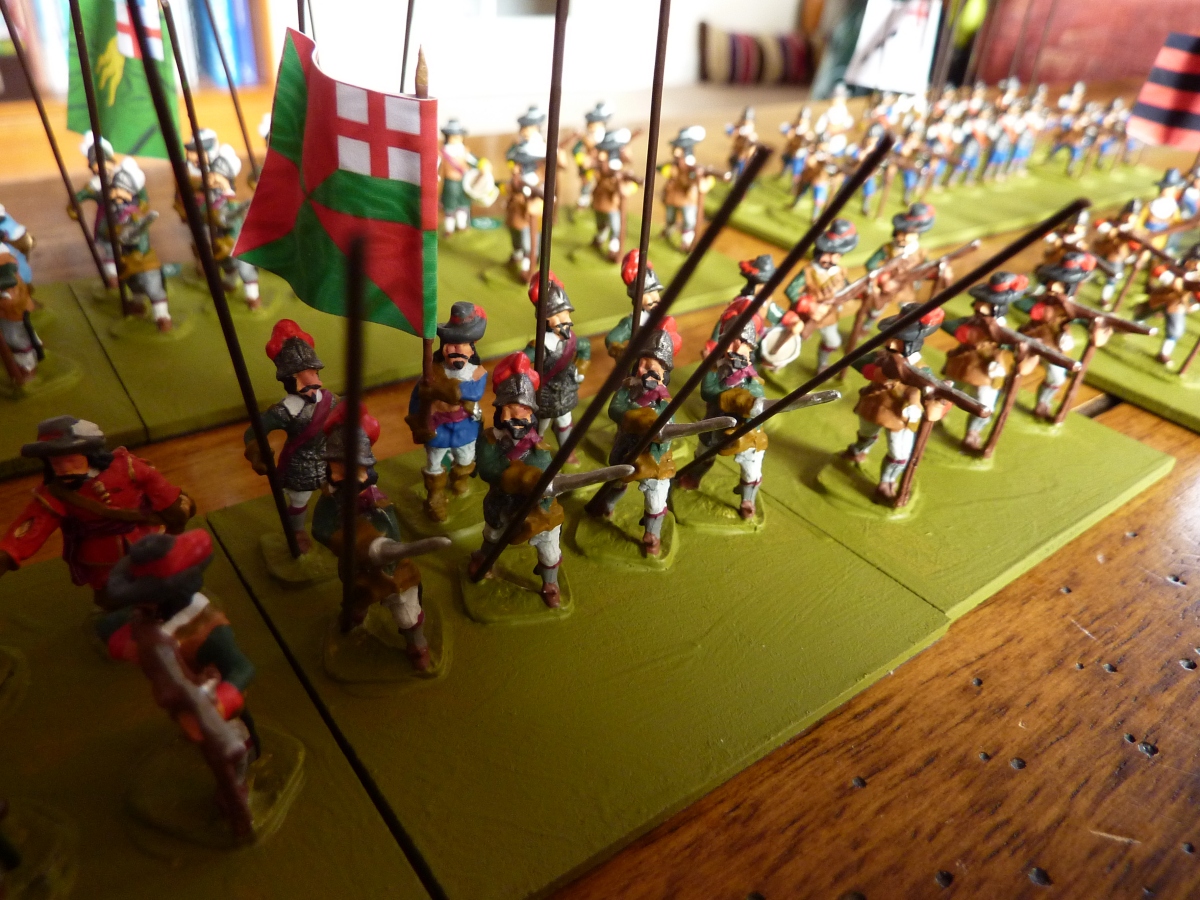
Napoleonic, WSS & ECW wargaming, with a load of old Hooptedoodle on this & that
Monday, 22 April 2013
Filler
Years ago, when life was simpler and I had more enthusiasm, I used to do a lot of figure conversions and scratch-build scenery items, and I used to use a Humbrol filler, and sometimes I used to use Plasticene, coated with banana oil in the celebrated manner mentioned in all the old books.
Recent hobby work - especially on resin buildings - has brought to my attention that I don't really have much idea what to do about filler now. Banana oil, if it isn't prohibited by Euroregs, is almost certainly plantain oil these days, and it was always dodgy stuff anyway. I have various clever two-part epoxy fillers and things which you mix together and knead by hand for half an hour before you find they have passed their sell-by date and will never set. I admit that I have even used Polyfilla on occasions to fill bubble-holes and graft-gaps in figure castings - at least it sands down nicely. I covered the brass plate on the front of a Hinton Hunt Old Guard Grenadier drummer's bearskin with Polyfilla once, and textured it with a pin, so that he could transfer to the Chasseurs. He's still serving in the ranks - no problems. Not something I would normally brag about, though.
Looking around, I see that Humbrol Model Filler is still on the market, and I believe that is the sort of thing I'm looking for - a simple, relatively non-toxic, one-tube gloop which will set quickly, sand smooth and take any kind of paint without blistering. I would happily order up some of the Humbrol, but felt a nervous twinge - in this day of wonderful acrylic things for modellers, is there something better I should be thinking about?
Yes - correct - replacing the bathroom wall heater would be a useful thing to do, but that's not what I was addressing here. Any gloop-lovers prepared to offer a little advice?
Saturday, 20 April 2013
ECW Playtest - Action at Meols Harcourt 1643
![]() |
With my feeling a lot more energetic, a little sunshine
outside and a spare Saturday to fill, Nick and I took the opportunity to give
the new ECW armies a bit of a run out, and do some further testing of the ECW
variant on Commands & Colors which I produced over the Winter.
This was real toe-in-the-water stuff. We deliberately kept
the armies small – Parliament had 5 regts of Foot, 2 of Horse, a medium gun and
2 Leaders; the Royalists had 4 of Foot, 3 of Horse and 2 Leaders.
The action took place in April 1643 around the mythical village of Meols Harcourt , which controls some key
crossings – a ford and an ancient stone bridge – over the River Hassop, which
might well flow into the Lune further west. We also kept the game simple –
since it was an early try-out we did not categorise any of the units as Veteran
or Raw or Militia (though we could have done) – the only complication we
deliberately included was that we made all the Royalist Horse Gallopers and
their Parliamentary opposite numbers Trotters.
It went fine. We were a bit slow, perhaps, because of all the
checking of rules and general unfamiliarity, but we hit no problems. It’s a
nice, crisp game.
The action suffered a little from having no real objectives
– obviously the forces had blundered into each other, and the idea was just to
cause maximum damage. The Royalists had cavalry on both flanks – Lord Byron’s
regiment crossed the river early on at the ford. Philip Egerton’s foot regiment
hurried to prevent the crossing, but they were driven back and then very
roughly handled once the horse were safely ashore. On the opposite flank a
lengthy and vigorous fight between the remainder of the horse (2 regiments on
either side) caused heavy loss to both sides, but was not decisive.
Eventually, the infantry forces in the centre came into
contact, and the Royalists just about won the day in this area – a bit of a
grinding match. On the Royalist left, Byron’s horse – delayed by a lack of
orders (i.e. suitable cards) eventually rolled up the Parliamentarian right and
the King’s men had won. Lord Byron and Sir Wm Fairfax were both wounded
in the process. They’ll be back.
Observations on the
Rules:
The Chaunce Cards had no effect at all today – only one was
played, and it was a False Alarum. I would expect a typical game to have more of
these.
We saw none of the unstoppable, rolling cavalry melees that
Clive and I experienced at the first playtest. The Gallopers had an edge in the
first round of any melee in which they were attacking, but did not necessarily sweep away the
opposition. In this action the cavalry pretty much cancelled out, though
I think the Parliament guys might have had some lucky dice to sustain that.
Artillery in melees, as designed, cannot fight back. The
best they can possibly hope to do in such a situation is somehow survive until
someone rescues them. If they are isolated, they are dead ducks in a melee.
Command Cards worked well – the Evade card was well used (one for each side) and a card called The Lord Is with Us produced a good
advantage for the Royalists at the end, contributing bonus dice in three simultaneous
close combats.
![]() |
| Harcourt House, home of Lord Meols |
![]() |
| Meols village |
![]() |
| Rigby's men [P] behind the tavern |
![]() |
| Parliamentary horse on the left - Dodding's & Lambert's |
![]() |
| The ford |
![]() |
| Sir Wm Brereton's RoF [P] |
![]() |
| Rigby's again - waiting for orders... |
![]() |
| Belching Norah |
![]() |
| It is recognisably C&C |
![]() |
| Lord Byron's Horse [R] ford the river |
![]() |
| The cavalry action beyond Harcourt, which lasted most of the afternoon |
![]() |
| Philip Egerton's Foot unsuccessfully try to prevent the Royalist horse crossing the ford |
![]() |
| Prince Rupert's Horse just about hold on to defeat Dodding's |
![]() |
| General view from the Parliament left, mid afternoon |
![]() |
| Gallopers from the Northern Horse [R] attack Lambert's Trotters (who held them) |
![]() |
| The infantry battle in the centre develops... |
![]() |
| ...and things look very bad for Rigby's, who should have stayed at the pub |
As is usual now, Nick did the photos. Thank you, Nick.
Monday, 15 April 2013
More on Scans of Old Books
![]() |
| The ghost in the machine |
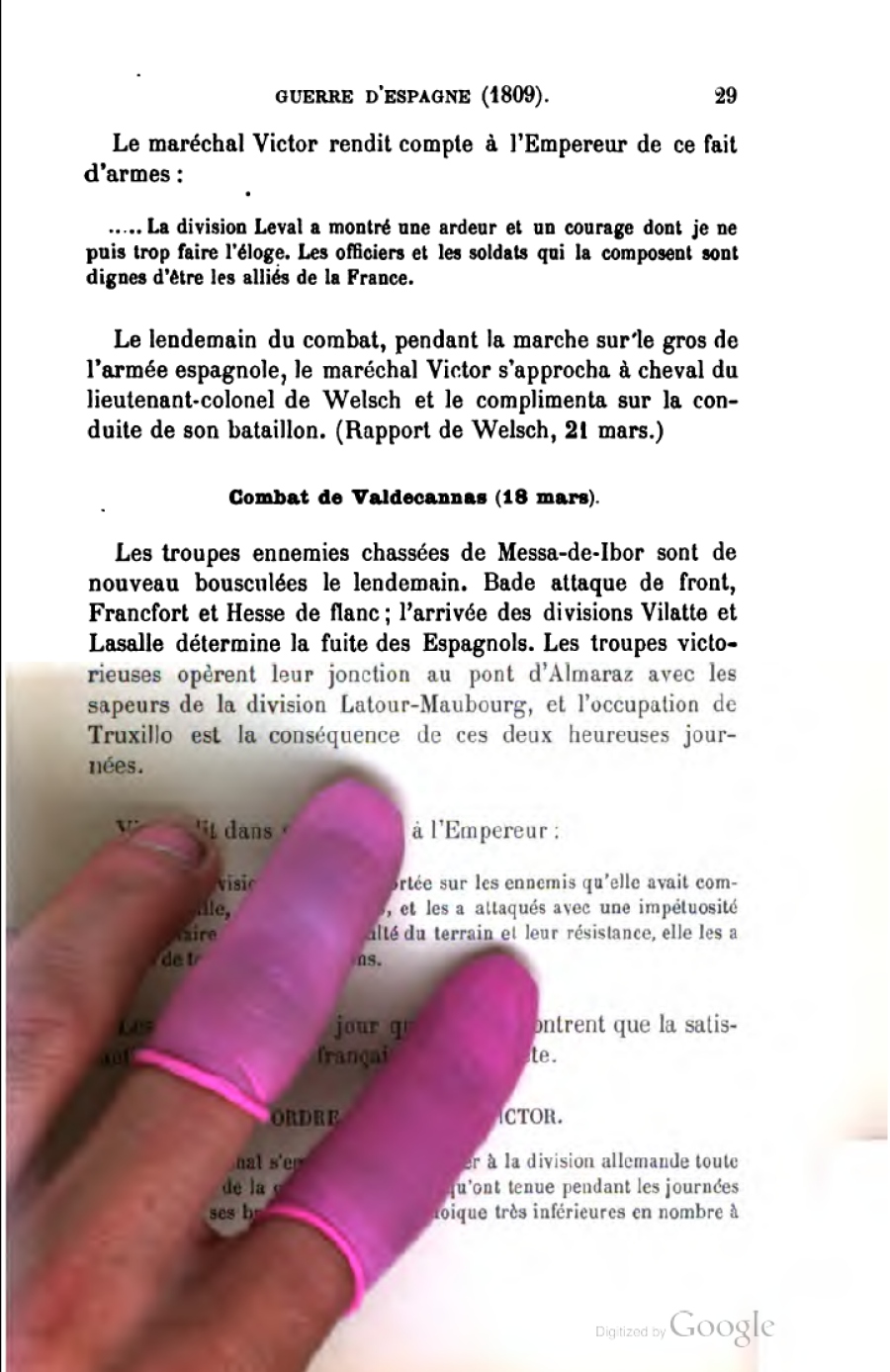
I wouldn't argue with that. My only gripe is that it would be nice if the quality of the job was always up to the worthiness of the intention. I imagine the scanning work being carried out by underpaid but overqualified inmates of a big library somewhere. Whoever does it, then God bless them, but a bit of inspection and quality control after the event would offer so much extra value. The picture at the top of this post is an excerpt from Google Books' pdf version of Les Allemands sous les Aigles Francaises - Tome 1 - Le Regiment de Francfort by Lt Colonel Sauzey. It is good that the anonymous backroom staff should occasionally get a bit of visibility, and also good to note that Google obviously encourage the practice of safe librarianism.
In addition, I wish to make some quick - and largely uneducated - observations about the products of a company or companies known variously as Nabu, Biblio and other things, whose mission in life is to make rare old books available in print once more, by exactly this same scanning process. Some of these books are print-on-demand products. I would describe them as approximate facsimiles. I have nothing at all to say about the copyright implications, nor on the apparent furore arising from the public thus having access to works which otherwise exist only in American libraries or private collections. I think I have two specimens of Nabu's output. They are alarmingly slipshod, and the books are not especially cheap.
![]() |
| Strange that the translator of Foy's work knew HTML? |
These books also have a surprising number of missing pages - presumably the operator sneezed, or ended his shift, at these points. Fortunately I have a complete pdf-file version of the same books, so have been able to fill the gaps in my own copies by including printouts of the required pages. Something seems not quite right, though, and I am not comforted by Nabu's published policy statement, part of which says:
This book may have occasional imperfections such as missing or blurred pages, poor pictures, errant marks, etc that were either part of the original artefact, or were introduced by the scanning process. We believe this work is culturally important, and despite the imperfections, have elected to bring it back into print as part of our continuing commitment to the preservation of printed works worldwide. We appreciate your understanding of the imperfections in the preservation process, and hope you enjoy this valuable book.
Cobblers. Are there any grown-ups at home?
I thank Nabu for their good wishes, and note that they are also committed to saving on production costs by not bothering over much with normally accepted ideas on quality assurance.
Not recommended.
Sunday, 14 April 2013
e-Readers - What to Do?
I own a Sony PRS-505 e-Reader. I’ve had it a few years now.
Originally I was really very pleased with it, and I have used it a lot, but
gradually it is becoming just another electronic white elephant. It lies about
the house, and on the rare occasions I wish to use it the battery is invariably
flat. I don’t mean to be unkind to it, but if I stop using something it usually
has some significance, if I can just work out what it is. Something like
“voting with my feet”.
Much of my disappointment with the Sony machine is a result
of the e-book market not moving in the direction that was predicted when I
bought it. I bought it because my main interest is in being able to read free
downloadable pdf format books – mostly 19th Century memoirs and
histories. I have a great many of these, mostly obtained from Google Books or
Project Gutenberg. Much of the specification of what I need my e-reader to do
is built around things I need and things which I do not like and am not
interested in.
* I do not wish to be glued into a single supplier (such as
Amazon) – they do not offer the books I am looking for.
* I require scanned pdf’s to be readable – one problem with
my current machine is that the pdf’s have to be especially clear to display at
all. Another is that the display size is not adjustable for pdf’s, and the
simple task of turning the page requires the entire book image to be
reformatted or reflowed, which takes about 20 seconds.
* I cannot use epub books for the material I study. It’s a
nice idea, but the automatic character-recognition software used to construct
these things at Google is mostly a joke. Being American, it has little patience
with strange, foreign concepts such as accented characters, or with 19th
Century fonts, and it also attempts to interpret squashed insects and footnotes
– to very strange effect.
* I am a dinosaur. I do not wish to share my books with all
my friends by installing them in a cloud or similar, I do not wish to browse my
collection by Genre or Playlist, unless the management software is really intuitive
and helpful. I like drag and drop and organised hierarchies of folders, and I
wish my portable device to be USB compatible, and to be recognised as a
detachable storage device by my computer when I plug it in.
* I do not care for iTunes or RealPlayer – mostly the software
for these is banned from our house. Also Creative’s software products – I have
a nice little Creative Zen mp3 player, which is almost ruined by the moronic
management software. These things, apart from being a pest to use, will usually
try to install a whole pile of stuff you don’t want, and make themselves the
default for every kind of file you use. Creative even re-installs itself after
you remove it...
* More positive – my wife has a Kindle and loves it. She
uses it properly, and downloads actual Kindle books, and it is great. It will
pay for itself all over again this year when we go away on holiday. We do not
know how to install pdf’s on it, and somehow it would feel wrong to have to ask
Amazon if it’s all right to download a book which has nothing to do with them.
The newer Kindles look even better, though I do not wish to have one which
thinks it might be a tablet. I need to find out how easy/possible it is to
install my dirty old French memoirs on a Kindle, without passing through my
Amazon account and without straining my poor brain, which is almost full.
* There are books available from Sony’s own eBook store, but
they are expensive, not very interesting, and the range and scope seems to be
much less than was expected a few years ago. Not a promising source.
* For a little while, it seemed to me that tablets might be
the future of reading books on screen. The drag and drop and file management
arrangements look about right, screen clarity is excellent – I really thought
that tablets might blow the Kindle (etc) market out of the water, but it
doesn’t seem to have happened yet. The trade-off between portability and
readability is tricky, and a decent tablet is potentially a bit large, a bit
fragile and definitely a bit expensive to shove in your pocket just so you can
read a book on the train.
* Of course, I have a friend who tells me that he always has
some books installed on his iPhone. Only in his more relaxed moments will he
admit that he finds them very difficult to read, and therefore doesn’t use this
facility. Bong! [i-Idiot alert]
* It is very unlikely that G4 will ever make it this far out
into the forest...
* This morning I watched a couple of YouTube reviews on
using Kindle with pdf’s, and they were quite frank about the fact that a 9-inch
tablet or a Sony reader (not the one I’ve got, I guess) are a much better
option, because of slow refresh and memory issues.
![]() |
| Dirty old French book - no wonder they say I'll go blind |
I think some kind of vague idea of what I would like is
taking shape. Ideally, I would like to find some miraculous way to make my
existing PRS-505 into all the things I hoped it would be. Failing that, I
really like the format and clarity of the new Kindles – particularly the PaperWhite,
but have not yet read anything that assures me that I will be able to shift pdf’s
of Marmont’s Memoires and Sarrazin’s
history of the Peninsular War from my desktop computer to the device, and be
able to read them comfortably if/when they get there.
Given a Kindle, I’m sure I could also occasionally find
something available in Kindle format which I was interested in, and buy it for
download in the approved manner. Despite my traditional anti-Apple (for
example) posturing, I have a fairly open mind about what sort of device I need,
though the cost and practicality have to make sense. Some of the received
wisdom online appears to suggest that what I really want for this role is a
cheap 9-inch tablet – Nexus? Could this just be the next white elephant? Hmmm.
If anyone can understand what I’m on about here and can
offer a little advice (preferably based on actual experience rather than statements
of faith from the Apple Chapel, for example), I shall really be very grateful.
Embarrassingly so, perhaps.
Friday, 12 April 2013
Hooptedoodle #84a - The Big Drop
![]() |
| Our resident artist's impression of the alternative Lottery Rainfall system |
Further Mathematical Rambles with a 10-year-old
The only connection with the previous post is that this one
also is prompted by conversations with my son. For a while we have chatted idly
about the idea of the rain falling as a single drop – which is potentially
amusing and environmentally catastrophic at the same time, but doesn’t actually
convey very much unless you try to put some numbers on it.
Numbers would also involve defining some boundaries. It
seems unlikely that Nature would distribute rainwater to match municipal or
parliamentary dividing lines, but we can well imagine what, say, an inch of
rain looks like, in the measuring glass, in the puddle on the lawn, in our garden,
in our county...
We spend a significant amount of time watching, or being
aware of, rain falling outside the windows. Our own county seems a reasonable
area to consider – we know it pretty well, can envisage it. An inch of rain is
a reasonable concept, too – it is not uncommon to get an inch on a particularly
wet afternoon. I am confident that I have taken part in many picnics, hill
walks, barbecues, football matches and so on which involved an inch of rain. I
have also, I am reminded, visited the odd battlefield in such weather.
OK – to specifics. We had a go yesterday. The results are
the sort of thing that prompts reactions such as:
1) Wow
2) Imagine that
3) What shall we play now?
4) I wonder what’s for tea?
This is an honest effort here, but we make no guarantees
about the decimal point always being exactly in the right place – decimal
places are not a strong part of my act. East Lothian is a small county on the
East coast of Scotland .
It seems it has a land area of 679 sq Km, which is certainly not large. If we
take 1 inch as 2.5-something centimetres, an inch of rain all over the county
(imagine, if you will, a rain cloud the same shape) gives a volume of almost
exactly 17 million cubic metres – that’s 17 million metric tonnes of water. Two
tangential thoughts – firstly, that represents 867 metric tonnes for each
resident in the county, and – secondly – intuitively it seems astonishing that
such a delivery doesn’t batter us to our knees and flatten everything in sight.
And remember, an inch is not an exceptional amount of rain for a single day.
Obviously this all works because the stuff is sprinkled
gently over the area, trickles into ditches and streams and drains, then into
rivers and eventually into the North Sea , apart
from any bits we choose to keep for later use. Our original idea, though, was
to examine the effect of applying a National Lottery principle to rainfall, and
dumping a single, giant drop on some poor fellow at some random point in the
county [tee-hee]. One inch for East Lothian , we calculate, would require a spherical
drop of water 318 metres in diameter – i.e. a bit larger than the average
football stadium.
That’s big, isn’t it?
![]() |
| For later use - Hopes Reservoir, Lammermuir Hills, East Lothian |
I wonder what is
for tea?
If you realise that we’ve messed up the arithmetic, and the
required droplet is disappointingly smaller than this, there’s probably no
point in letting us know, since our attention span has now been exceeded. We
are bored with this now, and are moving on to consider other sources of wonder,
like how much does the moon weigh, and why wood-pigeons always say exactly the
same thing.
Wednesday, 10 April 2013
Hooptedoodle #84 - Fun with the Recycling
With the completion of the ECW infantry, I was once again
encouraged to look at the rate of increase in my collection of painting
bottle-tops, and also the likely trend in the sizes of my future
figure-painting batches. The two curves do not meet, my friends. I have reached
a situation where I cannot throw out a bottle-top of the two proscribed types
(Tesco’s fizzy mineral water for infantry and Tesco’s semi-skimmed milk
containers for cavalry); the collection is continuing to grow without purpose,
simply because it has been doing so for a while and it is hard to break a
habit.
So I have decided to keep 40 of the little ones and 30 of
the big ones, and throw the rest out. Sorry -
that should read “put the rest in the recycling bin”.
My son (who is 10) is a real maths enthusiast, so we spent a
little while piling them up before they went away, and did some messing around
with tetrahedral pyramids, and a touch of gentle finite difference theory to
see if we could construct a formula for the number of bottletops in a
tetrahedron of side n (and so on). Oh
what fun....
We had enough of the smaller tops to make a tetrahedron with
a side of 11 tops, it turns out, which our formula tells us contains 286
bottletops. It did occur to me that if I have the spare time to fiddle around
with this stuff (it was for the boy, really...) then someone else might have
the time to look at a photograph of the event.
![]() |
| The eleventh tetrahedral number is 286 |
Good, eh?
We have subsequently thrown them out (though it was a
struggle to part with them in the end), together with the other surplus tops
which didn’t fit into the construction. Now then, at 500ml a bottle, let’s
ponder how much water that represents, and where it has all gone now. And then
there’s the gas...
Hmmm.
Tuesday, 9 April 2013
ECW - Finished the Foot
A small landmark today - still maintaining strict parity (8 units of foot for each side), I've now completed the infantry target for the first phase (you mean there will be a second?) for my ECW project.
Here are the Royalist greencoats of Broughton and Gibson, on the left, and the Parliamentarian units of Brereton and Mainwaring. Dragoons and artillery are coming along, and recruitment of cavalry will continue for a while.
The odd lighting in the photos is the result of a strange luminous object appearing in the sky over South-East Scotland today. I feel an inexplicable urge to rush out and sacrifice a lamb, or a maiden or something.
I was listening earlier to a discussion on the radio - some people were complaining that a ceremonial funeral for Lady Thatcher seemed a bit of an extravagance in the current economic situation. I think it is an excellent idea - in fact, I think they should break with tradition and hold the procession in Leeds, or maybe Glasgow, so that her loyal former subjects can take the opportunity to show their gratitude and affection.
I'll see you there? Looking forward to it.
Subscribe to:
Posts (Atom)