I received a pleasing number of responses to my quiz, some complaining that it was ridiculously difficult, some that it was too easy, and some (correctly) identifying that the photo is misleading. On the other hand, the actual history involved is also very misleading, so I shall attempt to explain the background story, hopefully without causing unnecessary further irritation!
Straight away, let me announce that the city is Regensburg, which has been a major strategic river crossing on the mighty Danube since ancient times. Nowadays it is in Bavaria, though at various times in the past it was a free city. It has also been known as Ratisbon, which comes from an old Celtic name, Radasbona. The Romans built a major fort there in AD90, which they called CASTRA REGINA [fort on the (River) Regen].
My photo shows sections of several buildings, all with different dates and histories of rebuilding. This whole area is known locally as the Altes Rathaus, though which bit was the actual working administrative HQ of the city varied from time to time. In the picture, on the right, the pale-coloured buildings, including the foot of a tower, are the site of the very first Rathaus for the city, which was built in the mid-13th Century, close to the Roman fort and the commercial centre. The building on the left, which is a sort of mustard colour and was later known as the Reichssaal, was built as a posh new add-on to the Town Hall in the 1320s as a big assembly and function hall, appropriate to the dignity and aspirations of the thriving city.
The building in the angle of these two older buildings (with the ornate doorway) is called the Portalbau, added in 1408, and upgraded in the 1560s, to provide covered access between the two buildings. At this point, the story becomes easier to follow if I produce another picture, borrowed without permission from Google Maps.

Here you can see the Reichssaal, on the left, with its distinctive balcony looking onto Rathausplatz, and the original Rathaus location, along to the tower (which was rebuilt in the 1360s after a fire), with the Portalbau in between.
During the 16th Century the Reichssaal became the preferred venue for the assemblies of the Holy Roman Empire, and from 1594 these Reichstag meetings only took place here. From 1663, the Perpetual Diet of the Holy Roman Empire was in permanent residence here, until Napoleon put a stop to the Empire.
To allow space for a functioning Town Hall for the city itself, the two wings of the Baroque town hall which you can see in the lower right corner of the Google aerial view were built in the 1660s and the 1720s. In this period, this was the Neues Rathaus, though in the 1930s a complete new administration centre for the city was built some distance from this site; this modern building, then, is truly the New Town Hall now. The Altes Rathaus now houses a fine museum and the main Tourist Information office for Regensburg.
Apologies for the complicated story! In summary, the answers to the 3 questions in the quiz are:
(1) Regensburg
(2) The city built a new Town Hall next door to the old one because from 1663 to 1805 the Holy Roman Empire's Perpetual Diet was in constant session in the existing buildings!
(3) My original photo shows several constructions, of different ages; they all form part of what is known as the Old Town Hall, though the location of the actual city management function changed from time to time under outside pressures!
For completeness, here is the modern Burgerbüro, some distance to the east:

My thanks to everyone who responded, in particular I received excellent answers from Jon Freitag, Dan Sarrazin, Martin S, nundanket, Cec Rhodes, Rittmeister Krefeld and Rigor Mort; after due deliberation, I decided that the best answer of all came from Count Goya - a splendid effort, with accurate historical information and humorous modern political analogies.
The noble Rittmeister also drew attention to the crossed-keys symbol, which appears in my photo at the top of this post, above both archways. Here's a close-up:
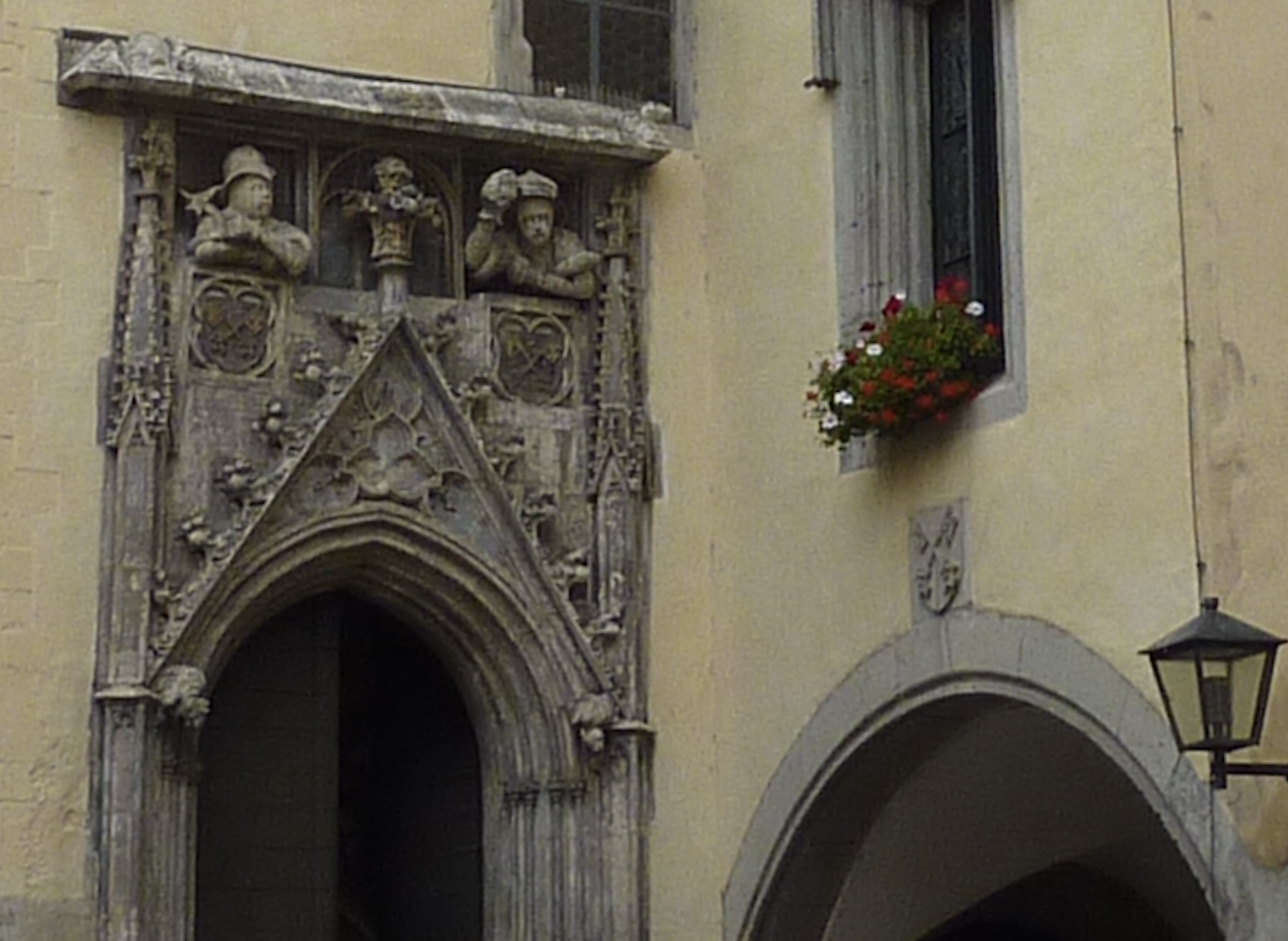
This symbol is a traditional Papal cipher, associated with St Peter and the Keys of Heaven (St Peter is the patron saint of Regensburg), and it has been in use as the arms of Regensburg since the 13th Century, so it is a useful clue. The slightly bad news is that it is also featured on the arms of well over 400 other towns and cities, including York, but no matter.

Interestingly, nobody who submitted an answer was interested in the prize, so the mugs will go to our village charity shop! I am alarmed to note that 4 of the entrants either have Covid or are recovering from a recent bout, which only increases my admiration.

Thanks very much for your time and interest, everyone who read the blog post and/or took part!