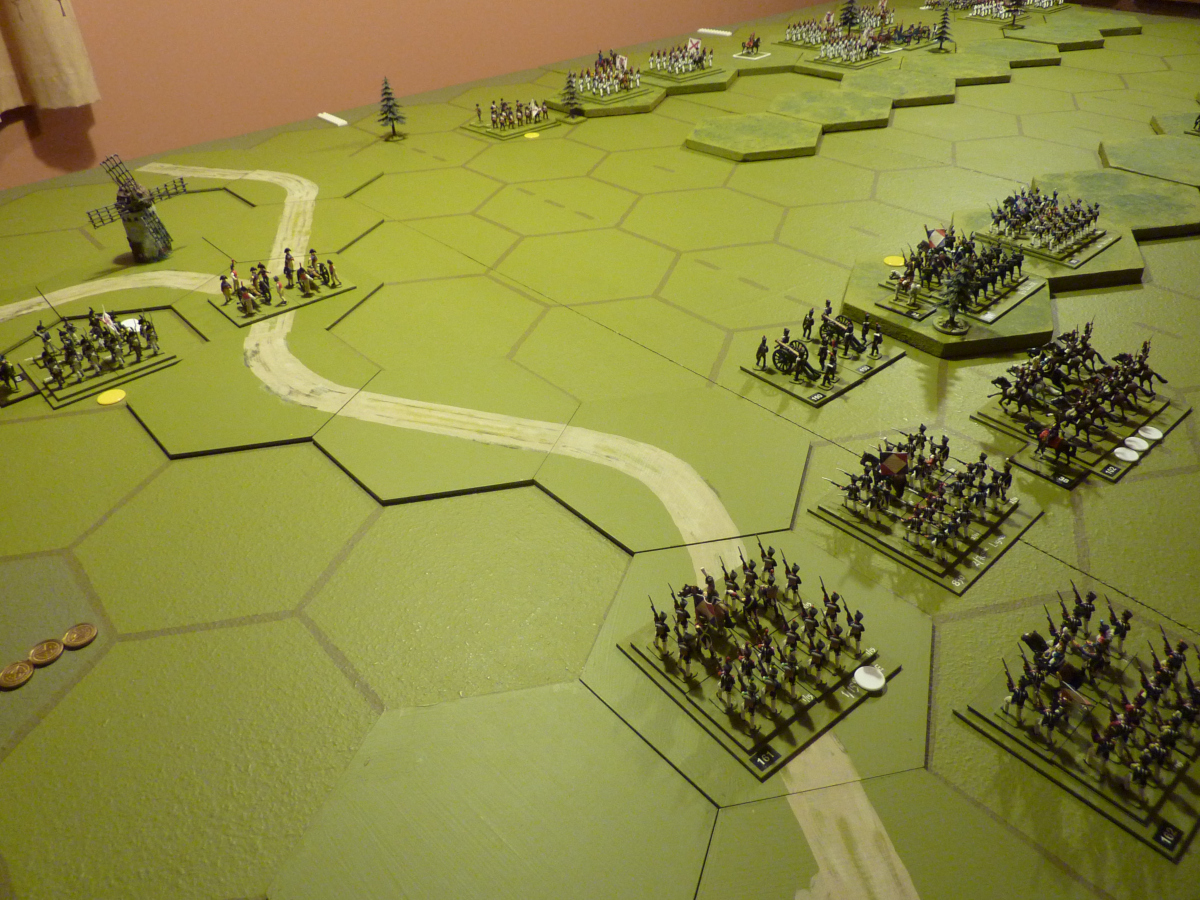
The end of this last week saw me involved in Zoom wargames on two consecutive evenings, which is unusual for me and was also very enjoyable. On Thursday I took part in one of Jon Freitag's superb extravaganzas [which you will find beautifully reported on Jon's blog here - thanks again, Jon] and on Friday I hosted a game of my own at which I had the same opponent - the Jolly Broom Man.
My own game was a return to the English Civil War; one objective was to try my Corporal John rules, which were developed to work with the War of Spanish Succession, with a few little tweaks to handle the ECW. JBM and I have been interested to try this for a while, to see if it might offer an improvement on my extant rules which I call CC_ECW, a name which is hardly poetic but gives an honest tribute to its origins.
In fact the two sets of rules are cousins, since one is based on Richard Borg's Command and Colors system and the other comes from Tricorne, which is Borg's application of his game system to the AWI. One distinctive feature of Corporal John is that musketry is subsumed into "Close Combat" as one of the unpleasant things which opposing units do to each other when adjacent, and the only explicit ranged combat which remains is artillery fire. This explanation is already sounding a bit dry, so I shall move on to the game itself.
I revamped a game which I had played years ago with my son (who was then 10, as I recall), which is set in my favourite context of the First War, before the New Model period removed much of the entertainment from the games, and also in the very amateurish North of England, my original home patch, for which I retain a great affection and for which (for the most part) I constructed my armies. The original edition of this game, as it happens, has a little resonance here because it was an early try-out of CC_ECW, which became my house ECW rules.
An old photo of my original game, in 2013, shows Alexander Rigby's Regt of Foot [P] standing guard in the village of Meols, which will have some echoes in the re-run
Thus my game on Friday was a re-run of the fictional Battle of Meols Harcourt, rather larger than the original (since the armies have grown in the interim), to see if Corporal John could handle it. JBM has offered me heroic support with Corporal John throughout its development, so I was delighted to have him on board again.
[Purists should approach what follows with a plentiful supply of salt, since our narrative may not sit comfortably with other, better-established versions of history, and some of the units and leaders present may well have still been in other places around the same time...]
Action at Meols Harcourt, some date in 1643
Back story and scenario notes
A Royalist force commanded by James Stanley, formerly known as Lord
Strange (no, really) but who became the Earl of Derby on the recent death of
his father, is on the march to secure the town of Preston, in Lancashire, for King Charles. The
Earl has something of a problem with maps, and his army has made slow progress,
though they have succeeded in stripping the countryside of horses and food as they went along.
Meanwhile, the Puritan commander of Parliamentary forces in the area,
Sir William Brereton, leads a rescue force to relieve a reported Royalist
blockade of Lancaster, but finds himself instead following the trail of wreckage
which marks the passage of the Earl’s little army, in the general direction of
Manchester. Something goes oddly wrong, and both generals are surprised to find
that they are actually marching towards each other, and come face to face one
misty Tuesday morning in farmland near the village of Meols Harcourt.
The village is on the land of the Twining family, a branch of the Heskeths, who live at nearby
Harcourt Hall. There is a good bridge over a little river, Hassop Beck, which
is otherwise fordable anyway. Hassop Beck may eventually run into the River Weaver
– the Earl’s people aren’t sure.
So this is an encounter battle - no strategic objective beyond chasing the enemy away. Since the Royalists have the better army, they
will probably take the offensive (and will move first). Brereton is gradually
starting to believe that he cannot defeat the Royalists in the field, so he may in any case prefer to take a more passive role.
7 of the Royalist units are rated as Veterans; Parliament have no
Veterans, but do have 6 newly-raised regiments rated as Raw. All Royalist
cavalry are classed as Gallopers; Parliamentary cavalry are Trotters. The
armies are very similar in composition (amazingly so, in fact). Each side has
20 combat units, so my standard algorithm involving the roll of 2D6 gave a
requirement of 9 Victory Points for the win.
[It is a feature of the early years of the conflict in Lancashire that some prominent Royalists were exiled from the area - Tyldesley, Gerrard, Molyneux are examples - and subsequently raised significant regiments for the King, which went away to fight in other parts of the country. This did nothing to help the Royalist cause in Lancashire itself, but it does mean that if (as on Friday) these regiments return to their homelands they bring with them a level of experience and competence which the Parliamentary troops cannot match.]
The river is just a water-splash, but has quite steep banks. Units
fording it must stop in the river, but may carry on next turn. All units
standing in the river or coming out of it must deduct 1 combat dice, and
artillery may not fire while standing in the river. The (walled) Hall and the
village count as built-up areas. There are two ploughed fields which count as
standard enclosures in the rules. Monument Hill on the edge of the table is
very rough terrain, and may not be entered. There are no points-scoring
objectives on the field.
Here is our OOB for the day - the "unit number" simply helps me to find the correct soldiers in the ECW boxes!
Rules tweaks for Corporal John
I shall only briefly mention what had to be done to transplant the rules to a period 60 years earlier. Some weeding out of anachronistic Combat Cards was necessary (not many), and we had patches to cope with a few characteristics of the earlier war:
* The early war situation of "Galloper" cavalry vs "Trotters"
* Stand of Pike formation ("Hedgehogs") against horse
* Slightly altered role of dragoons
* Incorporating a Veteran / Trained / Raw classification into the Corporal John combat and Rally Check systems
* Similarly, named leaders would have different abilities
Let's get on, shall we?
In my usual manner, I shall hope that some kind of narrative emerges from the pictures and captions.
View from Parliament's right flank at the start. The village and Harcourt Hall are visible at the far end of the field. From this end, the groupings are Thomas Myddleton's horse, Henry Mainwaring's infantry and William Fairfax's horse on the left
After one turn, it can be seen that Brereton's (JBM's) troops are already advancing with unexpected vigour - we are left to assume that his rather more bellicose flank commanders had a major influence. On the right of the picture, we see the Earl of Derby's Royalist troops: Thomas Tyldesley with the horse on the left flank, Henry Tillier with the main body of foot and Sir John Byron with the horse of the right
There is no question of John Byron backing down from a scrap, so a cavalry action between his troops and William Fairfax's began to shape up, and would continue all day
From Parliament's view, some of Mainwaring's infantry advance to the area around the village, while the remainder and Myddleton's horse move up towards the river in the distance
Ah yes - the Beck. This was specified as very moderate obstacle, and crossing a water-splash in one's own time is simple enough, but troops facing each other across the stream were understandably reluctant to fight their way across - early attempts by the Parliamentarians did not go well, so this area became something of a stalemate - a lot of glaring and swearing went on, but very little decisive action
Still the cavalry action on the Royalists' right, beyond the village and the Hall, is brewing up...
By an odd quirk of fate, Rigby's foot find themselves back in the village, as they had been in the first edition of the game, 11 years ago. Apart from the white "loss" counters [white shows up on Zoom far better than the regulation black], you may also see that Raw units are marked with yellow counters and Veterans with red - everyone else is Trained. If you see a purple counter (and you probably won't) then that denotes dragoons. Blue counters mark activated units, and shouldn't really appear in end-of-turn photos unless I've omitted to tidy them away [you can't get the staff, you know]
Attempts are made on the Parliament right to cross the river - these went badly enough to discourage much more of the same
Back at the cavalry fight on the other flank, the rule introduced to give Gallopers an advantage against non-Galloper cavalry at the start of an individual melee suddenly produced a remarkable result - the tweak allowed the Gallopers in such a situation to count crossed sabres as a hit - here is a photo to commemorate Marcus Trevor's RoH, with John Byron leading them in person, decisively overwhelming Shuttleworth's Lancashire Horse...
...and as the Parliamentary left wing fell back (William Fairfax was seriously wounded at this point), the flank was suddenly open
Rather late in the day, now that it was becoming obvious that the situation on the river was not going to change, the Royalists brought up more of their veteran foot in the centre
Sir William Brereton, in his best Puritan hat and accompanied by his trusty groom, Hector Smallpiece, suddenly realises that the Royalist right wing cavalry is now in his rear
Having held the village against allcomers through the day, Rigby's boys emerged into the open and were attacked by Lord Molyneux's horse, and, since their retreat was cut off, surrendered to a man, which made the VP count 9-3 in favour of the King's men, Lord Derby notwithstanding. The day was won
The position at the end - still with a stalemate on the river (no-one dared to attempt to cross, but neither side could risk giving the enemy an opportunity to cross in peace), the Royalists have taken the area around the village, and are heavily involved in the centre. The Earl of Derby, still firmly rooted on his baseline, is notified that his side have won. Since it is God's will, he is not surprised
As a closing shot, here is Tyldesley's cavalry, next to the river on the Royalist left flank, looking ready and able, but never in action throughout the day
Rules: brief footnote - the Scrabble rule
I did not intend to get into this, but there was a classic instance of something which is always a possibility in C&C-type games, which prompted some useful discussion afterwards and which will probably generate a rule change.
I describe this from my own viewpoint on the table, but the situation must have been the same for both.
Because Lord Derby was rated as something of a pudding as a commander, my Royalist hand of Command Cards consisted only of 5 cards. Since the river situation meant that we were both stuck in a stalemate on what was my left flank, I had a gradual build-up of cards allowing me to activate units on my left - eventually I had 4 such cards in my hand of 5.
Now the standard rules of Commands & Colors would allow me to play one of my Advance Left (or whatever) cards and just do nothing, which would give me a fresh card, but pressures elsewhere on the table made me reluctant to do this, and in any case such an action would make it very clear that I was trying to lose "Left" cards.
Our discussion was around what in the past I have called a Scrabble Turn. As I recall, in Scrabble you may trade in a letter tile for a fresh one from the bag if you are stuck. My first-sketch application of such a rule to Corporal John (or any of its relatives) is as follows:
(1) On any turn, either player may choose to discard a card from his hand - unseen - and take a fresh one. This replaces his turn, and the game proceeds.
(2) Alternatively, he may ask his opponent if he may change more than one card; the opponent may allow this, or may refuse (thus restricting him to a single card), or may negotiate for a different number of cards.
(3) If a number greater than one is agreed, the active player may change his cards, and his opponent may also immediately exchange the same number of cards (without further negotiation) from his hand instead of ordering units, and the game continues.
And that's quite enough about that.
Once again my thanks to JBM for his company, enthusiasm and wisdom, especially concerning the ECW.